National Parks of Southern Africa
As a child I did not get the opportunity to visit any of South Africa’s great National Parks but it was always something I longed to do. A few months after we got married we moved up to Kariba and I got my first taste of living close to the wild. A few years later we moved down to Pretoria and then the Kruger National Park was within reach. Once the children were old enough we bought a small tent, packed up and headed to the Park. The first article below is the story of our visits to Kruger. It was submitted to National Parks as part of a competition.
A lifetime of dreams
As a young girl I fell in love with the Kruger National Park after reading Joy Packer’s book “Nor the Moon by Night” and seeing the movie three times in Port Elizabeth with my friend Petrea. But living in Grahamstown there was not much chance. My parents went a few times, usually with friends or relatives from England but somehow it was never convenient to take me. We went often to Addo National Park, in the days when the elephants came every evening to receive their ration of oranges offered down a chute into their camp behind the fence. But it was not the same.
When I left South Africa in 1969 to live in Zimbabwe, then Rhodesia, I despaired of ever going to Kruger. But eight and a half years later I was back and this time living in Pretoria with my husband, Kev, one small child and another on the way. Much closer than Grahamstown, but still, with small children and only one salary, a teacher’s as well, it would be a few more years before the dream was actually realised.
Finally in the April school holidays of 1981, we began our first visit to the Kruger National Park, and our lifelong journey of discovery. The prices of the huts and bungalows seemed very expensive to us and in any case we decided that camping would be more fun and would bring us closer to being in the wild. As we only had a small Mazda 1300 most of the camping gear was piled up on the roof and we could easily have been mistaken for itinerant gypsies.
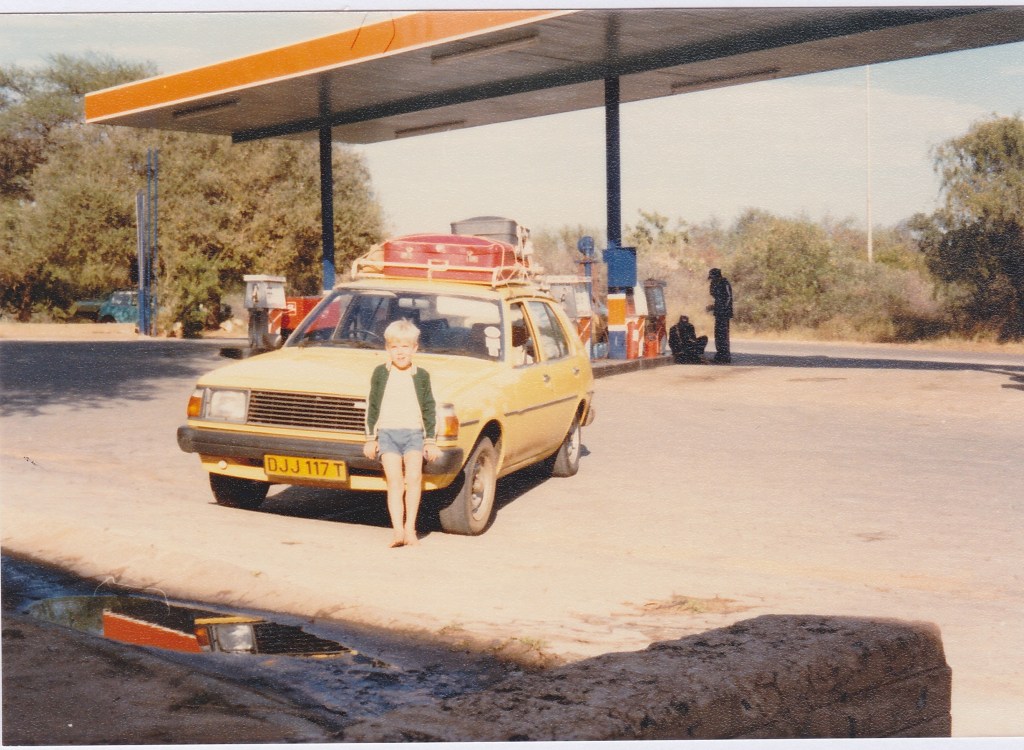
Our first taste of Kruger was Skukuza camp. In the early 1980’s it was much smaller and more rustic than it is today but it was still the headquarters of the National Park and, in its information centre and museum, we learned much about its history and the great foresight of its founders and custodians in preserving this vast tract of pristine wilderness.
I don’t remember all the animal species we saw (in later visits we kept a list), but one early morning, as we made our way to the bathrooms to get ready to be waiting for the gates to open at 6.00 am, we spotted a serval right inside the camp, scavenging at the dustbins for leftovers from the previous night’s braai.
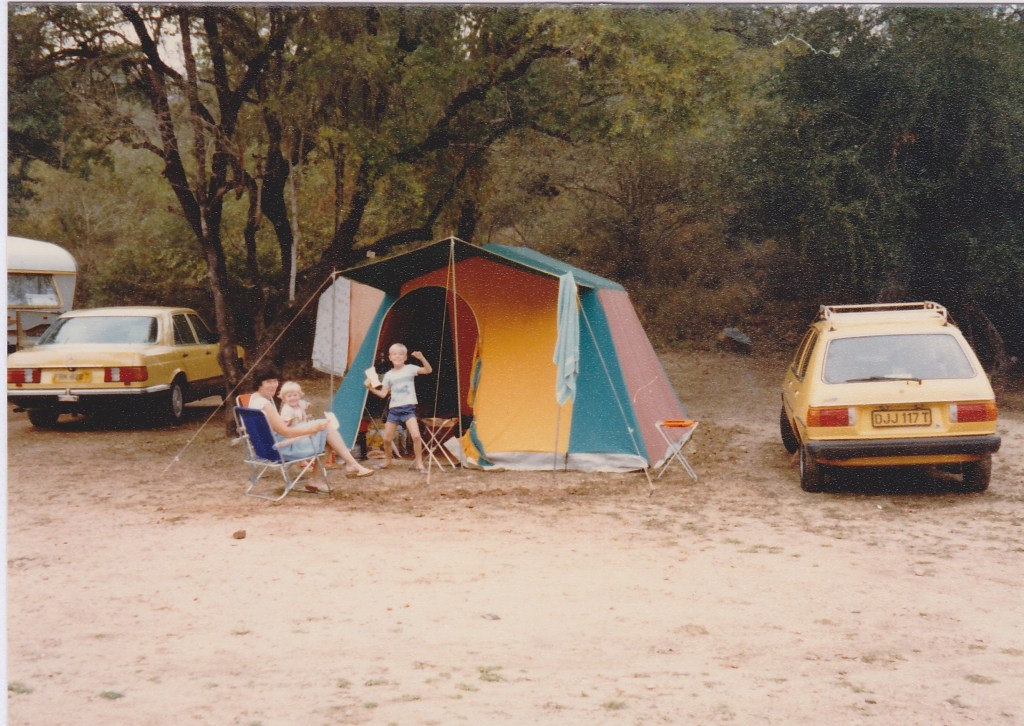
From Skukuza we made our way up to Letaba – from that first visit it has been one of our favourite camps. We pitched our tent close to the perimeter fence in hopes of being able to see or at least to hear, the night time sounds of the bush – the derisive cackle of the hyena, the mournful grunts and coughs as the lion builds up to a full-throated roar. When we had eaten that evening, we took our torch and walked close to the fence shining it into the bushes. Almost immediately we saw several pairs of red eyes and realised they belonged to hyenas that were patrolling the fence and hoping for some offerings from the human side of the camp. Later in the night we heard the hyenas chuckling and whooping. In the morning we spotted some very clean bones and surmised that someone had taken pity on them.
I remember most of all the feeling of peace and being away from all the pressures of everyday life. No phone, no newspapers, no speeding cars. You have to slow down. Even for small children – ours were five and a half and three and a half on that first visit – the magic of the unspoilt bush, the butterfly leaved mopani trees, the deep shade and the bright sun all had a calming effect. Our son, Shaun, was fascinated with all the animals and became an expert spotter. Tanya was rather scornful of this preoccupation with seeing game and often preferred to look at her books. However, some incentive in the form of additional pocket money usually revived her interest.
Our second visit was two years later and this time we spent a week split between Shingwedzi and Satara camps. We were still camping, but this time had the loan of a trailer from Kev’s parents so we had more room in the car, still our little yellow Mazda. As we were going to the northern part we decided to leave at some unearthly hour of the morning to avoid the holiday traffic and the heat and we were on the road before dawn broke. At the Tropic of Capricorn, on the main north road, we got the children out of the car and took a picture of them in front of the sign, still with long dawn shadows on the ground and the pale early morning sky behind them. We entered the Park at Punda Maria Gate and turned south for Shingwedzi, hoping to see species not seen in the south on our previous trip. “Stop!” said Tanya, “what are those funny buck over there?” Is that a roan antelope or a tsessebe, we hoped. Quick into reverse to see what they are. Crunch!!!! Oh dear, in our excitement we had forgotten the trailer, which now lay on its side with the disselboom twisted through 180 degrees and a big dent in the side of the car. I’m afraid we did disobey all park rules and get out to see what damage had been done.
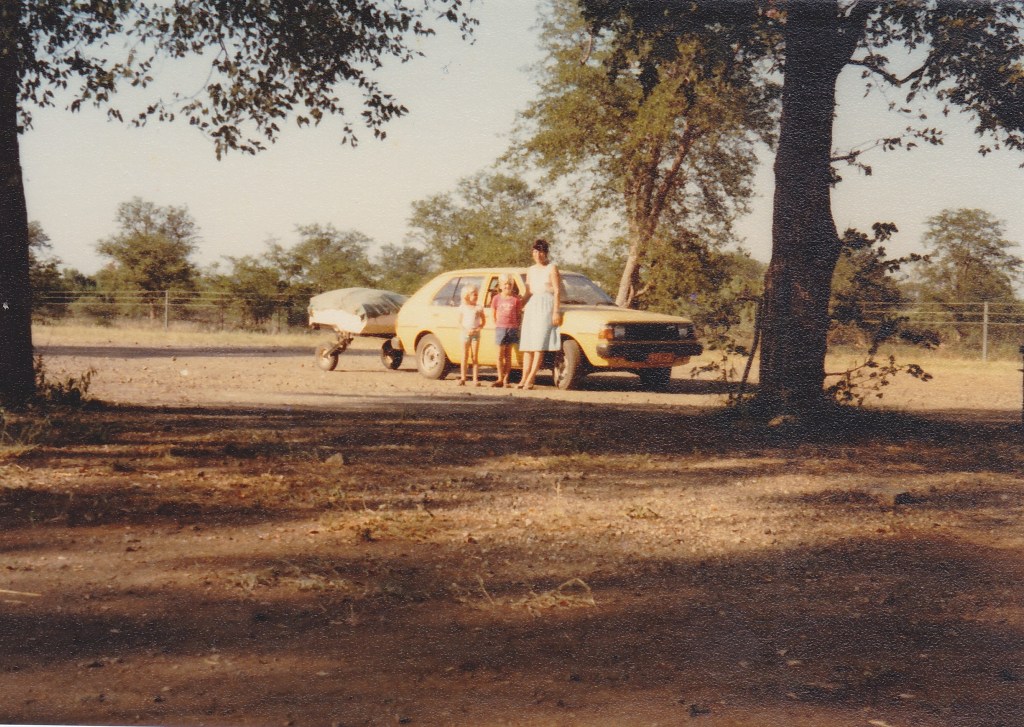
Fortunately in those days the AA had a workshop at Shingewedzi. The mechanic was called by people who passed us, saw our plight and stopped to help. The mechanic managed to get the trailer unhitched, to be transported later to the workshop, and we piled the essential things into the car. We made our way sadly to camp feeling the holiday was ruined and we would never be able to face Kev’s parents with the news that their trailer could no longer be used. But the mechanic was not at all phased by our mishap and he and his team set to work to sort it out. And sure enough a couple of days later, the disselboom had been straightened out and could safely be hitched on and towed by the valiant little Mazda. As we were AA members we were entitled to free roadside assistance and towing but these repairs had gone way beyond what was normal. We enquired rather hesitantly in view of our still rather meagre financial situation what sort of payment we would have to make, only to be told that of course it was all free but perhaps a bottle of whisky would be nice. We made that two bottles with our very grateful thanks.
Shingwedzi in those days was a fairly small and remote camp, not much in the way of grass and lots of ants! But it was one of the few that had a swimming pool. We still have a picture of our little tented home with a drying line strung up between two thorn trees to dry the towels.
In Kruger it is essential to get up early and be ready to go as soon as the gates open if you want to catch a glimpse of the animals that have been active at night on their way to dens, or burrows, or finding a shady spot to pass the long hot daytime hours. A trick that we learnt from our very first Kruger trip makes those early starts more acceptable. I think it was in Letaba one evening while doing the washing up in the communal kitchens, where there is always hot water boiling on the camp fire, that we chatted to an elderly couple putting a teabag into a thermos flask and filling it up with boiling water. They said this was for their early morning tea on the road. Who needs a “teasmade”, I thought! It is a trick we have used ever since then.
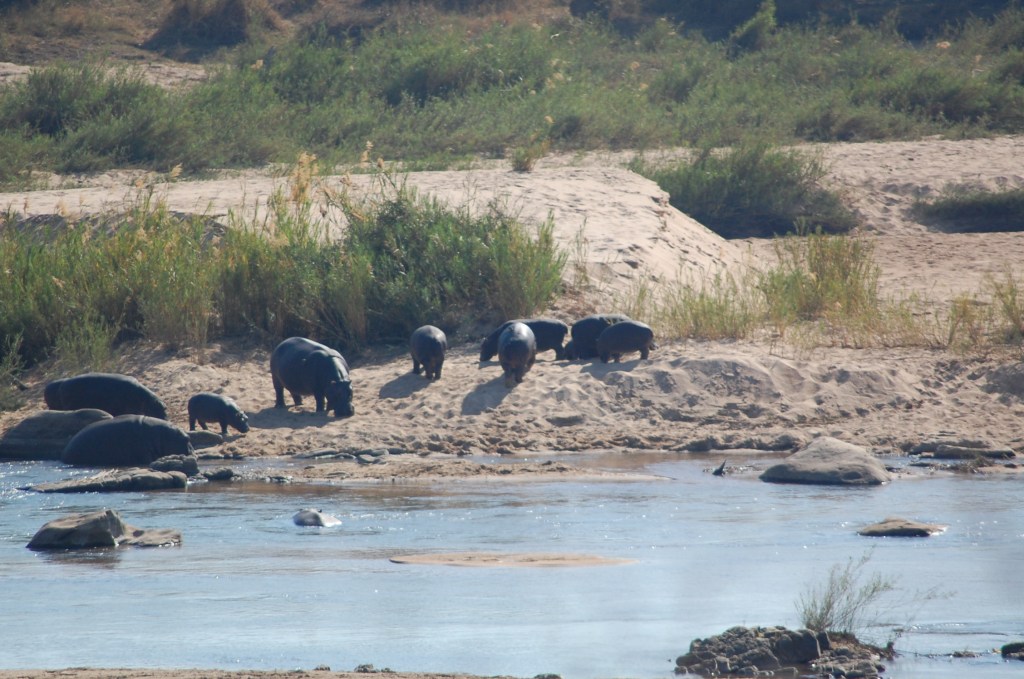
One of the drives we did from Shingwedzi was right up north to the Pafuri River. Just as the vegetation changes from the south of the park to the north, so do the rivers. The Pafuri is sluggish and orange-brown, and like the Limpopo, set about with fever trees. The Letaba, with the camp set above it, meanders through a wide, sand-banked valley, while the Olifants, a little further south is steeper-sided and a haven for hippo and crocodiles.
The sounds and smells of the Park are different too across its vast spread. In the north it is almost continual summer, with the sounds of the cicadas reminding us of Christmas even in April. Further south the sickly smell of the Terminalia is almost suffocating in December. After rain, the grateful earth gives off a smell that forever reminds you of the open spaces and big sky of Africa.
The other camp we stayed at on that trip was Satara. This was a lovely camp for the children with a wide green lawn to play on and always the prospect of seeing animals just over the fence. Sometimes they were inside the fence as well, as there was a small resident warthog family.
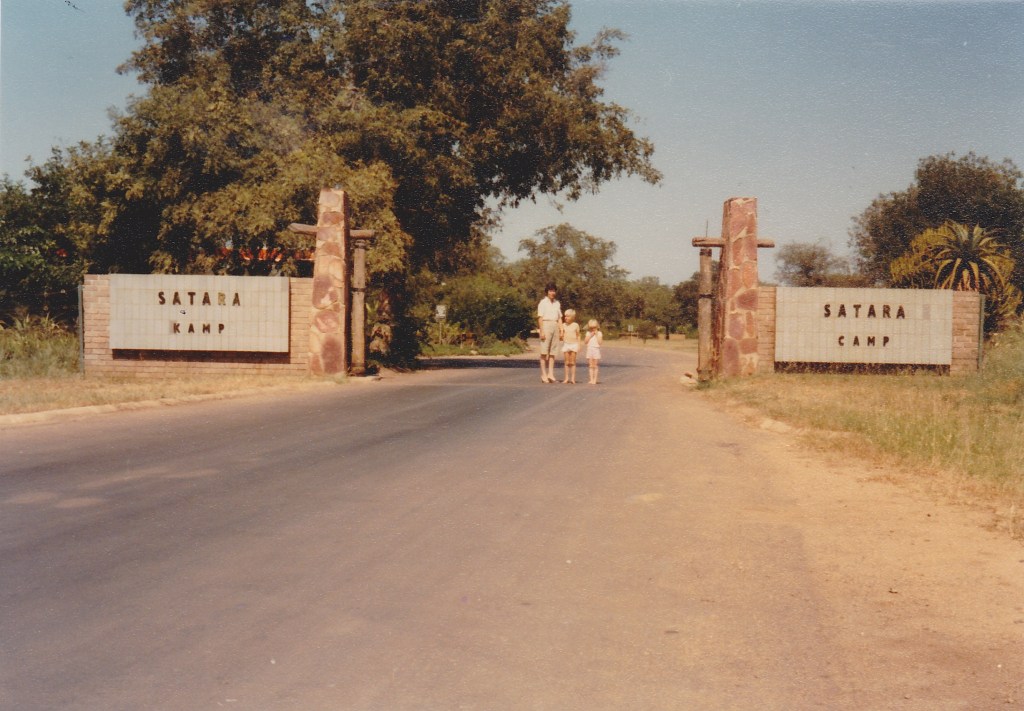
We had to wait a few more years for our third trip. Still camping but now we had a bigger car – a Toyota. This time we decided to stay in the south and look for rhinos. In Pretoria, Tanya was a member of a Brownie pack and one of the songs they sang involved “going on a weegie hunt” which we adapted to “going on a rhino hunt”. This was mainly to get her interested in spotting animals, but we sang the song until it ran through our heads every time we thought of looking for any animal! Even today it can set the whole family off on reminiscences about Kruger. Needless to say, we did not see a rhino on that trip. However, we did have a wonderful sighting of wild dog. They were in a little clearing close to the road near Malelane, on the southern border of the Park. It must have been a family group, as there were several adults and a number of pups, clambering over each other and their parents, who were trying to sleep in the heat of the day.
This trip was a good one for the big five, apart from rhino, as we saw lion strolling along the road and had a glimpse of a leopard going home after a night’s hunting. We always see elephant, which are for us, especially now we don’t live in Africa any more, the quintessential symbol of the Kruger National Park.
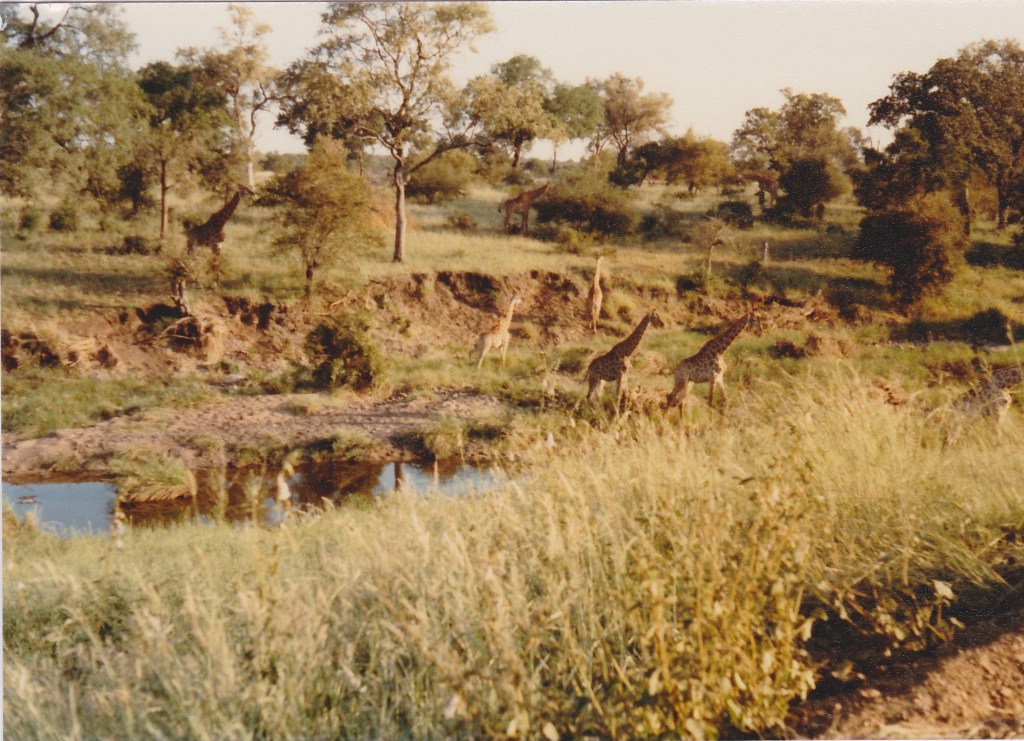
The camps we visited on this trip were Pretoriuskop and Lower Sabie, which gave us a chance to explore the southern rivers. The Sabie River, between Skukuza and Lower Sabie is a magic kingdom all on its own. The perennial river comes from the eastern highlands down to the busheld, sometimes placid and calm but we have also seen the aftermath of tremendous floods that have uprooted trees and left the landscape looking as if all the vegetation is growing upside down.
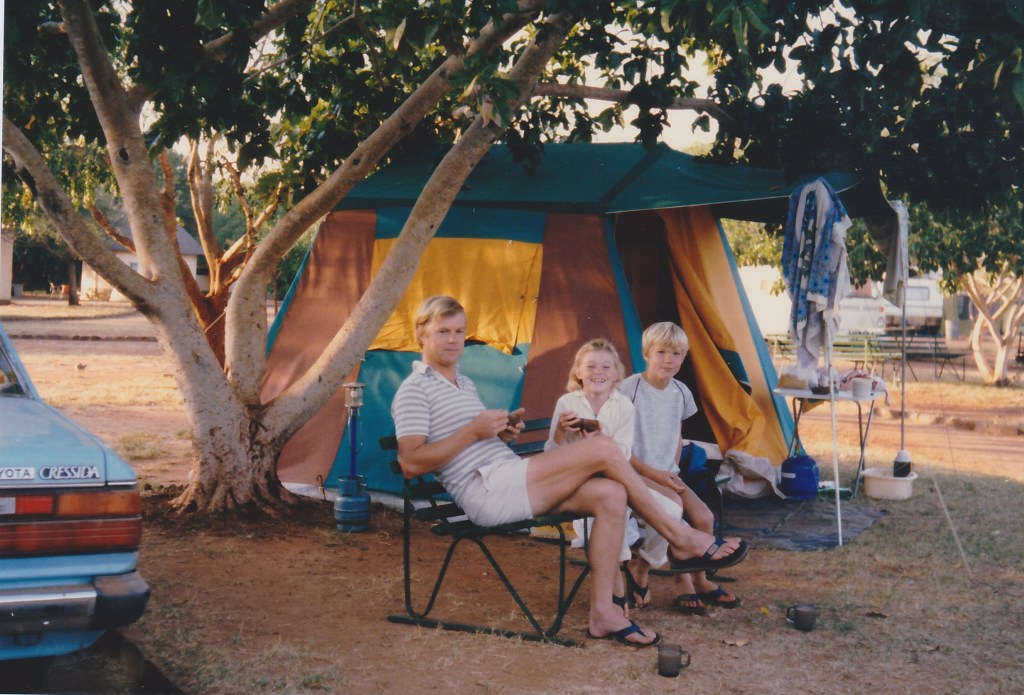
At end of 1980’s we moved to Cape Town, knowing that our next Kruger visit could be sometime in the future. Little did we know that it would be 17 years before we got another chance, by which time we had to fly all the way from Rome.
Each time we go back it seems as if we have not been away that long, because, although the camps have grown bigger and been modernised and more services are available, when you get out on the roads you are largely alone, as the numbers of cars and visitors are still kept reasonably low. And the bush only changes with the seasons. The feeling of timelessness descends as soon as you pass the formalities at the entrance gate. You enter a sort of time warp that joins past and present and enables you to examine the experience of life in a new and different way, from the way you perceive it in “normal” time. For us, now coming from overseas the adventure begins as soon as we step off the plane. Our first trip back was finally in 2002. We drove through Magoeboeskloof, down in to the lowveld and along the long straight road to Palaborwa. We stopped at a local Spar to stock up for our week in the Park. To local people, shopping at the Spar supermarket is probably not the most exciting thing but when you have been away from familiar brands and tastes, it can be sheer indulgence. We treated ourselves to things like Black Cat peanut butter, marmite, Mrs Ball’s chutney and of course, boerewors. As we shopped we reminded ourselves of the food we took with us on our camping trips – Smash and Buffalo meals (dried soya mince in a tasty sauce) were a couple of favourites.
Once checked in through the Palaborwa Gate, we were so enthralled by this first taste of Kruger after so long, we dawdled along the road and only just made it into the camp at Letaba before the cut-off time.
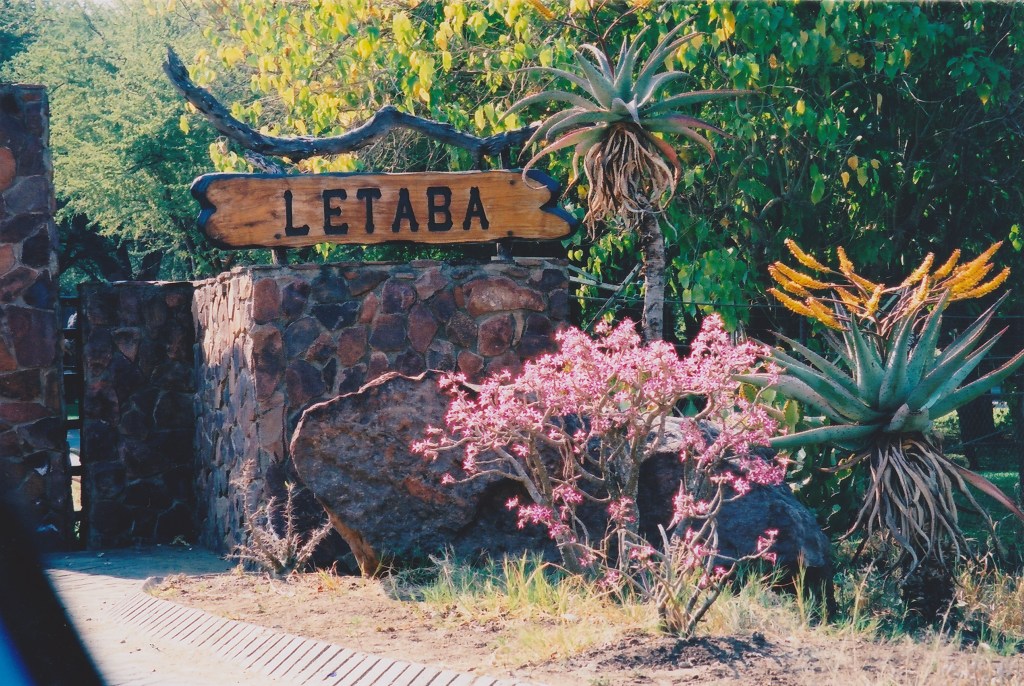
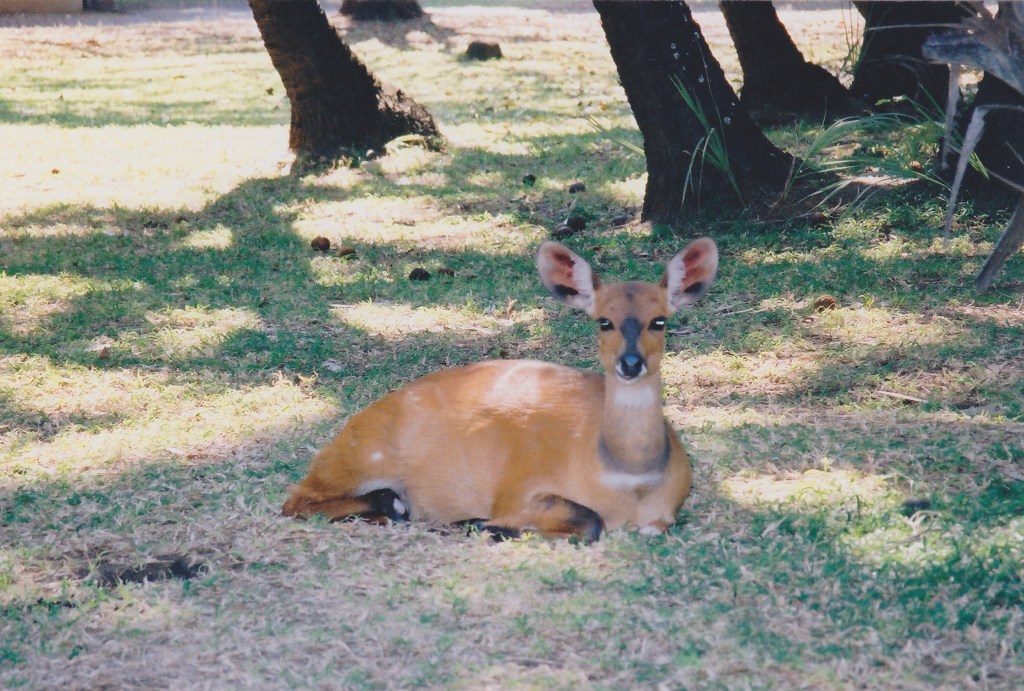
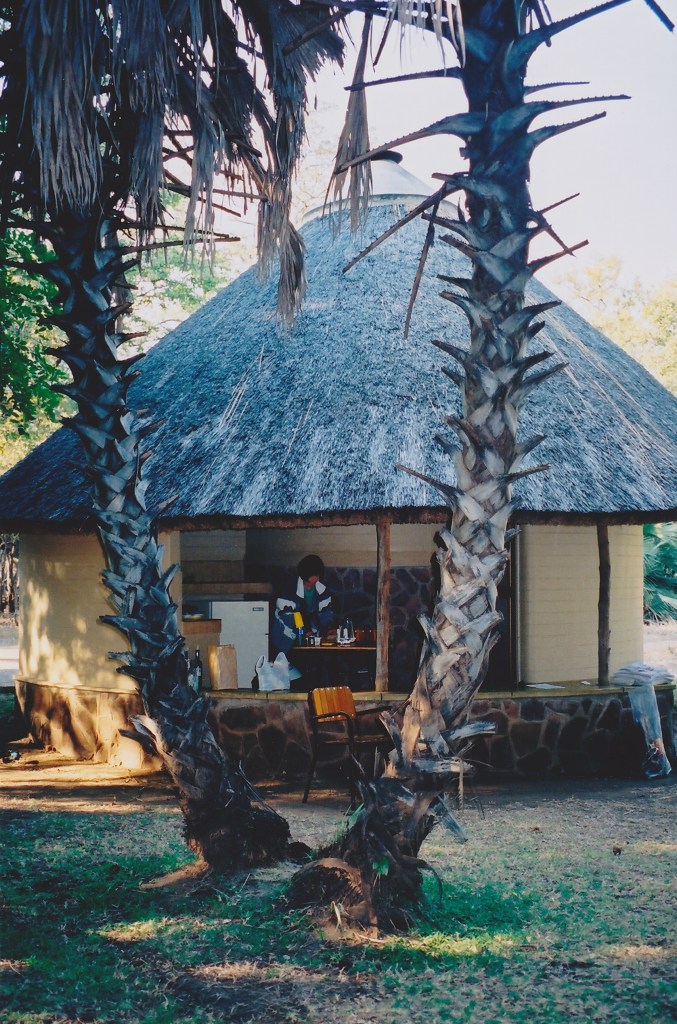
Another first was staying in a bungalow. This one was a rondavel with the kitchen outside on the veranda and a braaigrill just beyond. Letaba is well known for its herd of resident bushbuck and they lost no time in investigating whether these newcomers had anything of interest.
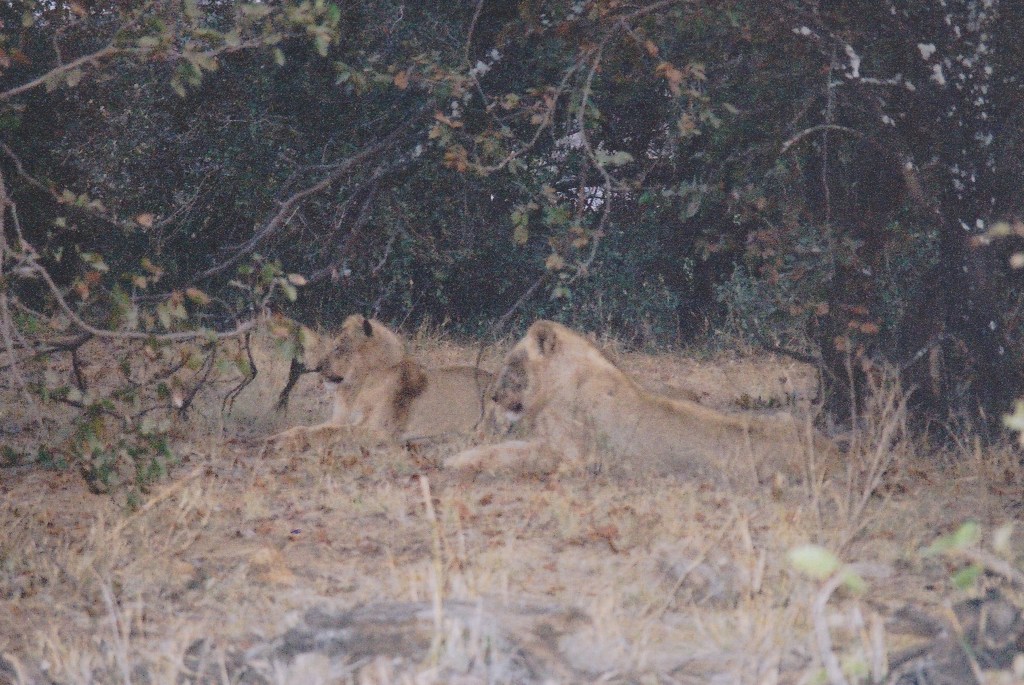
Next morning we were up early and on the road as soon as the gates opened. Only a few kilometres from the camp we saw a pride of lions dozing in the early morning sunshine.
This was just the start of a wonderful week of game-viewing. According to our list we saw 33 different species of animal that week and 70 species of bird. It is not always the bigger and more visible animals that are exciting to see. On this trip my husband decided that the country around Lower Sabie, the second camp we stayed at, was good ratel, or honey badger, country. We spent several hours on different days parked close to a likely looking spot where we imagined the ratels’ burrow could be, but with no luck. Finally on our last day, as we were once more making a quick detour past the ratel burrow, we saw a pair trotting briskly homeward after a night out hunting for their varied diet of mice, spiders and scorpions.
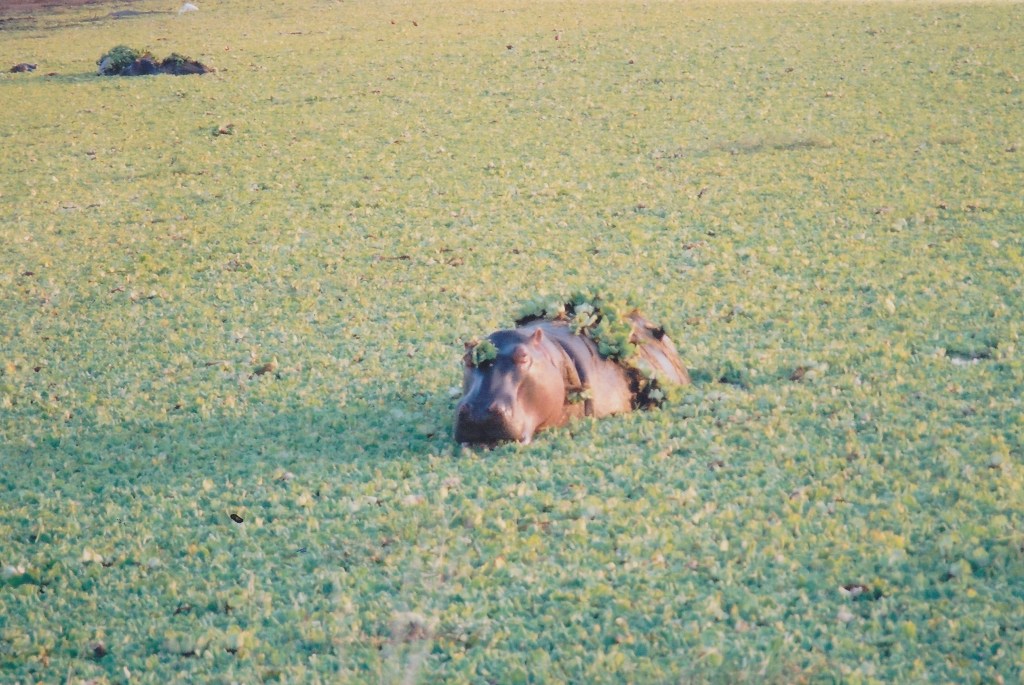
Lower Sabie has another attraction for me. Usually our homeward trips each evening are fraught with me wanting to make sure we get to the gate before we get locked out and Kev wanting to see just one last new species. Lower Sabie gives me a break from this tension as there is a beautiful dam very close to the gate where it became our custom to spend the last half hour or so watching the resident hippos emerging with from the water with their hats of Salvinia and waiting for any other visiting game.
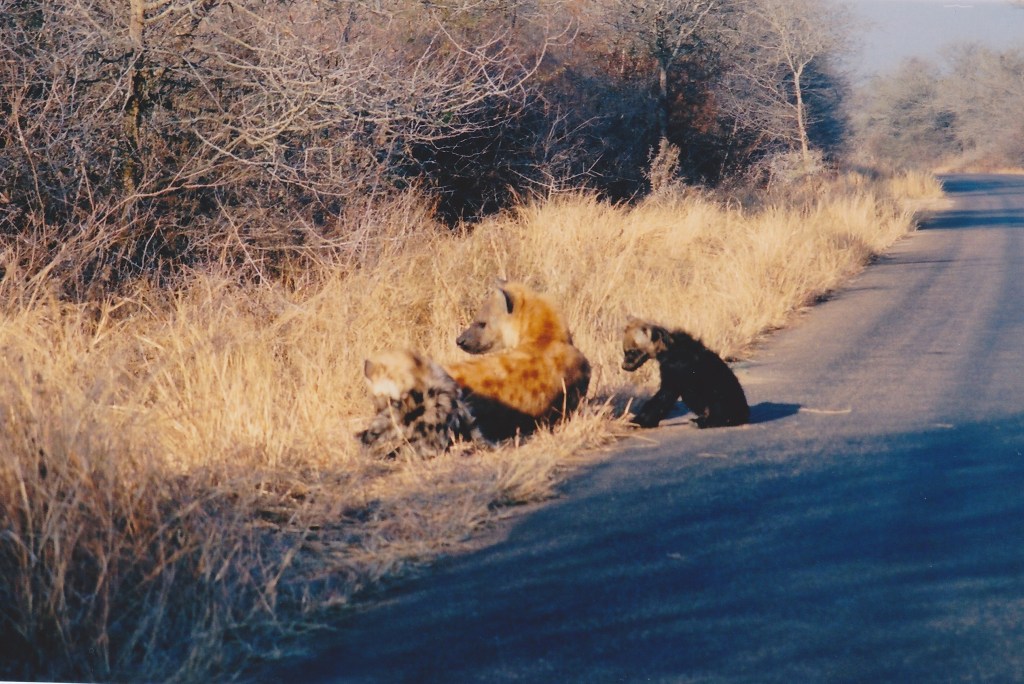
On our last day heading south towards our exit gate at Crocodile Bridge, we came across a strange sight. In the middle of the road was a young hyena and on the side of the road were a mother and a younger cub. The one in the road soon joined the others and they seemed to be a family, but why were the two youngsters of obviously different ages? We wondered if one of the cubs had been adopted because its own mother had died.
Our most recent visit to Kruger was last December. We left a cooling Rome to go to a hot summer South Africa. Even though the winter had hardly set in in Europe, it was good to be heading south for a warm Christmas.
But to start with, Christmas was not really on our minds – we had the Kruger National Park to look forward to. We landed at Oliver Tambo International at about 9 in the morning and headed straight to pick up our rented car and were soon on our way to Orpen Gate and Kruger. As it was a Saturday afternoon and we were not sure what food we would be able to get at Orpen Gate we wanted to stop on the way to buy a few things. Our chosen route was to leave the N4 at Belfast and take less frequented roads winding through the highveld areas of Mpumalanga Province. Not knowing the route and the availability of supermarkets and bottlestores on the way, we decided to stop in Belfast to stock up before risking going on further and not finding anything.
Saturday afternoon in Belfast reminded me of Saturday mornings in town in Grahamstown, in the days when shops closed at lunch time on Saturday and didn’t open again till Monday morning. The whole population of Belfast seemed to be on the streets, with loud music adding to the partylike atmosphere. I went in to the local Spar, fortunately quiet inside, while Kev went across to the bottlestore. As it is always nice to be back in a familiar South African supermarket, I did not hurry too much in making our few purchases of food for the evening and breakfast the next day. Once I had paid, I took the couple of bags outside to wait for Kev. I was a little surprised that he had not reappeared while I was still in the supermarket as, after all, how long can it take to buy a dozen beers? Just when I was beginning to get a bit concerned, he finally reappeared. Apparently there had been some sort of disturbance outside the bottlestore and the owner and police had locked the store with everyone inside trapped until the problem had been sorted out! We chuckled to ourselves over this reintroduction to our home country as we continued on towards Kruger.
We drove on with the scenery getting more spectacular as we got towards Ohrigstad, the Abel Erasmus Pass and the Strydom Tunnel. The last time we had been this way was in 1981 on our way from Kruger so we had approached from the opposite direction, and also did not remember how beautiful the mountains looked. Now we were headed downwards towards the lowveld and the temperature rose even more. Soon we were passing some of the many private game reserves that cluster around the western fringes of Kruger. At last the Orpen Gate was in sight.
Orpen Gate is a peaceful little camp on the edge of the Park but still fully part of it. As soon as we had unloaded the car, we walked down to the perimeter fence overlooking the waterhole – immediately we saw impala, wildebeest, kudu – and knew we were back in Kruger. As Orpen gate does not have a restaurant, we stared preparations for another South African tradition that we miss in Rome – the braai. The smell of the fire burning and meat cooking reinforced our homecoming and made Rome seem a distant memory.
The next day we had a leisurely drive up to Letaba camp, where we met up with our companions for the next three days and were taken to the Olifants Wilderness trail camp, on the south bank of the Olifants River. We arrived at about 6 in the evening, in time to find our accommodation and settle in with the last rays of sunlight, before relaxing in camp chairs on the slope above the river and watching the sunset. As it grew darker the campfire burst into life with a sudden injection of fuel and the paraffin lamps in the lapa and outside our huts were lit.
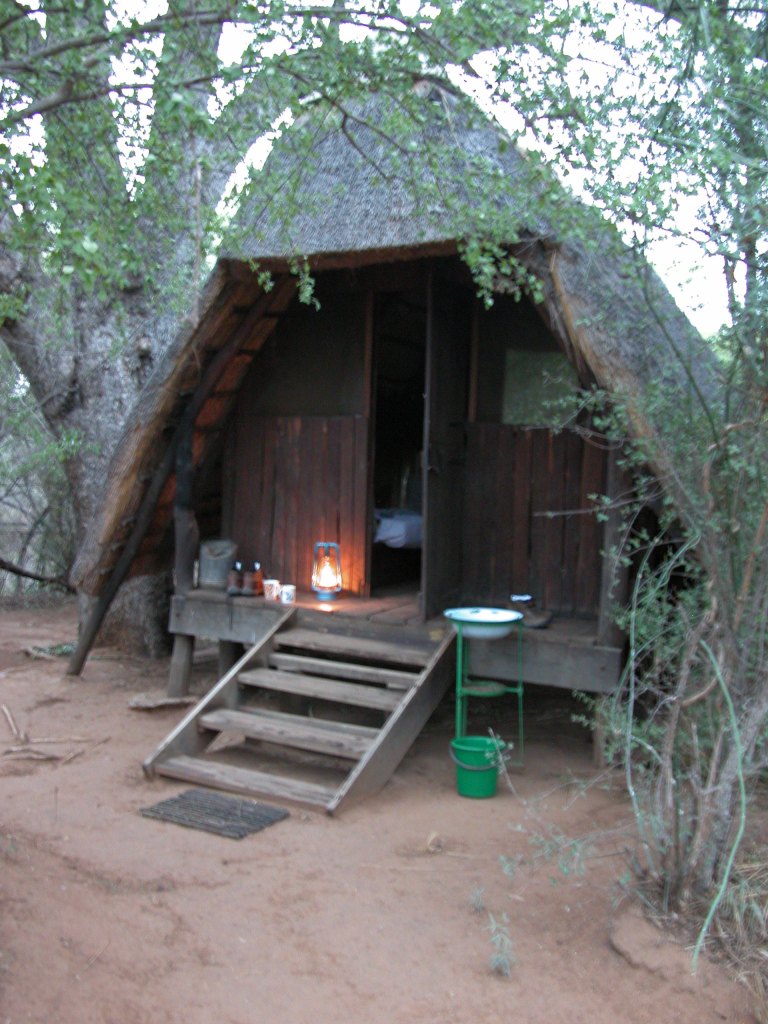
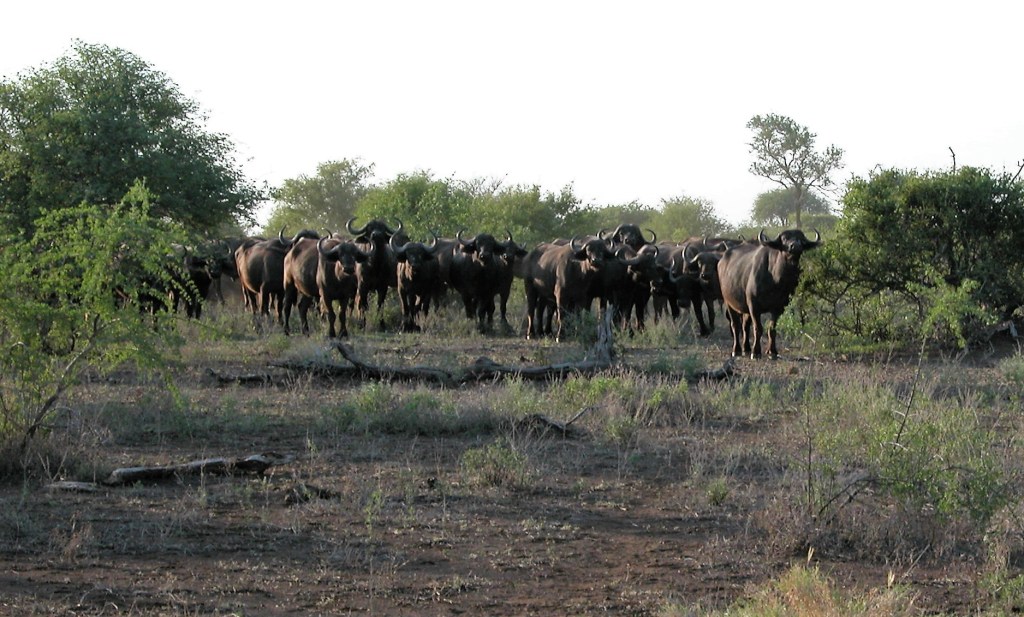
Our home was in a little A-frame thatched hut on stilts, equipped with two box beds and a small shelf at the end of each bed for storage. That first night was almost unbearably hot, so that the wakening gong at 4.30 was quite a relief. We staggered out into the half-light of pre-dawn, to find that Thomas had already put hot water for washing into the basin outside the hut and the kettle on the fire was boiling, ready for our early morning cup of tea and rusks. Kallie and Sjambok, our guides, herded us into the Parks vehicle as soon as possible to make the most of the coolest time of the day. We drove some distance before Sjambok seemed to become very interested in the tracks in the sand next to the road. Buffalo, he said, and close by. We got out of the vehicle and started on our first walk and, sure enough, we very quickly came on a large herd of buffalo, still bunched together as they had not yet started out on the daily search for grazing. The elders of the herd quickly moved forward to face us, hiding and guarding the females and young behind them. In a large mixed herd buffalo are not generally dangerous; it is the lone bulls that are the threat. This herd stood squarely in the line we wanted to take so we had to go around them, trying not to disturb and panic them. As we moved slowly round the older males would also move, facing us and making sure the more vulnerable were protected.
Out next encounter was with a rhino, a mother with her young one. Again it was Sjambok who spotted the tell tale signs that some large animal was near by – this time it was the sudden flight of oxpeckers that gave away the position. Kallie realised that we could be closer than he would have liked to whatever lay hidden behind the thicket so he indicated to us that we should find a protected place behind some bushes should it be necessary. Slowly we crept a little nearer and spotted the rhino and her baby in the same instant that she was alerted, perhaps by smell as rhinos’ eyesight is notoriously poor, to our presence. She started to charge. “Get behind the bushes” hissed Kallie. By good fortune, I spun round and scampered behind the bush, just in time to turn and see the rhino and her calf veer off to the left, after coming straight for our group. And it was fortunate that she did head off away from us, as, in the hurry to get to safety, the rest of the group had done a classic slapstick act, running into each other and landing in a tangled mass in the shrubby thorn bushes next to the trail. “Where are they now?” they all asked, as they untangled themselves. Fortunately long gone!
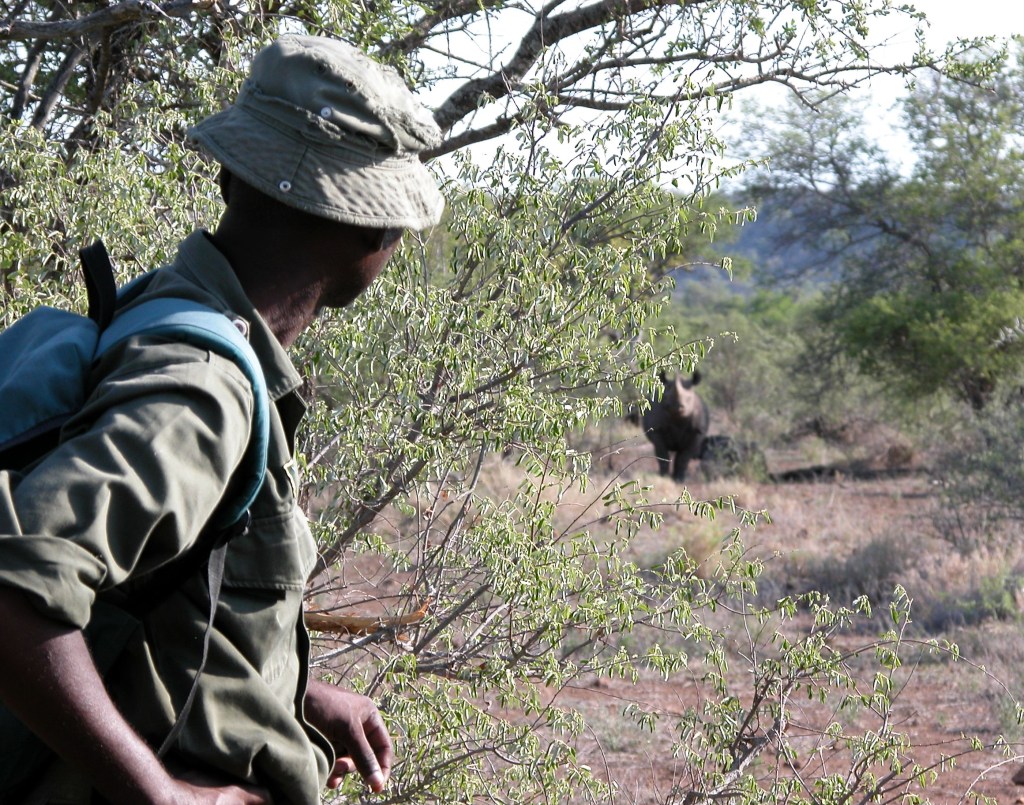
The rest of the walk was more peaceful; although we did have another good sighting of another rhino and her calf, this time a bit further away and our scent did not carry in her direction. Finally we headed back to camp and, after a delicious breakfast, tried to get some more sleep.
However, it proved too hot for even that and it was cooler to sit in the shade of the thatched lapa, reading and sipping a cold beer. We soon became aware of constant comings and goings at a little bird bath in the rock by the side of one of the huts. My book got little more attention that afternoon as I tried to keep pace with all the different visitors. We managed to identify more than twenty different species, with help from Kallie, but I am sure there were many more. Not only was the bird bath well used but the space underneath the little huts was alive with birds trying to get some respite from the heat.
Later in the afternoon we got into the vehicle again, as Kallie decided it was too hot to do any serious walking. As we drove westward, we could see the sky darkening and soon heard the first rolls of thunder. It was what we had all been hoping for – a good tropical thunderstorm to bring some cooling relief. On our way back towards the camp we stopped to watch a huge herd of grazing buffalo, even bigger than the one we had seen in the morning.
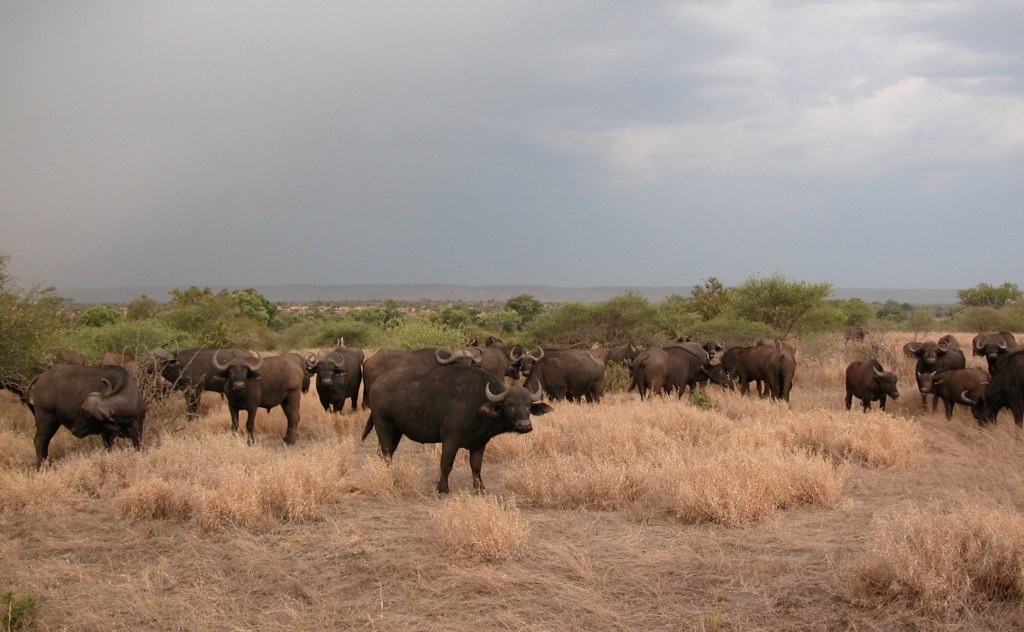
While most of us were entranced with watching the huge beasts slowly moving past us, Kallie and Sjambok were more interested in the possibilities of something behind the herd. And soon one of them spotted it – a lion. Lions often follow herds of buffalo, not necessarily menacing them all the time but keeping them in mind for when they get hungry. We all turned around to try to see the lion, but it immediately started to move away; then we realised that there was more than one but could not be sure just how many. Under pressure from our group, Kallie agreed that we could track them. Carefully keeping down wind, we quietly followed the guides down to a dry river bed and there, in the long dry grass on the other side of the would-be river were the lions. As dusk was fast approaching it was difficult to make out how many there were but three seemed to be the consensus. We did not stay long watching them, as, although lions are unlikely to attack humans in daylight hours, the night time is a different matter and they become bolder and more dangerous.
Back in the vehicle we found that the buffalo had melted silently into the bush, leaving still a sense of presence, a slight tension in the air, a lingering smell of damp earth and crushed grass. The following lions were still lazing in the riverbed, waiting for nightfall, and keeping their pantry in sight.
Once more in camp, after the drenching downpour, the evening was wonderfully cool, our meal delicious and beds beckoned. We all slept much better that night, waking a little more reluctantly this time to start our day at 4.30 again.
The walk on our second morning was not marked with the adrenalin rush that we had had the previous day but gave us time to absorb some of the sights and sounds that you can only do by walking and by learning from those who have spent their lives studying and understanding the ways of the wild.
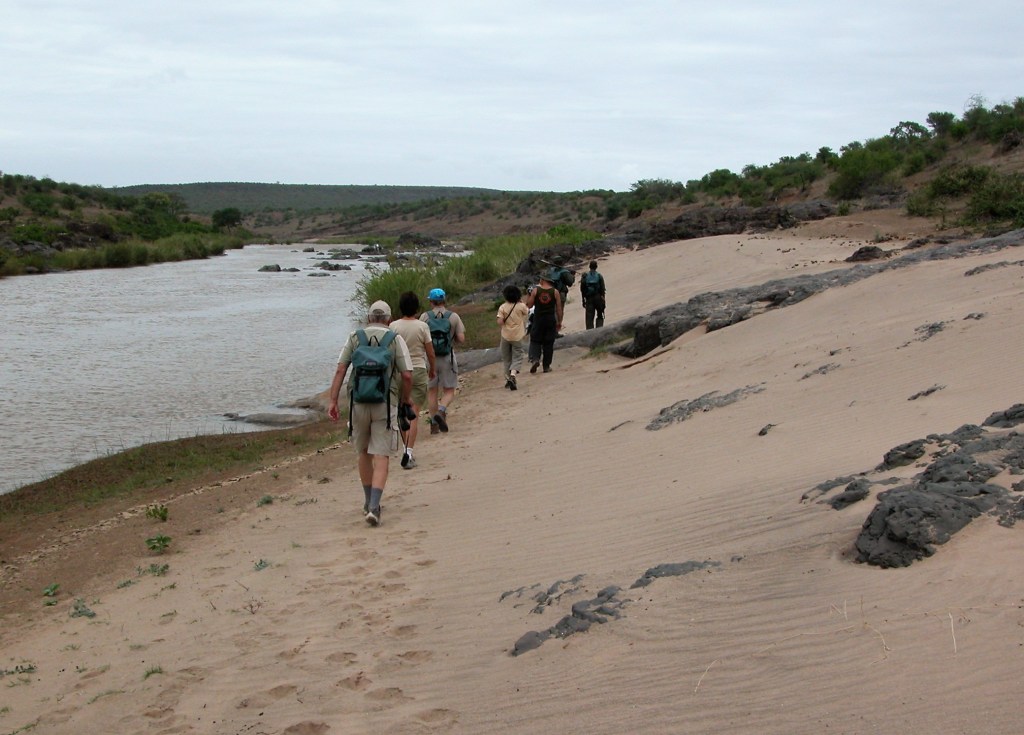
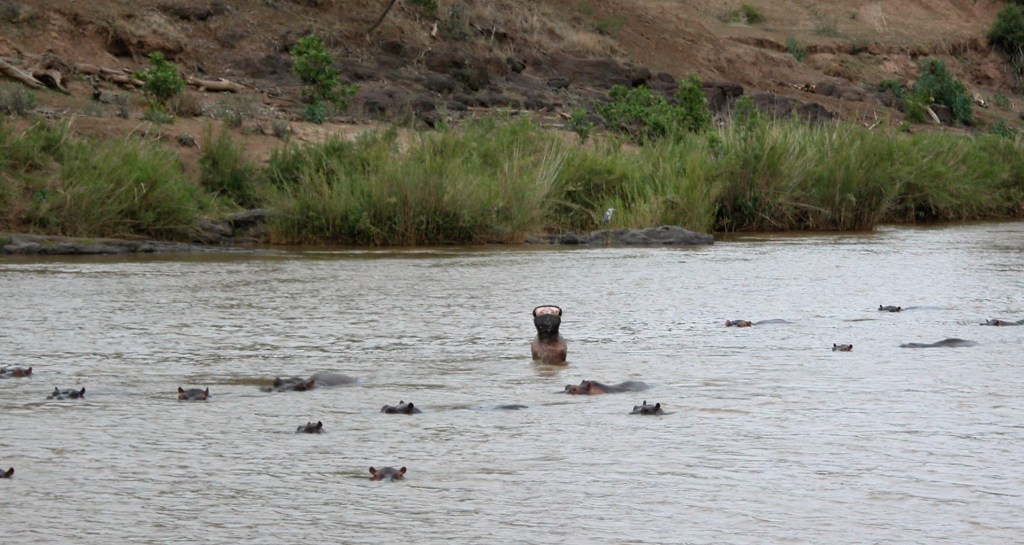
Our afternoon walk was spent wandering along the banks of the Olifants river, watching the many crocodiles and hippos. We sat on a sand bank some way upstream of a big herd of hippos that lay cooling in the water, with just their ears twitching and their eyes steadily observing us from a distance. Slowly but surely, as we sat there enjoying our sundowners, the hippos drifted closer, eventually forming a semi-circle in the river quite close to us. They seemed just curious, not threatening, as they sank slowly beneath the water and re-emerged a few minutes later somewhere else. The peaceful scene was somewhat rudely interrupted by one particular hippo that began whirling his tail vigorously while spreading the waste matter from his grazing as far as possible from him. Well, I thought, so this is where the expression “when the you-know-what hits the fan” comes from!
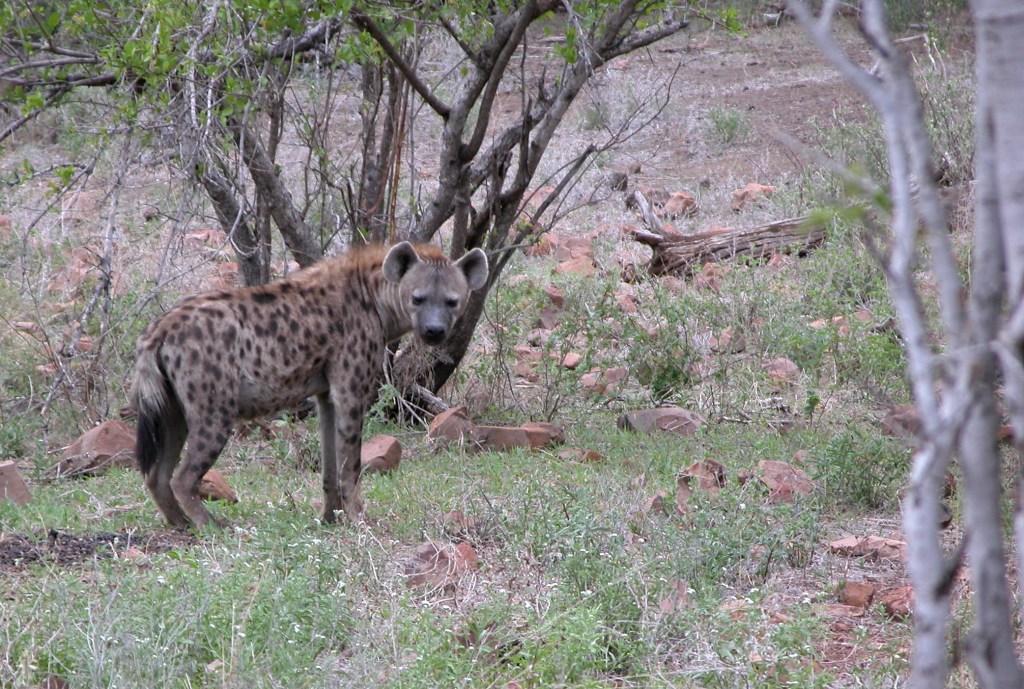
Next morning on the way back to Letaba, not far from our camp, we came across a group of hyena that posed most obligingly for photographs.
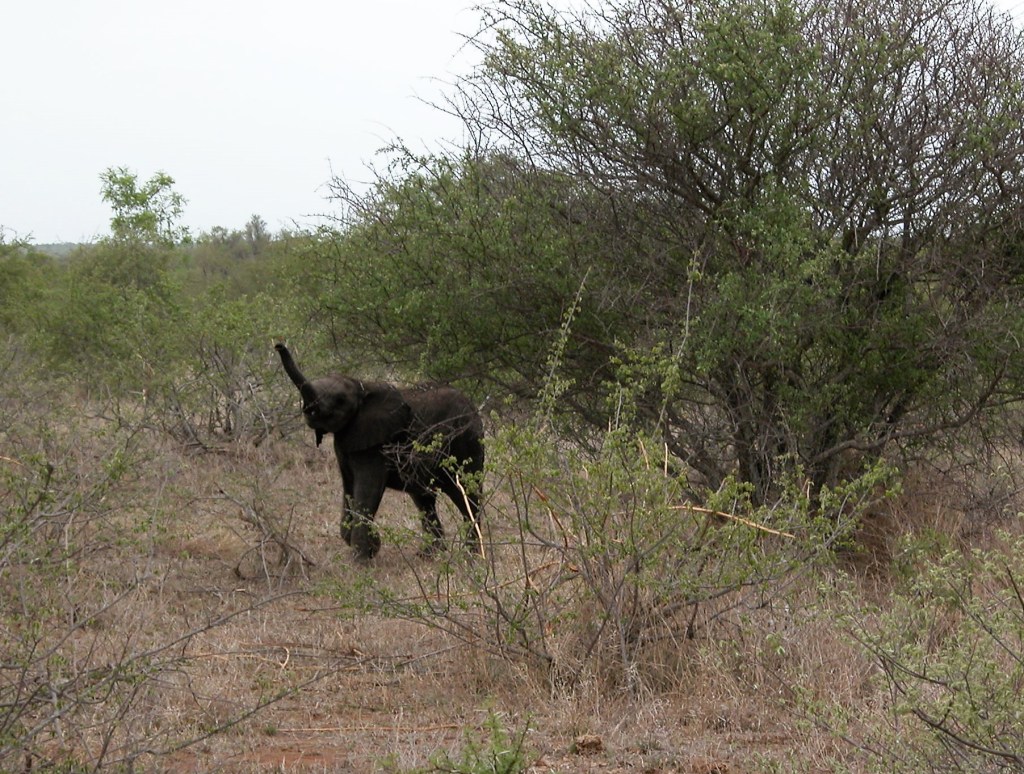
A bit further on we found ourselves in the middle of a herd of female elephant busy sheparding their babies across the road. They were in no mood to be photographed and tried to hide the young ones under their enormous bodies to protect them.
Back in Letaba, we took our bags along to the laundry and did the washing while we waited for our hut to be cleaned. The friendly bushbuck were there to greet us, lying in the cool grass under the ilala palms. In the afternoon we drove north along the river, savouring the heat from the safety of the car this time. We did not go far but parked quietly in the shade in several beautiful spots along the Letaba river or its backwaters.
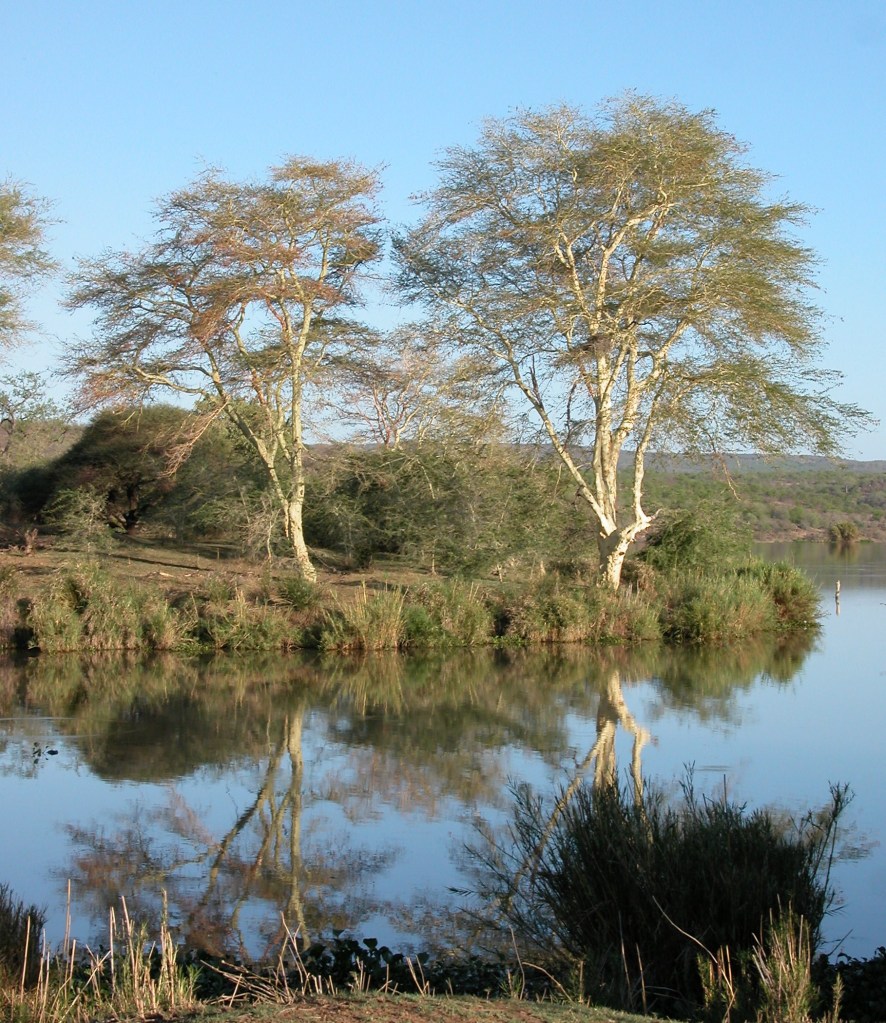
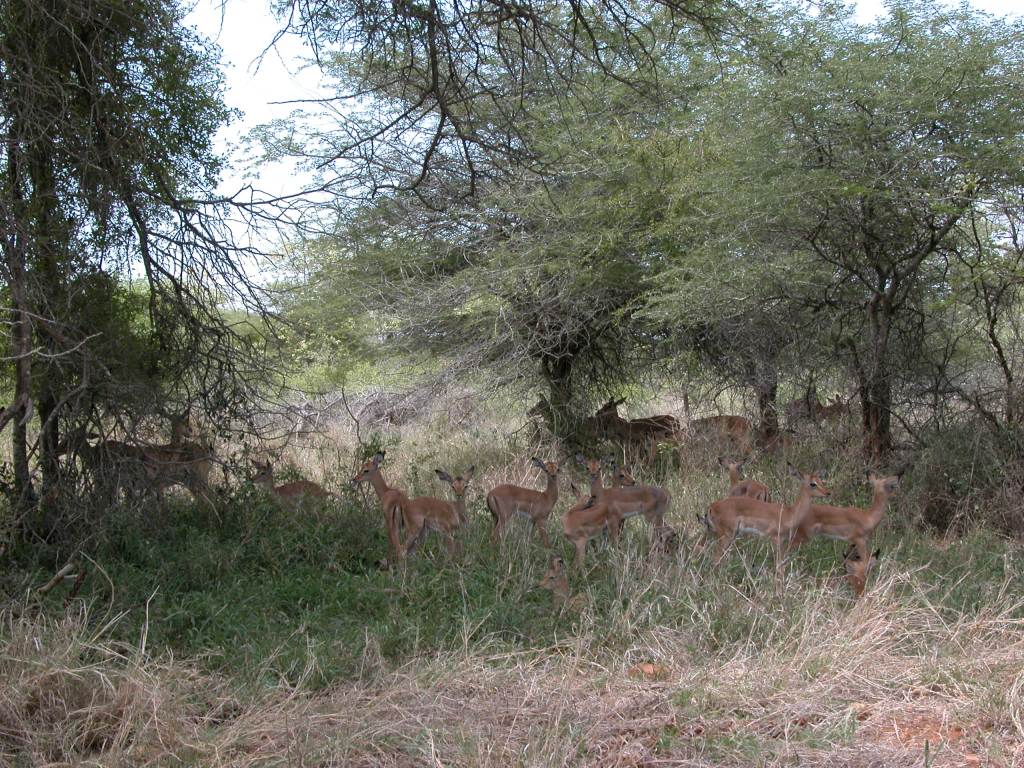
There was almost always a view of elephants, usually on the other side of the river, but it was the smaller species that kept our interest that lazy summer afternoon – the leguaan exploring the river bank, the herd of impala with lots of little ones trying out their skills on long unstable legs, the colourful rollers in the trees, the little moorhens delicately picking their way along the river bank. We even saw a scrub hare. We got up early once more to take a last morning drive, past the spot where we had seen the lions last time, going south first along the river then doubling back further away from the river. We didn’t see much game but that is not always bad – what is more important is the privilege of having access to such an enormous area of unique natural beauty. If the animals and birds are not immediately visible, it is a good time to be aware of the variety of trees and shrubs, the flowers along the roadside, the different soil and sand types that change with the underlying geology.
In terms of the number of days, or even hours, we have spent in the Kruger National Park, it is a very small proportion of our lives, but heightened awareness and anticipation make the time seem longer. Memories are more vivid and lasting. Each time we go back it seems so familiar, like coming home. The real time spent there may be only small but that reality continues in dreams throughout life.
While in Kruger, I bought a book by Kobie Kruger, about her experiences as a game ranger’s wife, and while in Cape Town I relived our experiences with her. She has written other books, which I will savour at a later date and so to, hopefully, we will return and revisit such a special place, to continue our journey of discovery.
Namibia 2003
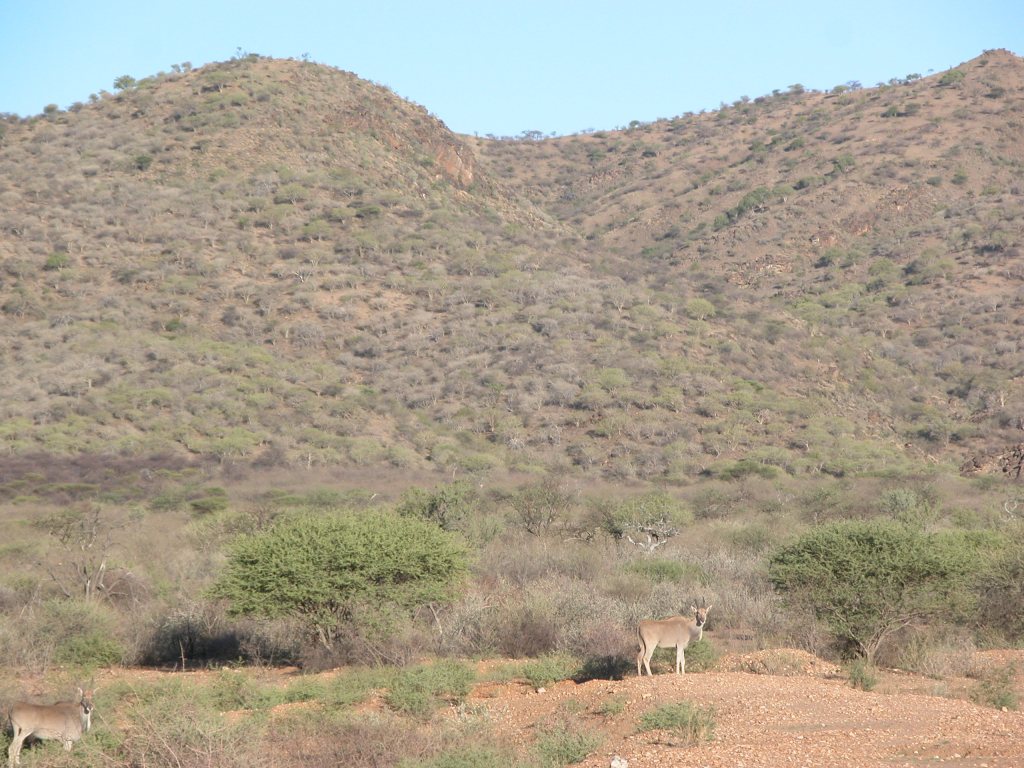
Another special place is Etosha in Namibia. In 2003 we were fortunate to be visiting Namibia for work and a had a few days leave in which to travel up the Etosha. This is the story of our time there.
At the Waterhole
My first visit to the Etosha National Park was for 3 days only – even before we arrived I knew it would not be enough, it would only give a taste of the great spectacle that Etosha offers. Because it was school holidays in Namibia and South Africa, we were only able to get accommodation in one of the three camps. This was Halali, the newest of the camps, opened in 1967. The name “Halali” is a German word meaning the trumpet call signifying the end of the hunt and it was chosen to represent the final end of all hunting in Etosha. The area was first proclaimed a reserve in 1907 by Dr F von Lindequist, the then governor of South West Africa. His aim was to put a stop to the waves of explorers and traders who relentlessly hunted game throughout the area and threatened to deplete the huge number and variety of animals passing through on seasonal migrations. The initial size of the reserves was much larger than today and was certainly good for the conservation of the land. However, the fate of the people who had lived on the land was not really recognised, although, in the 1960’s, the area of the reserve was redefined and it shrank by 77%. Halali is the smallest of the three camps, the other two being Okaukuejo, the Administrative centre and Namutoni on the eastern edge of the pan.
In Etosha, especially in winter, the waterhole becomes the social centre for animal interactions. The climate of the Etosha National Park gives three seasons each year. There are four dry and cold months, four dry and hot months and four wet and hot months. According to legend, the Etosha Pan was formed by the falling of the tears of a young mother, inconsolable at the death of her husband and children at the hands of hunters. Her tears were so abundant that the formed a huge lake. Then the sun came out and dried the tears, leaving the ground covered with a shimmering white layer of salt. For most of the year the pan is barren and desolate, with dancing mirages defying the existence of the horizon. But from November each year, rains bring a reminder of the past and the lake begins to form again. In exceptional years a real, if shallow body of water stretches across the flat landscape, but usually only muddy pools and meandering streams appear, fed by floodwaters from the north. By June of the following year the climate will have entered the dry and cold months, bringing warm but often windy, days, and cold, even freezing nights. At this time of year there is no water in or around the pan itself and animals must rely on waterholes for drinking.
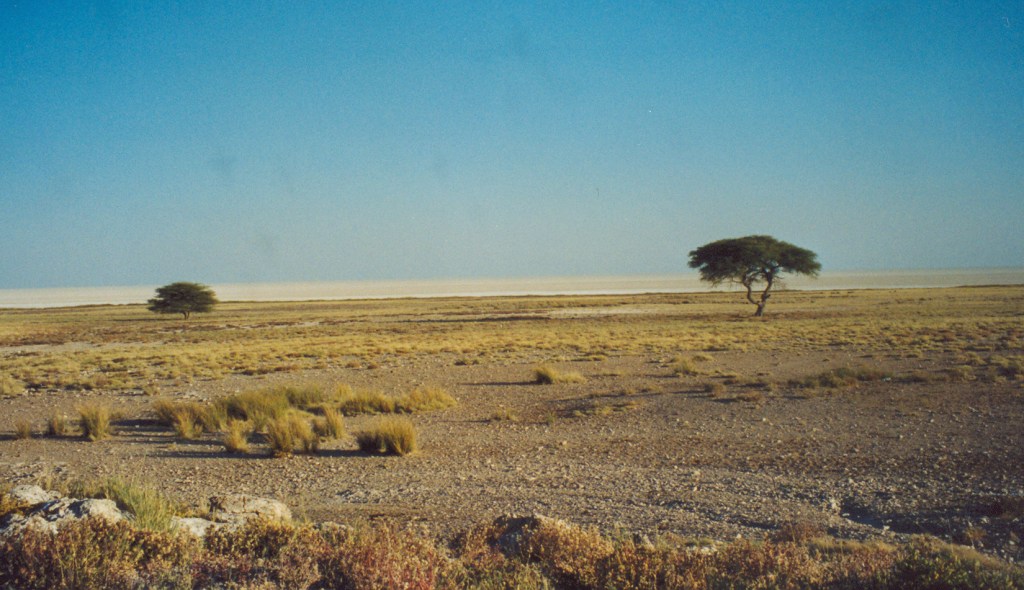
Etosha National Park – the pan shimmers in the distance
There are different types of waterhole, both natural and manmade. Some occur on the edge of the pan itself, where the water-bearing, calcrete layer ends and water seeps out onto the impermeable clay of the pan. Others are formed in depressions that dip below the water table. These are not always reliable as they depend very much on the water table in any one year. Artesian springs are much more reliable as the water is forced up under pressure from greater depths. There are usually found in hilly limestone areas and form deep pools. Manmade waterholes are to be found all over the Park, as Etosha would not be able to sustain the high carrying capacity of game without them. Many are concentrated along the southern edges of the pan as well as at each of the main camps. To see animals in Etosha, it is necessary to have only a little patience, as animals must drink and it is to the waterholes that, sooner or later, they make their way.
All three camps now have floodlit waterholes that can be visited day and night. Halali’s waterhole, which is artificial, was opened in 1992 but has since become one of the most popular. It is situated at the base of a small dolomite kopjie, fenced off from the camp. The hill above is part of the safe area in the camp and it offers meandering trails amongst the boulders and trees. On the side facing the waterhole, the lower levels of this hill form a natural rocky amphitheatre from which the ongoing drama of animal life can be seen. Many people seem to feel they have not had the “game reserve experience” until they have seen the thrilling chase or at least viewed the gory after effects. I would willingly forgo all that just to sit peacefully at a waterhole and watch the comings and goings and social interactions of the variety of animals partaking of life’s other necessity, water.
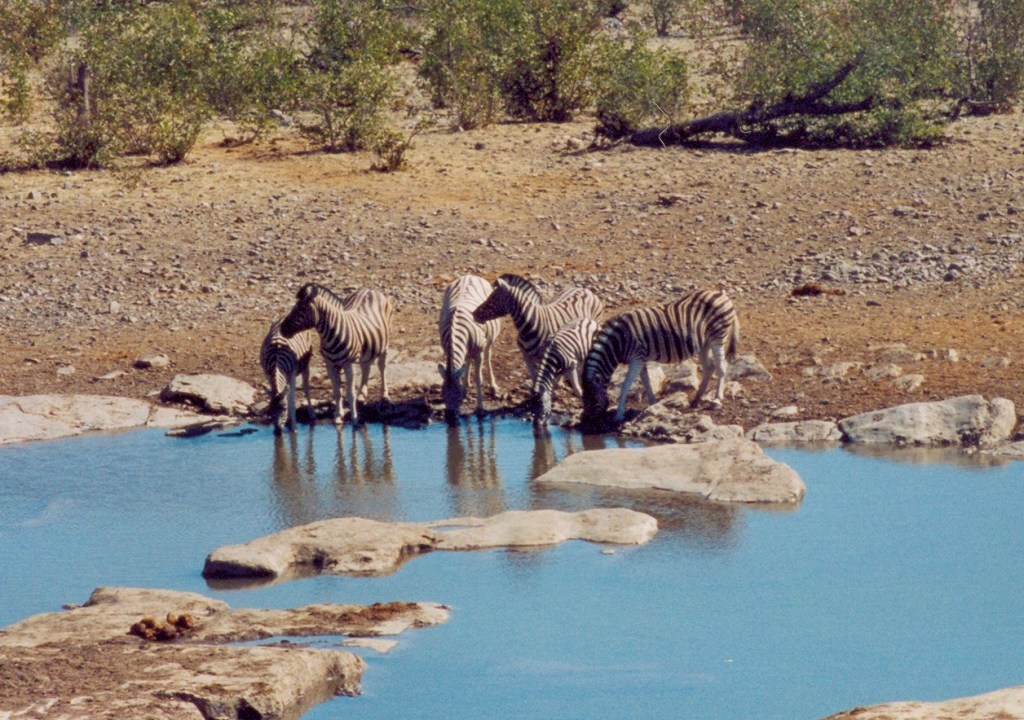
Moringa waterhole, Halali Resort
As the day darkened rapidly into night on our first evening in camp, we made our way to the waterhole, set at a short distance from the campers back from their daytime drives and busy preparing the evening meal. We were close to the waterhole when we were met by a small, highly excited girl with gleaming eyes who whispered “elephant – about thirty”, as she ran past to tell the rest of her family. We knew our first visit to Etosha was going to be special. There were indeed about thirty elephant, crowded round the small waterhole, from the large matriarch to the smallest
baby. We were surprised at how many people were already in position and watching the elephants as we had not heard a sound on approaching the waterhole – throughout the hours that we sat and watched the quietness and respect that people afforded the spectacle was heartening. The elephants seemed oblivious of the great gathering above them, as they quietly went about getting their daily fill and relishing the cool water after the heat and dust of the day. The absolute silence with which they moved was incredible. A favourite spot seemed to be at the point at which the water gushed into the small pool. Perhaps it was the movement of the water that appealed, or maybe it was still especially cool. The older elephants took turns to drink from this spot or to lazily spray water over their backs. During all the time the elephants remained at the waterhole, the matriarch exerted a subtle control. She did not appear nervous or watchful but her presence was enough to cause deference to be paid. Several babies were amongst the herd but these were not always easy to see, as the mothers and other, older elephants all seemed to play a part in protecting and hiding them. The only time the matriarch actively exerted her power was when one of the younger elephants, who seemed to have been posted on the outskirts to keep watch, was dreaming on the job. Some of the other elephants had already started to move away from the waterhole and the matriarch was gently encouraging others to move on when she spotted the dreamer. With an angry squeal, she rushed towards the younger elephant, who was instantly awoken from peaceful reverie, and returned to guard duties.
The following evening a different drama was played out at the waterhole. The previous evening we had noticed on occasion even when the elephants were present that a rhino was keeping to the shadows and waiting his turn to drink. We had gone back later after the departure of the elephants to see him drinking on his own. He appeared to be a fairly young black rhino. On the second evening he was on his own at the waterhole when we arrived. Shortly, however, a fairly large and probably middle-aged bull elephant arrived. The rhino melted quietly into the background. The elephant took his time drinking and spraying himself with water, again preferring the chosen spot where the water gushed out into the pool. The rhino, meanwhile, became rather impatient at the leisurely toilet of the elephant and he began to approach the waterhole again. At that moment two hyenas hunched their way towards the water, keeping to the opposite side of the pool from the elephant. They were very cautious in their approach and reluctant to drink at all but they had a hasty gulp and then melted in to the darkness again. We could still see them some distance from the waterhole so assumed they had not finished yet. The rhino then grew bolder and wanting to assert his right to use the waterhole, approached the elephant. The elephant just looked down his long trunk at the incautious rhino and ignored him. The rhino, not taking this brush off, approached further. The elephant came towards him this time but only slowly. The rhino pressed his luck once more and the elephant, at last annoyed with the upstart, made a mock charge towards the rhino, who turned tail to beat a hasty retreat, when he spotted the two hyena trying to return to the waterhole. Immediately his backward flight changed direction and became a full tilt charge at the poor unsuspecting hyenas, who fled rapidly into the darkness. Once he felt happy at having routed the foe, completely ignoring his own folly, the rhino strolled back towards the other side of the waterhole and behaved as if nothing had happened. Later that evening we saw another interesting episode involving the same rhino. We assumed that the environs of the waterhole were part of his territory, but, perhaps, had not been so for long, as he seemed fairly young and may not have been away from his mother for long. He seemed rather unsure and insecure. As we watched him that evening, another, larger rhino and her calf approached the waterhole. The large female did not pause in her approach even when she became aware of the presence of the young bull. The young one did not display any of the annoyance that had been directed at the elephant, but rather slowly came towards the female and her following calf. She paused and allowed him to come slowly up to her till they were just touching noses. Some recognition was definitely taking place. During all the time that the mother and her calf spent at the
waterhole there seemed to be a kind of peaceful truce between the animals, with the restless male calmed by the presence of the female. We wondered if this could indeed have been his mother and he had become independent from her on the birth of this the next calf. Young black rhino normally remain with their mother for 2 –4 years after birth, although they are weaned at about 18 months old. Males then move into solitary territories of their own, whereas females are not territorial and have larger home ranges. They can move up to 10 km a day in search of water, but do not need to drink more frequently than every 3-4 days.
In Etosha, the advice to go to a waterhole and sit quietly in your car and let the animals come to you is often given and certainly should be followed some of the time, even if, when you arrive, there is only a lone crow perched on an old gnarled stump, the animals will soon, silently and without warning appear.
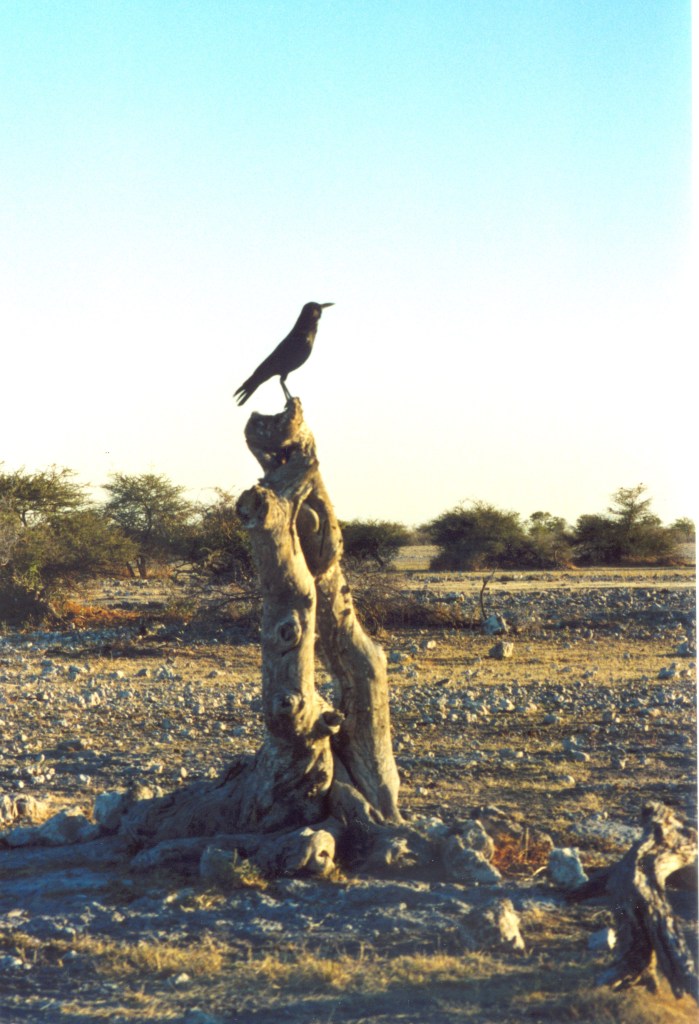
Lone crow, Goas waterhole
But, if you don’t drive around you will miss the sights and sounds of this unique environment, the different vegetation types, the rocky outcrops, the flat, windblown plains and above all the pan itself. Vast herds of springbok are often seen spread out over vast barren plains. Sometimes, when the wind is blowing cold and hard, they lie down, not in comforting groups but individually riding out the rough weather. Gemsbok are also a common sight on the barren plains, their striking markings and long, straight horns making them distinctive. The common impala of the east of southern Africa is here replaced by the black-faced impala. They are restricted to Namibia and southern Angola and one of the rarest animals in the region. Other species that can be commonly seen in Etosha are jackal, giraffe, blue wildebeest, kudu, zebra, red hartebeest, eland, roan, and steenbok. The tiny dik dik, endemic to this area is fairly common but rarely seen because of its size
and because it is very shy and likes to hide in dense bush. The cats, such as lion, leopard and cheetah, are also frequently seen, thought the caracal is more elusive. At the Halali waterhole we were fortunate enough to see an African wildcat making its way round the pool.
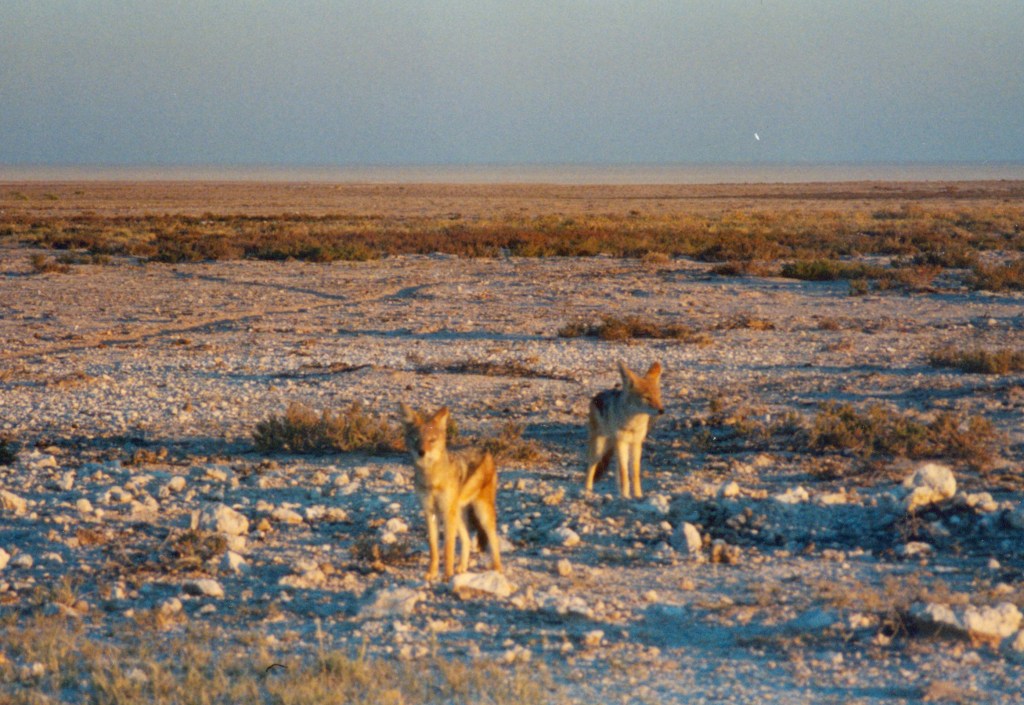
Jackals in the hazy light of early morning, near the pan
On our last morning in Etosha we decided to visit several of the waterholes between Halali and Andersson’s Gate, where we would reluctantly have to leave the park. The waterhole on the Gemsbokvlakte provided a fascinating spectacle of the social interaction between many different species, all competing for the chance to get a drink of life-giving water. As we arrived we could here a shrill sound, almost like a bark and we could see that many of the animals were restless and agitated. The landscape here is very flat and stony with very little grass and some small scrubby bushes. The waterhole itself is a manmade trough, sunk into the ground and almost invisible as the land is so flat. We sat for sometime in awe at the number and variety of animals coming and going, listening to the eerie “barking” sound but as yet not sure of its origin. It was then that we noticed the jackal. The jackal was waiting patiently, camouflaged by the sparse golden grass rippling in the desert wind. He waited and watched, while the continuous parade of animals made their way to the waterhole. The jackal was not necessarily there to drink at the waterhole, as jackals don’t seem to be particularly dependent on water, but he was there as an opportunist, hoping for a piece of the action. But it was not the jackal making the strange sounds.
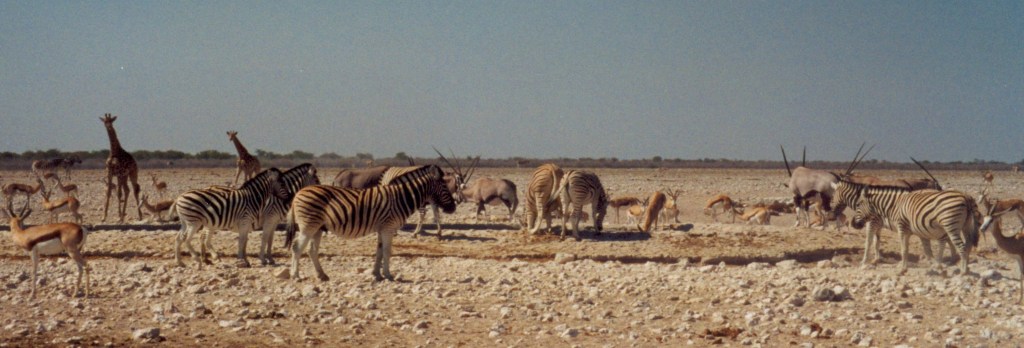
Gemsbokvlakte
The animals that were in greatest numbers initially were zebras – there were a number sparring with each other, then galloping round and round stirring up clouds of dust. As they started to leave, the strange noise seemed to become more distant and eventually we realised that it was the zebras, in particular one lively youngster, that were making this sound. As they drifted off in a long winding file, other animals came to take their turn – gemsbok, giraffe, springbok, even ostriches were there. Another jackal appeared at a distance from the water and both jackals seemed to be working in some sort of accord, one circling one way, the other in a different direction, then both would lie quietly watching before getting up to circle once more. At times the wind gusted up so much dust that the landscape was almost obliterated, then the animals would stand still as if waiting for the storm to pass, before plodding on to or from the waterhole. The graceful giraffe glided up the edge of the trough before bending to drink, an act of faith as they are so vulnerable to attack at that moment. The gemsbok were slow and cautious, stopping to feel the wind and keeping a horn’s length away from their neighbour.
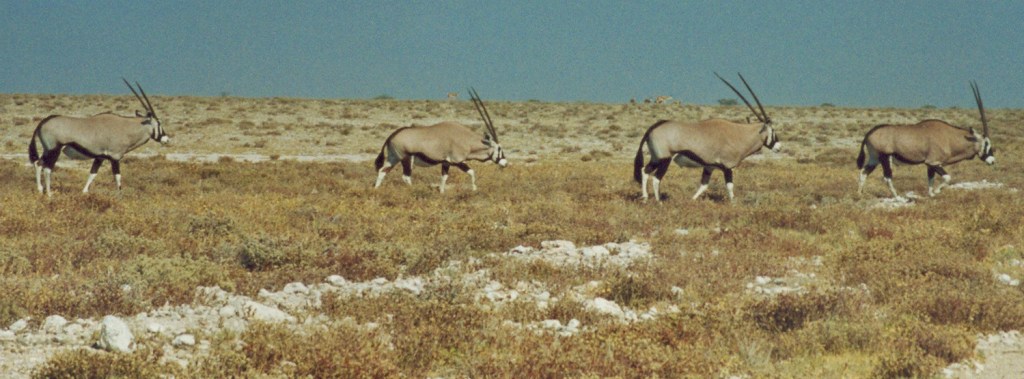
Gemsbok walking at horn’s length from each other
The animals are aggressive and use their horns for jabbing at those not respecting the hierarchy of dominance. In a more serious skirmish, we saw them lock their horns together near the base, pushing and twisting against one another. The ever present springbok wandered quietly backwards and forwards, occasionally “pronking” (leaping straight in to the air for 10 or 12 feet) when disturbed. We watched the endless comings and goings until, with regret, we knew we too had to leave. And still the jackals watched and waited, now and then working the crowd, looking for action and hoping for the next meal.
We drove slowly towards Andersson’s Gate, still seeing many animals on the way, until we passed the checkpoint and emerged on the long, straight tarmac road leading south towards Windhoek. Already it was a different world, with fast-moving cars, farms and all the evidence of human development. Etosha and its magical kingdom entered the realm of dreams, to be revisited in memory time and again.

