Life in lockdown can be pretty boring, even for us older retired folk. But something that has provided a daily source of interest has been keeping up with the comings and goings of the chameleons and skinks in our garden. They can be found in several places in the garden but our spare bedroom provides a viewing place for both species – chameleons in the restio at the front of the house and the skinks in our “secret” walled garden to the side of the house.
One of the chameleon species found here in the Western Cape is the Cape Dwarf Chameleon, Bradypodium pumilum and this is the one that inhabits the restios and Buddleja trees to the front of the house. The English word ‘chameleon’ is derived from the Latin chamaeleon, which in turn comes from Greek words meaning ‘on the ground’ and ‘lion’.
Several years ago, I was lucky enough to attend a lecture by Prof Krystal Tolley at Kirstenbosch entitled The Dwarf Chameleon’s Tale: threats and conservation in South Africa. Her insights into the lives of these fascinating little creatures were very interesting and form the basis of my information about them.
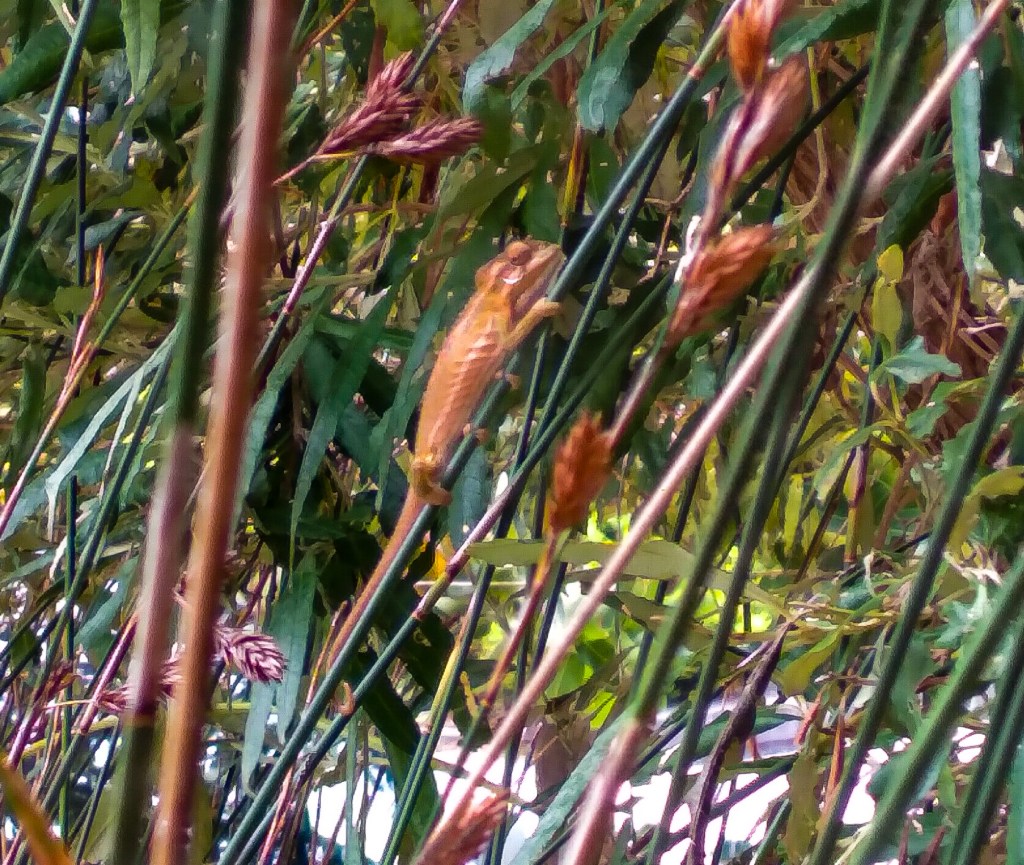
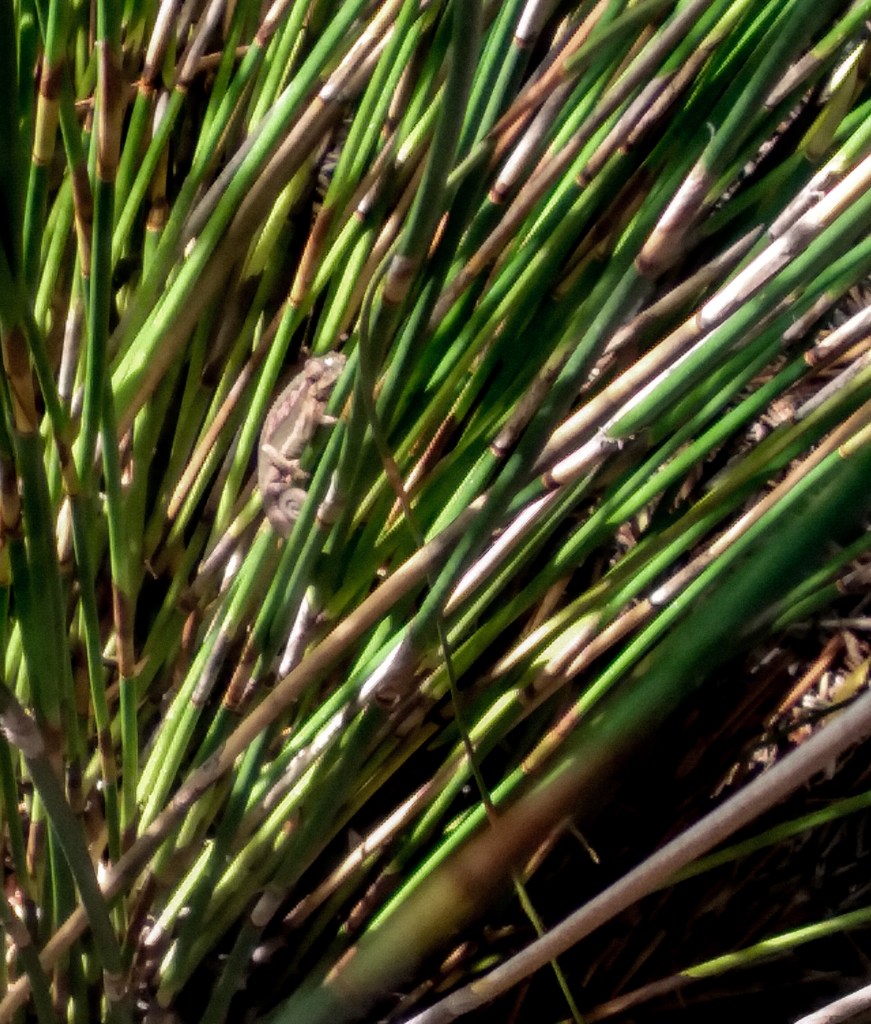
The Cape Dwarf chameleons are thought to live for about 5 years, based on those in captivity, but could be less in the wild. Some chameleons lay eggs in nests but the Cape dwarfs have live babies, which are enclosed in an egg-like sac until they are ready to be born. The mother can carry 10-20 such sacs and the babies will be born one after the other, which is why you often notice a large number of very small chameleons in the same bush, at least for a few days. Late in December we noticed three small, brown chameleons in the restios outside the window and have been watching them grow and develop over the last couple of months.
There is some difference between males and females, with males usually having more ornamentation in the form of a helmet-like extension on the head. This is used for display – either to warn off other males or to attract a female.
One important question that Prof Tolley posed and tried to answer is: “Where have all the chameleons gone?” Nowadays there seem to be far fewer chameleons in our gardens than when many of us were growing up – why has this happened and can we do anything to bring them back?
One of the main reasons why there are fewer chameleons is that, with the growing number of people, suitable places for them to live have shrunk. Climate change is also likely to be a threat in the future. The Cape dwarf chameleon is listed by the IUCN as a vulnerable species – this means that it is facing a high risk of extinction in the wild in the medium-term future, and as the Cape dwarf chameleon already has a small distribution, it is likely to decline further in future.
Of course, a good supply of food is necessary for the survival of chameleon with insects being the main food source. Prof Tolley appealed to us not to kill the bugs and especially not to use pesticides!
Unfortunately, chameleons are a food source for other animals and in the wild they are preyed on by birds such as hadedas and shrikes in the day, as well as snakes at night. But in urban areas, cats are a big problem. Well-fed domestic cats don’t often kill for food – they kill because it is instinctive and they like to have fun. It has been shown that a cat will bring home less than 20% of what they kill – the rest are just left to decay.
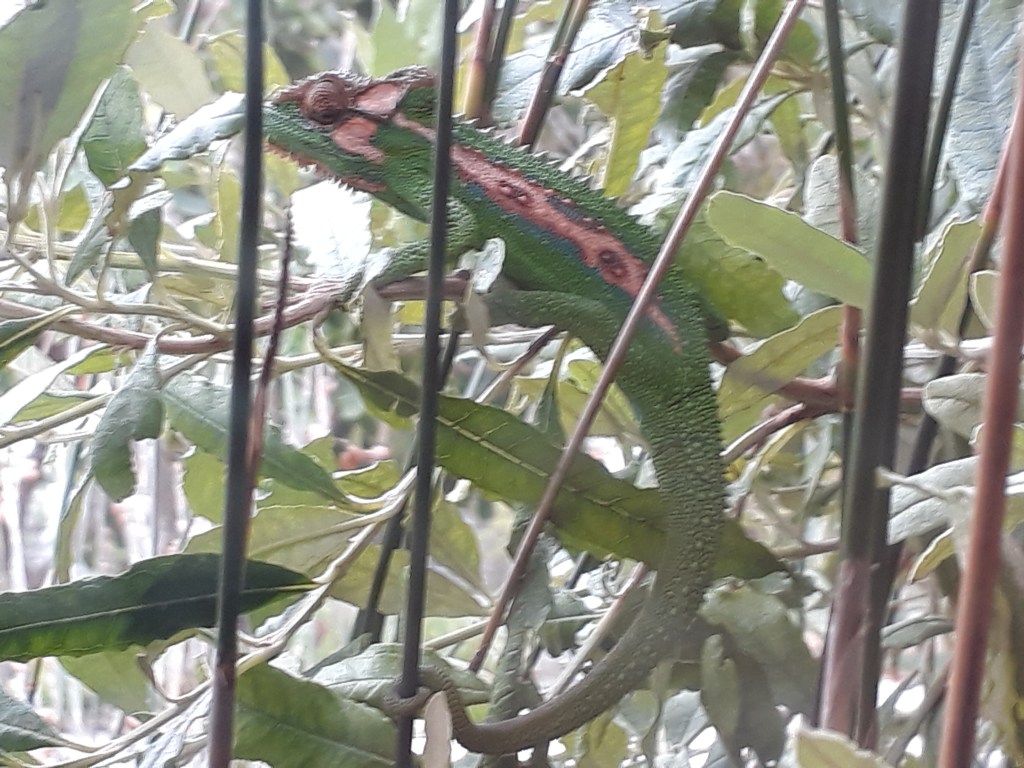
The cryptic colouration of the Cape dwarf chameleon does afford some measure of camouflage. They are almost uniformly leaf-green but with an orange to rust-red lateral stripe. If you look for them during the day, they can be very hard to spot as they blend in beautifully with the vegetation, especially restios, where they seem to mirror the colours. Also, because they perch lower down in bushes in than day than at night. At night chameleons sleep at the tops of perches and often become paler. The colours are also used as a means of communication. We watched our baby chameleons grow, not only in size, but also in the development of colouration, from a uniform pale brown to pale green to the emergence of the colourful lateral stripe.
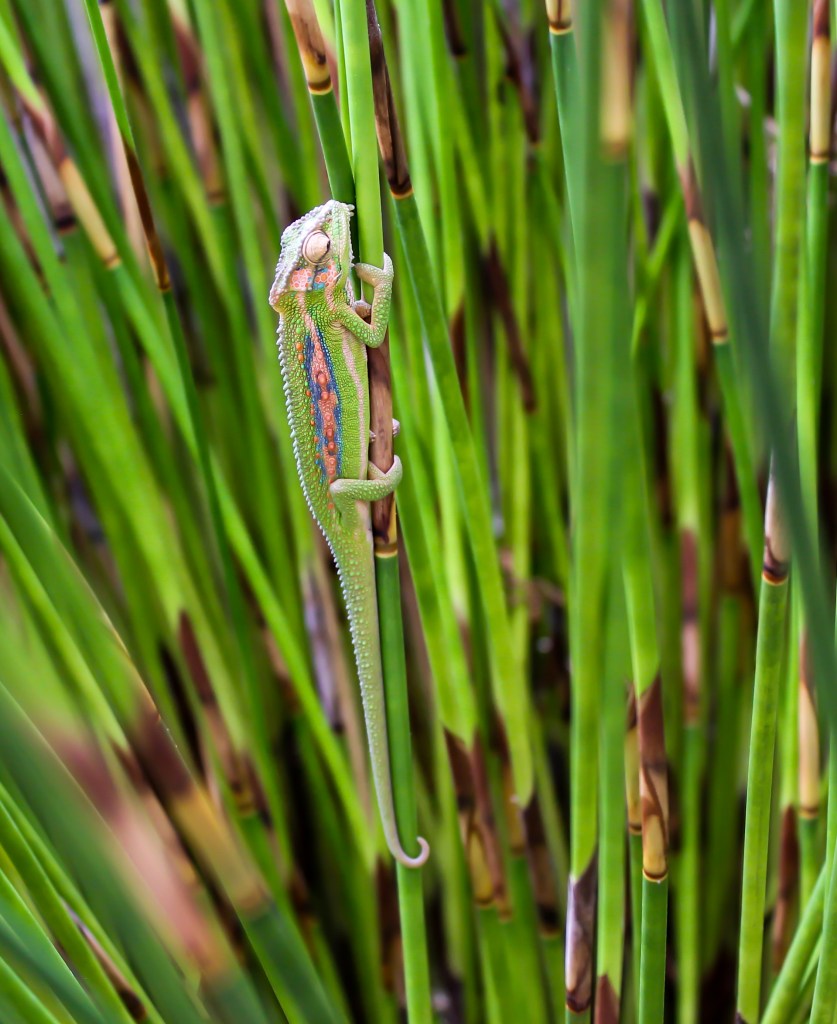
Interesting observations were made about the differences in the ways in which males and females behave, with males often following females around or ‘guarding’ a chosen female for a period of time, even chasing other males away from her.
The size of the branch or perch that chameleons favour is very important and is dependent on the size of their hands, with the babies favouring small and thinner branched species than the adults. Local plant species that have suitable perches are restios (especially the thatching restio Elegia tectorum), Rhus, wild olive, Buddleja and Tecoma capensis among others.
Research has found that our local chameleons have relatively small home ranges, around 50 m2 on average, but that they don’t seem to be territorial. However, we have noticed that, if they get too close together in the same restio there seems to be quite a conflict over space, with one chameleon appearing to dominate the other with hissing and aggressive movement to chase the intruder away.
One often thinks of chameleons as moving very slowly and cautiously but we can see that they often move quite swiftly along the restio stems and into the Buddleja tree next to it. An important observation that also came out of local research is that chameleons are capable of moving between different areas provided that suitable vegetation links these habitats and the creation of connected spaces of the right sort of habitat (including the species mentioned earlier) could be an important way to bring them back into our gardens.
In contrast, the skinks are much livelier and seem to move at lightning speed if frightened. While the chameleons are relatively undisturbed and observed from behind the glass, the skinks are regularly disturbed by us watering the garden and generally maintaining the area, although we do tend to let the weeds grow for a while to give them added cover! The size of the garden is not much bigger than the spare bedroom itself – it is partly paved, which provides the skinks with a nice warm place to bask in, especially in winter, but also has quite good plant cover for them to disappear into, as well as a “lizard” bath at ground level (as opposed to a bird bath). They also enjoy perching on a pile of thin wood logs from which they can see if there are any insects to hunt.
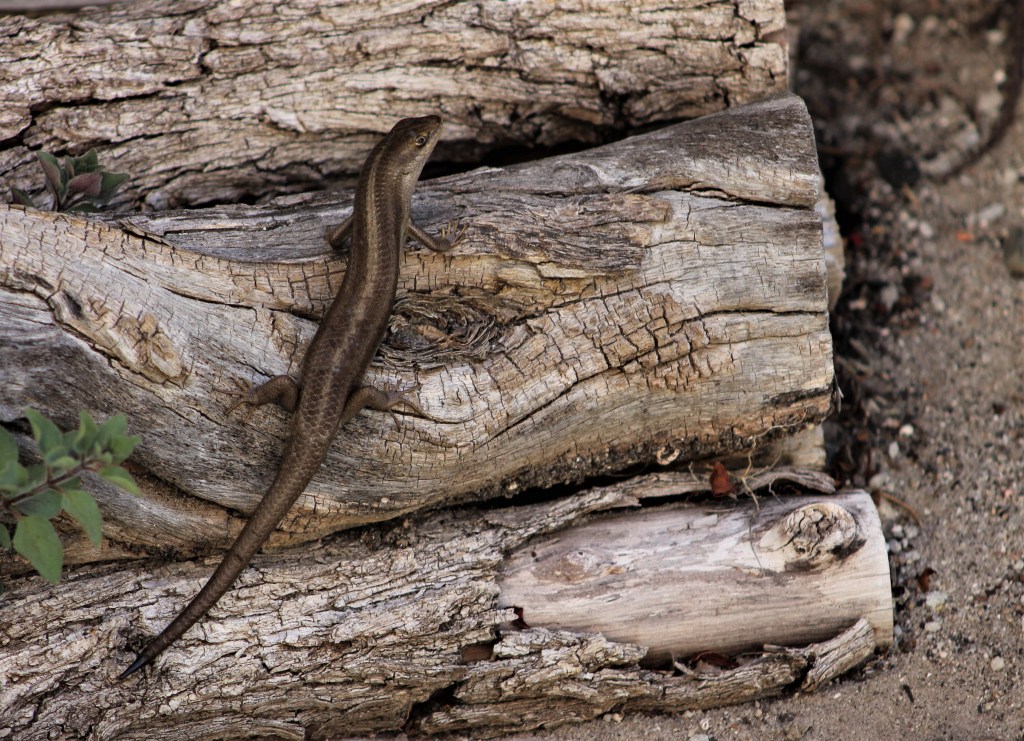
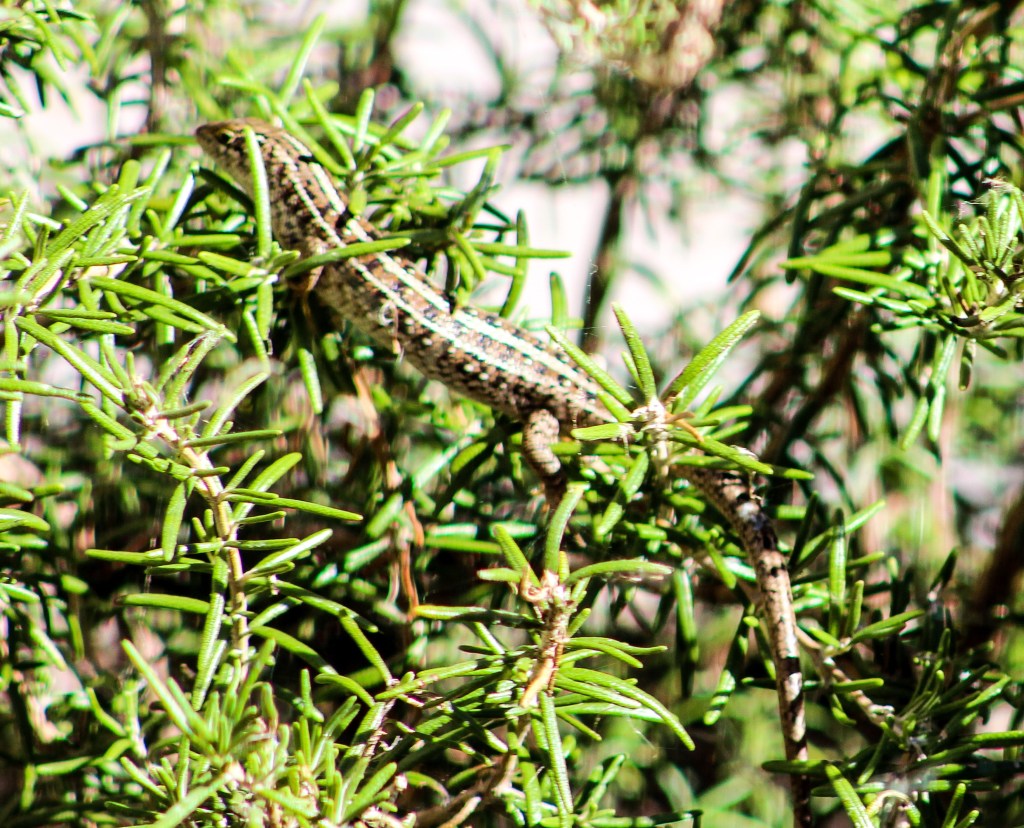
The skink species that inhabits our garden is a typical skink in the genus Trachylepsis. It is the Cape skink, Trachylepsis capensis, common in much of South Africa. It is described as a gentle skink but I am not sure our skinks learnt that trait as they do not get on with each other!
This species of skink lives on the ground and hunts for insects. It also makes tunnels or burrows in the loose sand. In most places the female gives birth to live young (5-8 babies) but in some areas they are known to lay eggs.
Unlike the chameleon the skinks are not very colourful, being mostly light brown to olive greyish brown above, with three paler stripes. The flanks have darker brown to black spots or bars. The belly is a palish yellowy-white. However, one of our skinks is a more uniform olive-brown with only vague stripes.
At one time last year, there were at least 5 skinks in the secret garden but now there seem to be only 3. One definitely died because we did find its body but the other just disappeared. As skinks only live for two or three years and we are not sure when (or how?) they first arrived in the secret garden, old age is the most likely cause.
Unfortunately, so far there don’t seem to be any babies emerging to replace those that have gone. However, the 3 that remain provide quite a bit of entertainment value. The largest one is obviously the boss, as the 2 smaller ones tend to be very wary when it is around and avoid getting close to it. If they do get too close a frantic chase occurs. The large skink has a very handsome long tail but the tails of the other 2 are usually quite short, indicating that they shed their tails if chased to closely by the aggressor! The tails then grow back fairly quickly but seem to be lost again as the chasing doesn’t stop. The two smaller ones are not friendly to each other either.
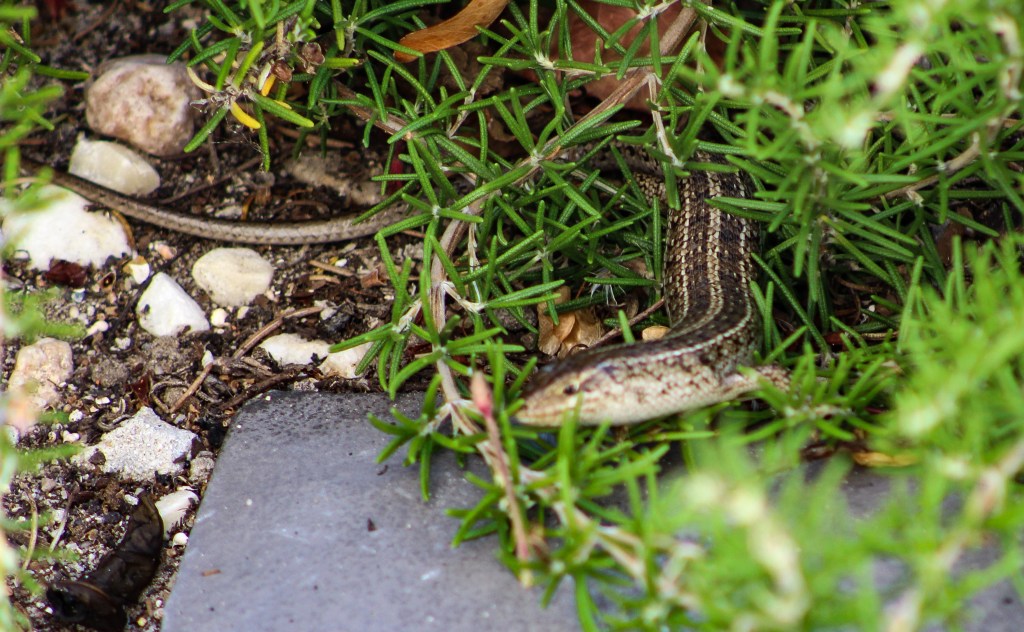
The favourite hiding place of all three skinks is a large rosemary bush. This is the refuge to which they retreat when being chased. As the bush has been in the garden for several years and has really thrived there, it has spread quite widely and grown quite tall. In summer, the skinks are most active fairly early in the day, when the garden has patches of sun and shade. The rosemary bush flowers in summer and attracts many insects, which the skinks hunt avidly, even climbing to the top of the bush. Sometimes, if the one in the bush spots another on the ground, it will dive-bomb the intruder and a mad chase ensues round the garden!
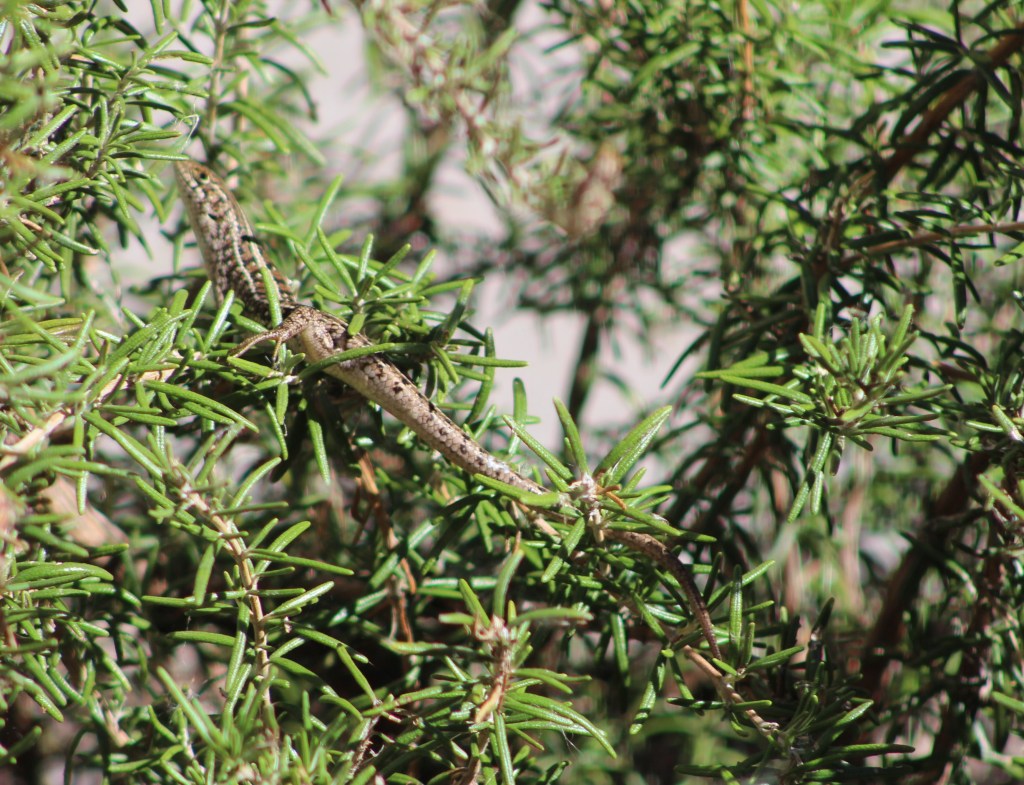
It is very rewarding watching these interactions, both of the chameleons and the and skinks and I guess, if it wasn’t for our enforced homestay, we wouldn’t have the time to spend gazing through the windows and waiting for the action to start!

