A different experience in the south of the Park
Day 15 5 November. Our first full day in the south of the Park. The south definitely has a different feeling from further north – perhaps it is because of the closer proximity to civilization outside the Park as well as the large size of Skukuza, with its facilities for research and greater concentration of employees and staff, making it basically a small town.
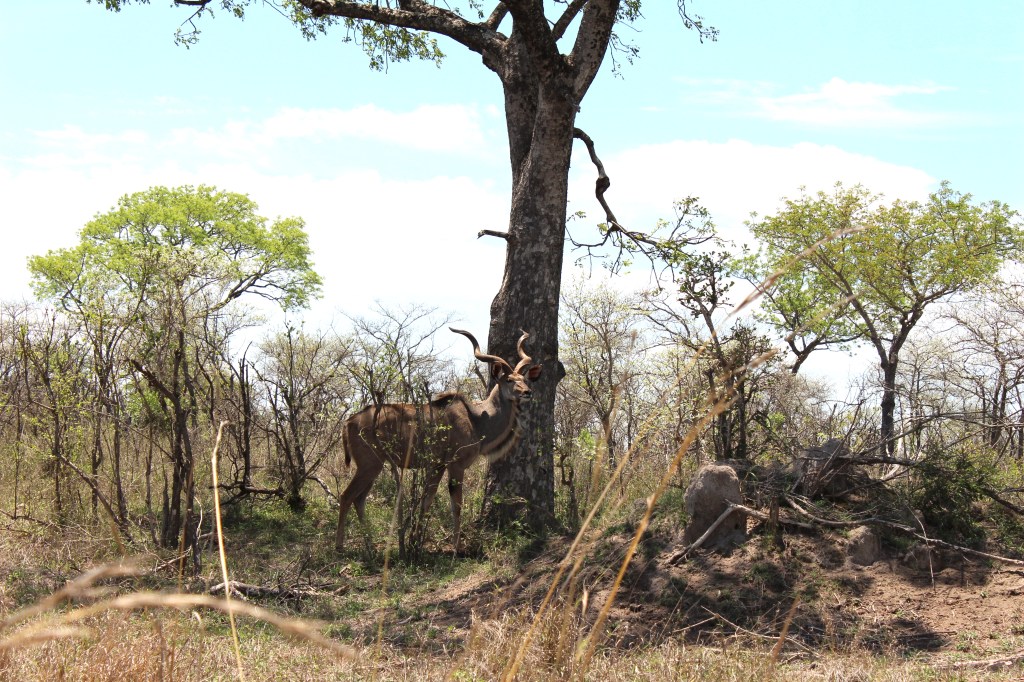
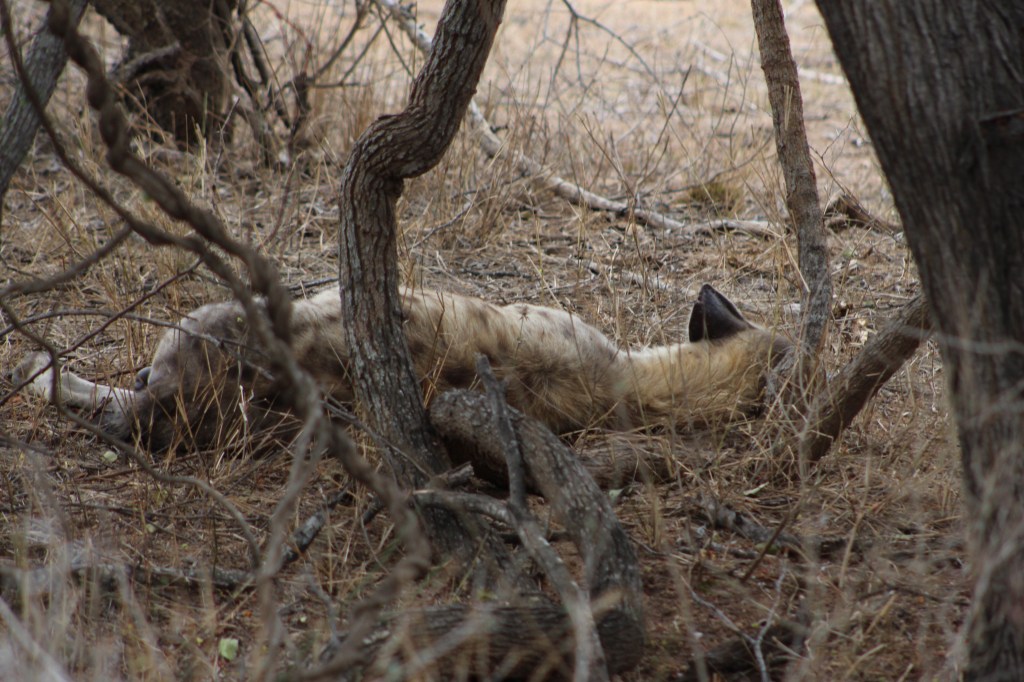
We got up reasonable early and were on the road by 6.45am with our tea and rusks, setting out in the same direction as the previous evening, and intending to drive to Lower Sabie and back before breakfast. It was still cool and a bit cloudy after rain during the night and the animals still seemed to be asleep as we didn’t see much at all – just some kudu and impala, a few monkeys and a sleeping hyena.
Close to Lower Sabie we saw several cars parked by the side of the road and pulled up to enquire what could be seen. It was an impala kill that had been hoisted up into a tree by a leopard but at that time the leopard was nowhere to be seen. We decided not to stay and wait to see if the leopard reappeared but to go on to Lower Sabie. At Sunset Dam just before the camp we parked for a while to watch the hippos and see what other animals and birds were around the dam. We were very fortunate to see a spectacular pair of Diederick’s cuckoos with their olive-green plumage and black and white barred underparts.
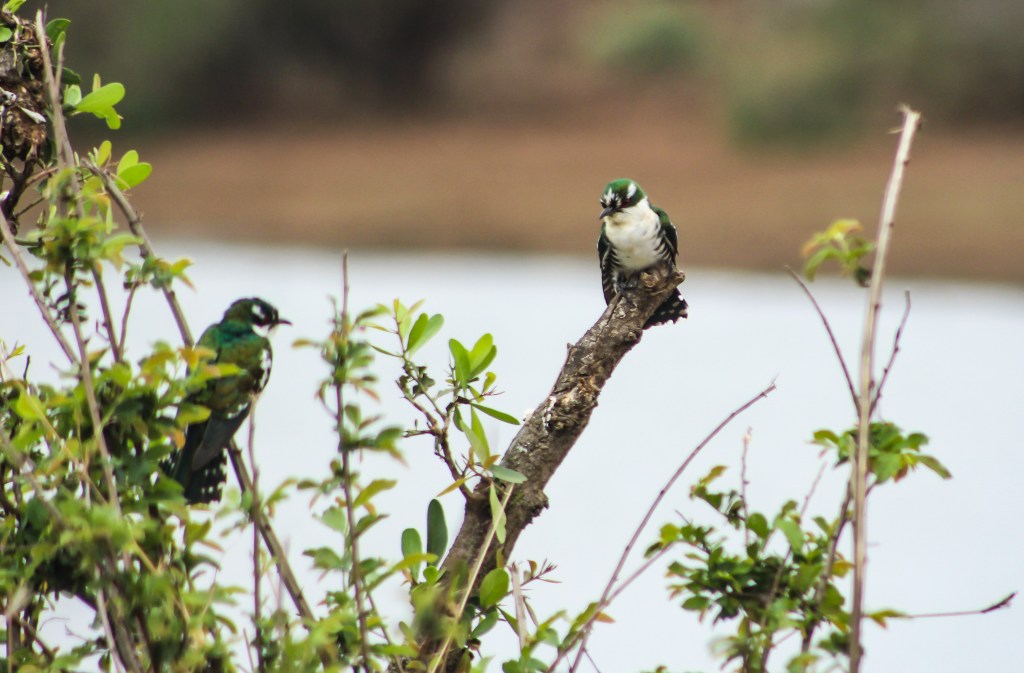
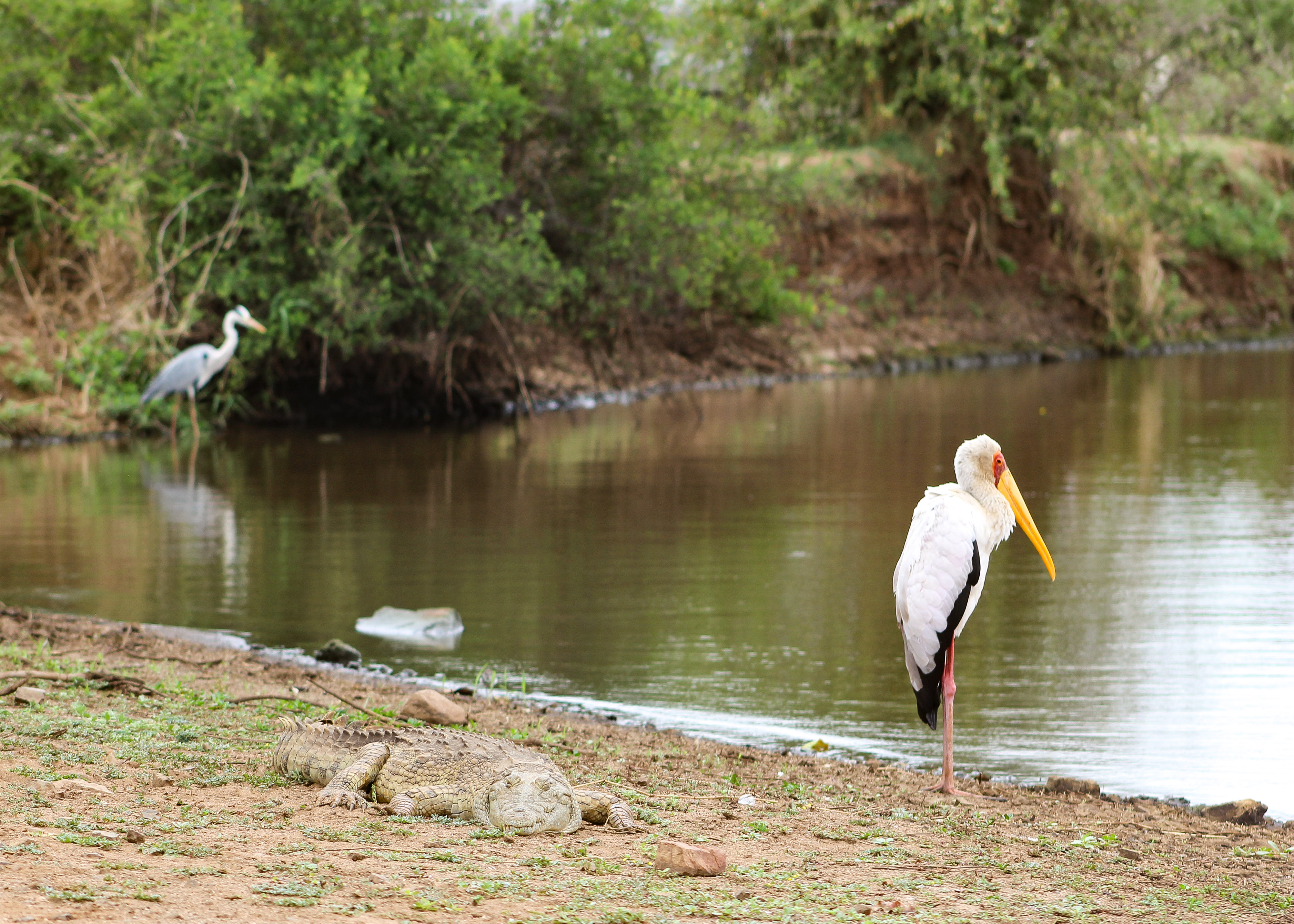
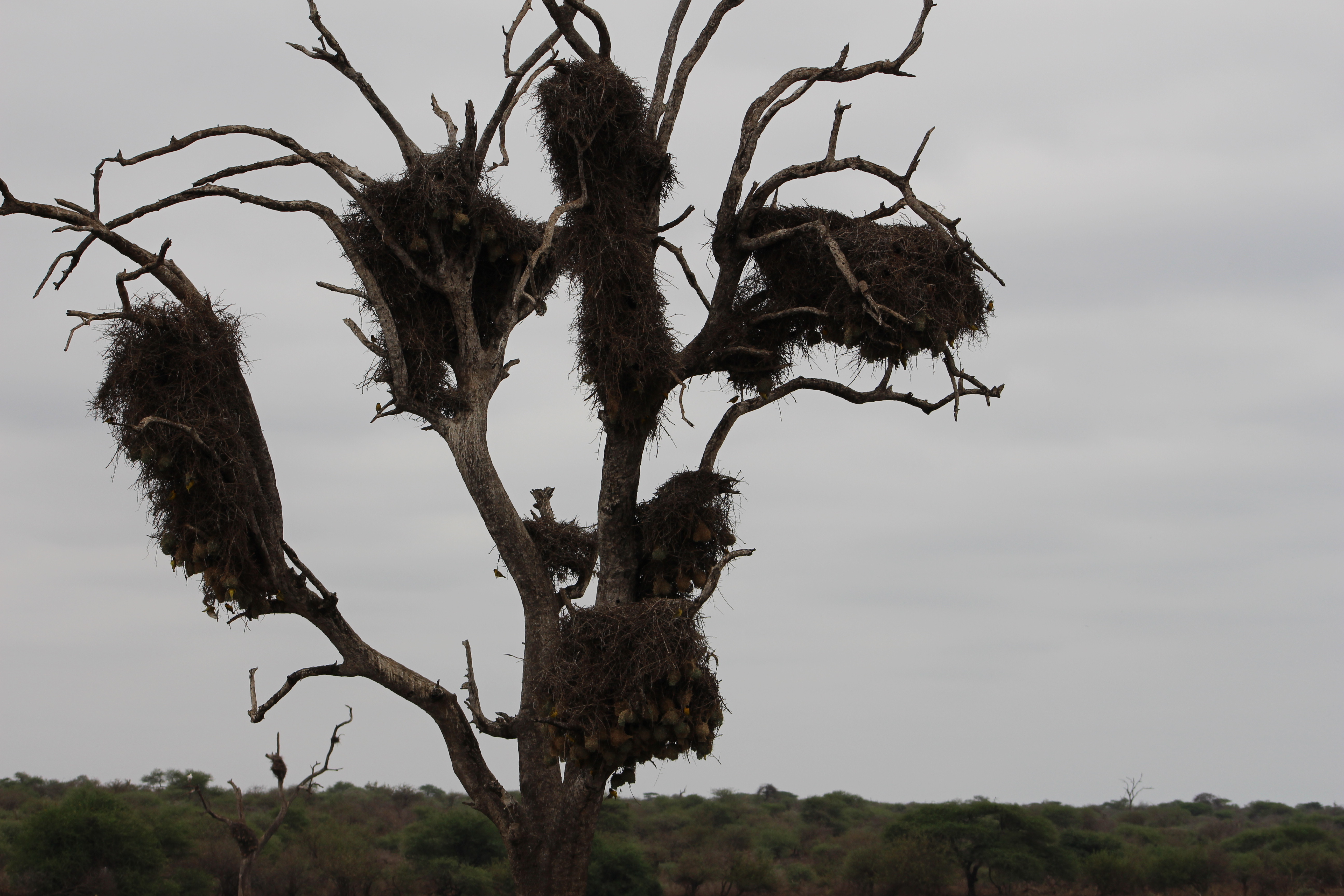
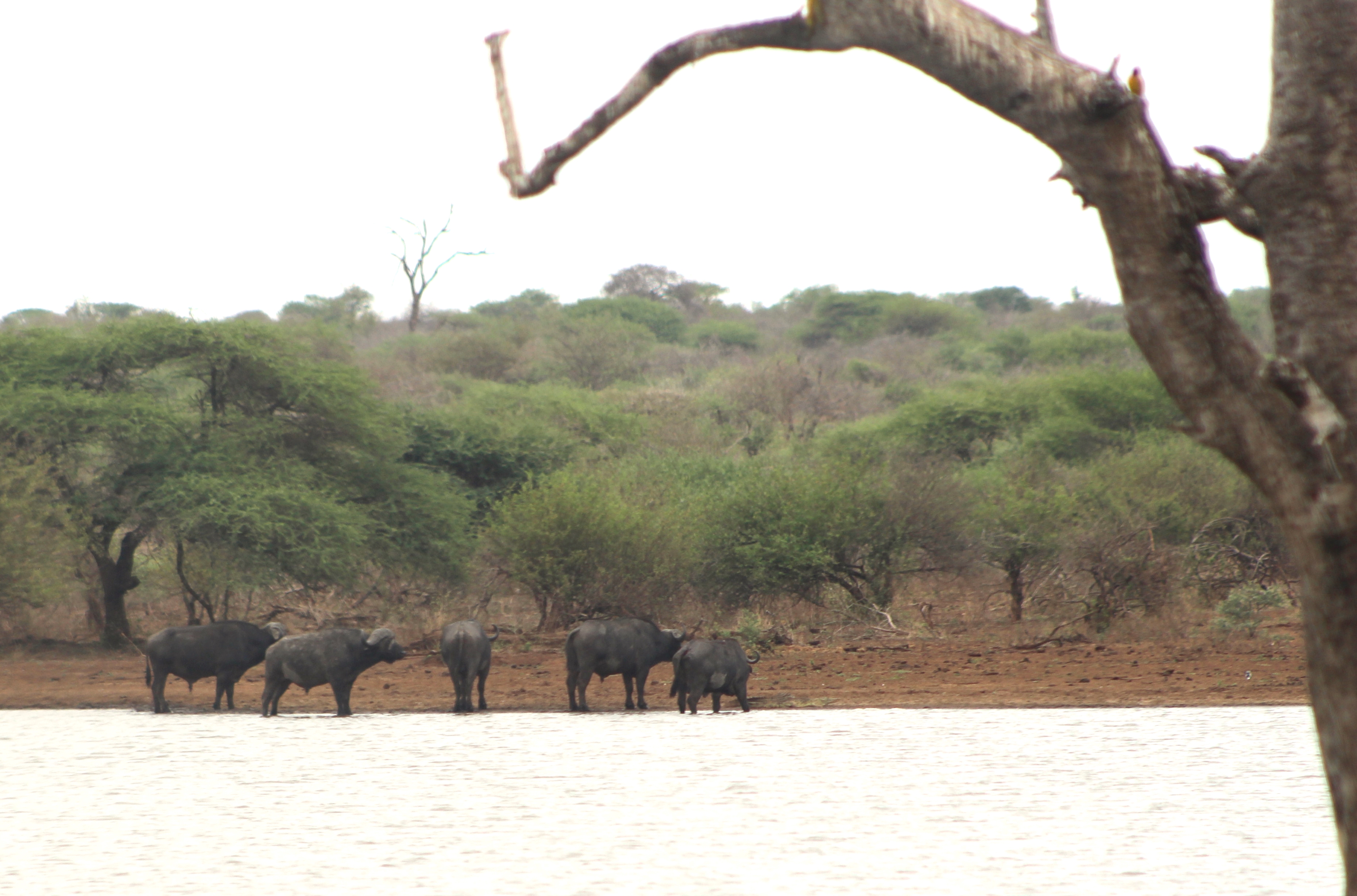
As always there was plenty of activity around the dam. The hippos bobbed up and down, grunting occasionally. A small herd of buffalo were drinking on the other side, close to a yellow-billed stork. In a dead tree close to us were several nests belonging to buffalo weavers. And when we moved briefly to another spot, we saw a very large crocodile flanked on either side by a yellow-billed stork and a grey heron, neither of which seemed in the least bit perturbed by the proximity of the crocodile.
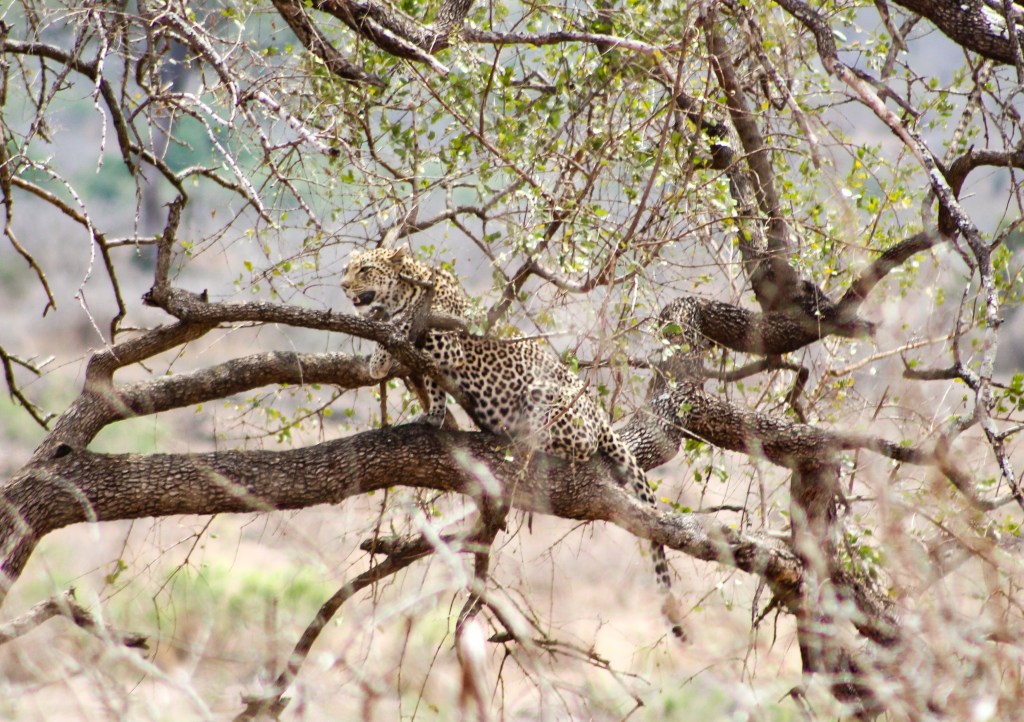
We stopped in at Lower Sabie Camp for a short while and had a wander round to remind ourselves of where we had stayed many, many years ago but it was not easy to see as the camp has changed considerably over the years, not least because the main building had burnt down some time ago and had been rebuilt. Back on the road towards Skukuza at the place where the impala kill was, we could see immediately from the greater number of cars that the leopard had returned. Despite so many cars we did manage to get a good view of the leopard in the tree and take pictures of it.
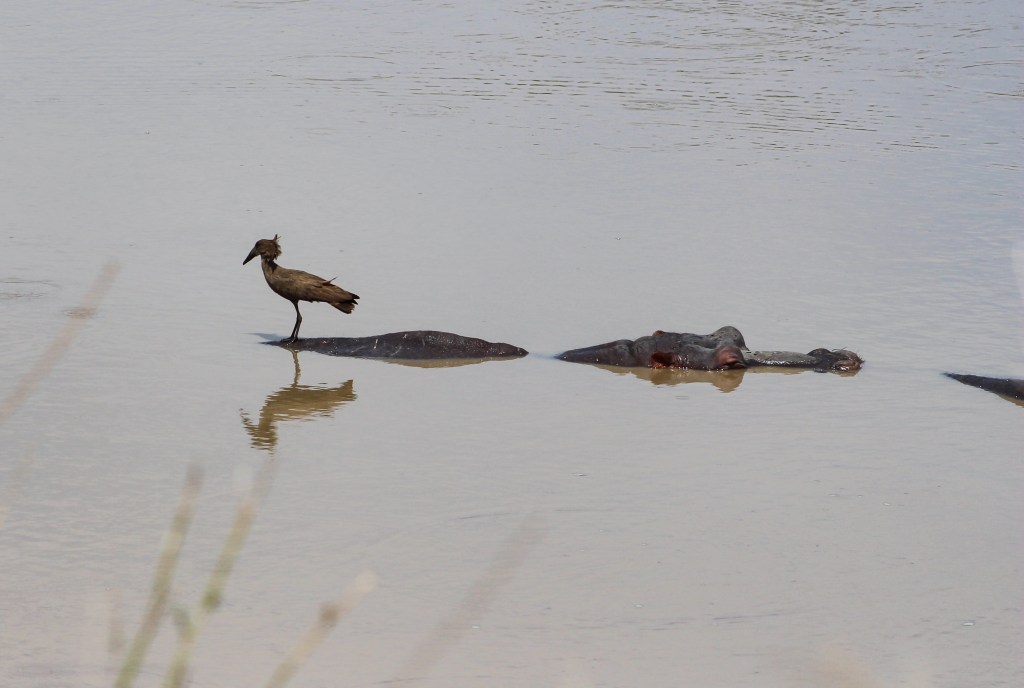
At the N’watimhiri Dam, which we had not passed on the way down because we took the detour to the causeway, we were greeted by the comical sight of a hippo with a hamerkop sitting on its bottom!
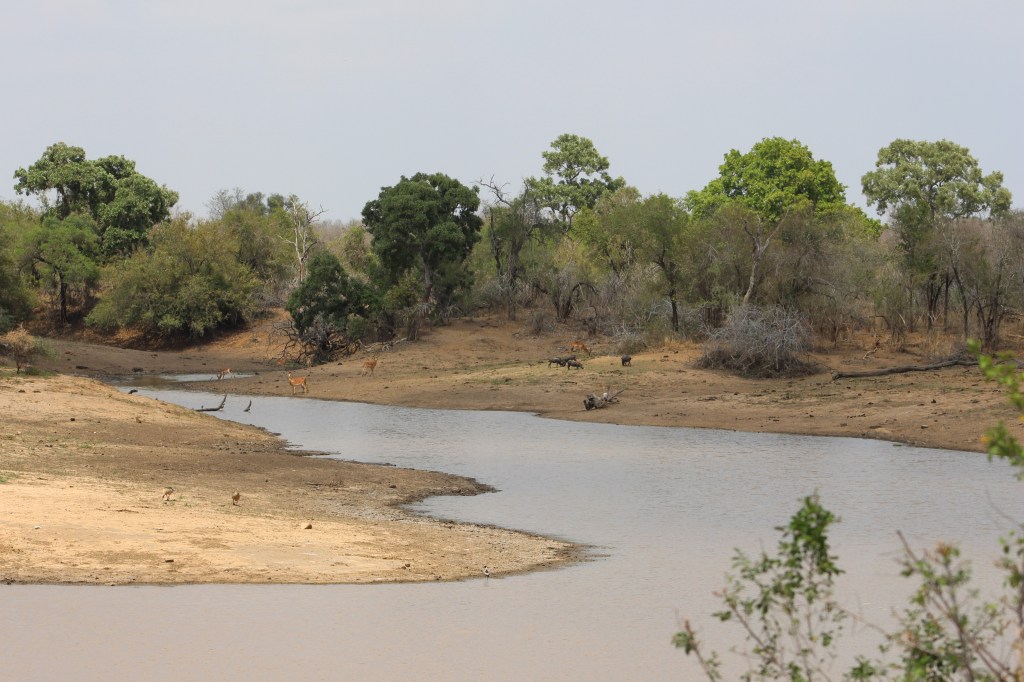
On the opposite bank some impala were coming down to drink and several warthog were grubbing in the mud.
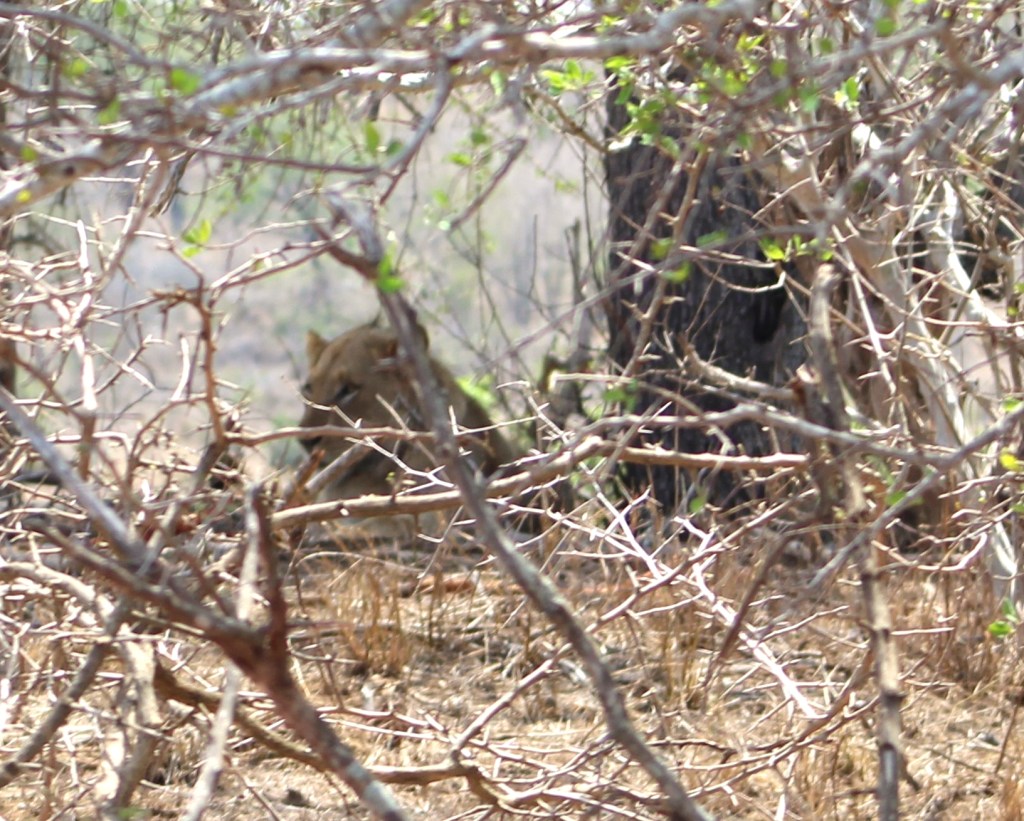
Shortly before we reached the Nkuhlu picnic site there was another bunfight over position – this time a lion was lying tucked away in the shade seemingly oblivious to the commotion on the road. We did manage to get a brief sighting of the lion and a couple of blurry photos. This is the disadvantage of the southern part of the Park – more visitors, less patience. It definitely detracts from the experience and makes it seem more like a zoo.
Back in camp we did not even stop for breakfast but set out to discover where the laundry was. We found it eventually but there was only one washing machine in working order. Having checked what coins were required we dashed off to get the change from the shop. Unfortunately, by the time we got back to the laundry with the money and the clothes someone had already put a load in the only working machine and someone else was waiting with his bundle of clothes for it to finish. As we hadn’t done any washing for several days I decided to stay and keep my place in the queue. Kev went off to buy some yogurts for breakfast and to make sure there wasn’t another laundry somewhere else – but no luck there. We took it in turns to keep our place in the queue, waiting while others came, some went, some stayed and by the time we managed to put our load on, two other people were in the queue after us. It was rather a painful process as it was incredibly hot waiting there and with the tumble drying following the washing, it was well into the afternoon before it was finished. Still, I heard some interesting stories from the other people waiting to do their laundry!
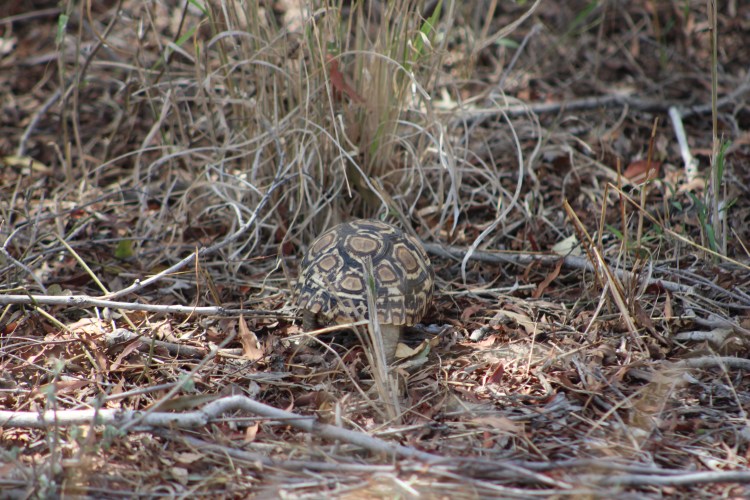
Day 16 6 November. We had breakfast and prepared sandwiches for lunch before setting out for a round trip via Pretoriuskop camp. We headed south straight down the H1-1 for nearly 15 kilometres before bearing to the right and west along the same road in the direction of Numbi Gate. Shortly before the bend in the road we saw a hinged tortoise on the side of the road and a little way along towards Pretoriuskop a small herd of wildebeest were gathered in the shade of one of the tall trees.
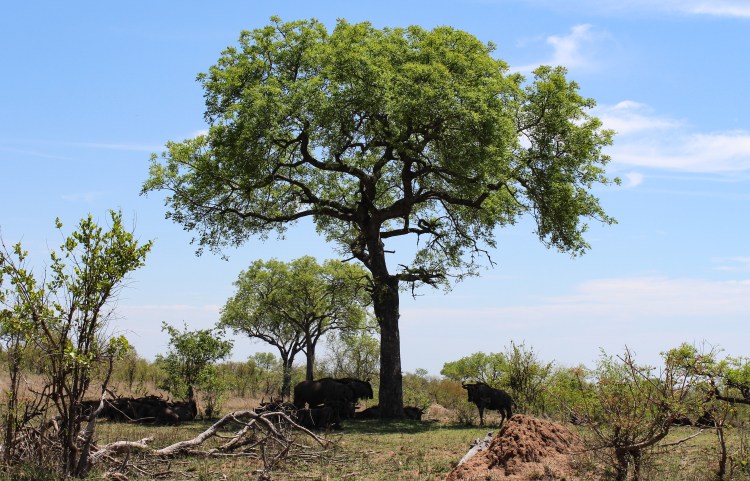
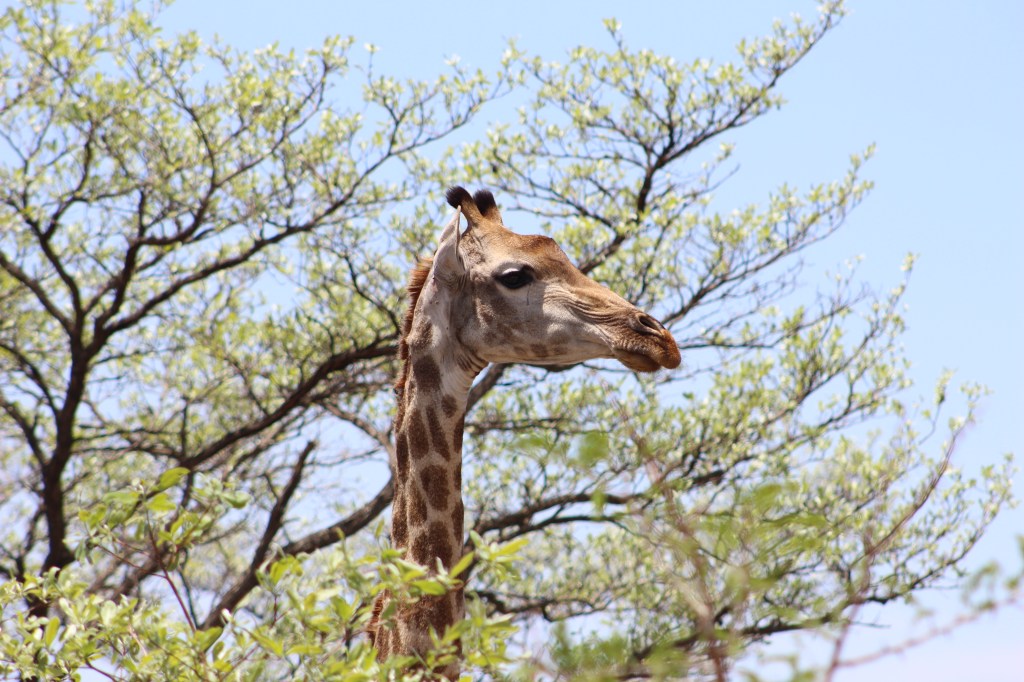
Although it was not yet 11am the animals, like impala and kudu were beginning to seek shade from the hot sun – although the giraffe were still out browsing and the warthog snuffling in the undergrowth.
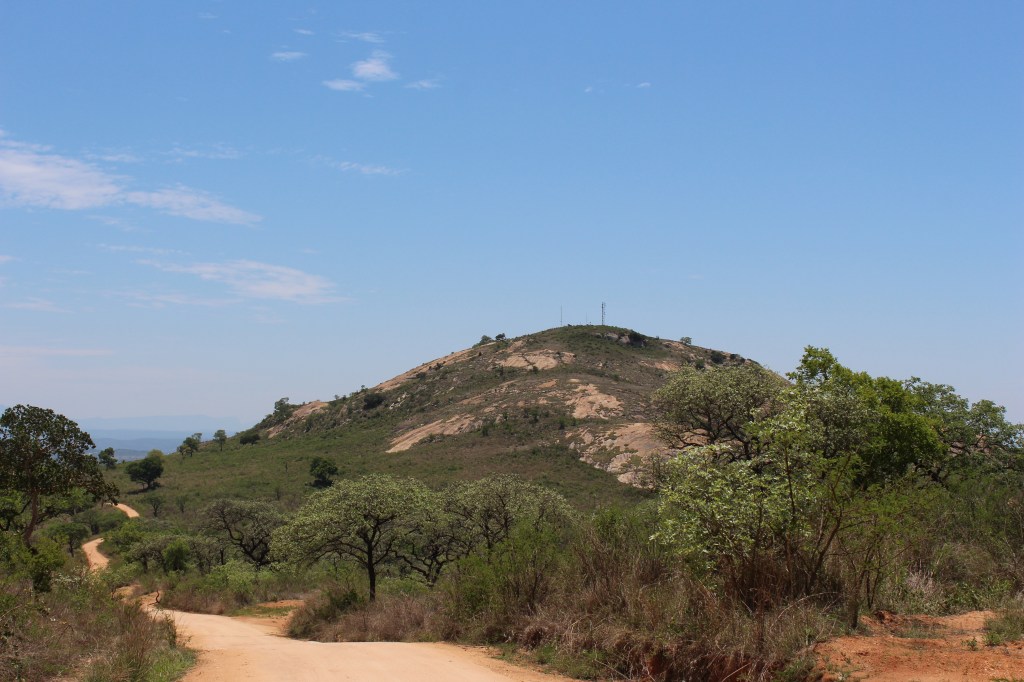
We drove into Pretoriuskop camp as we couldn’t find another shady stopping place to have a late coffee break but were soon on the road again, taking the S7 and S3 north to the junction with the S1 coming into the Park from the Phabeni Gate. The S7 took us passed the impressive Shabeni Koppie, a large granite dome-shaped hill rising up from the surrounding sourveld, which is dominated by Silver Clusterleaf trees.
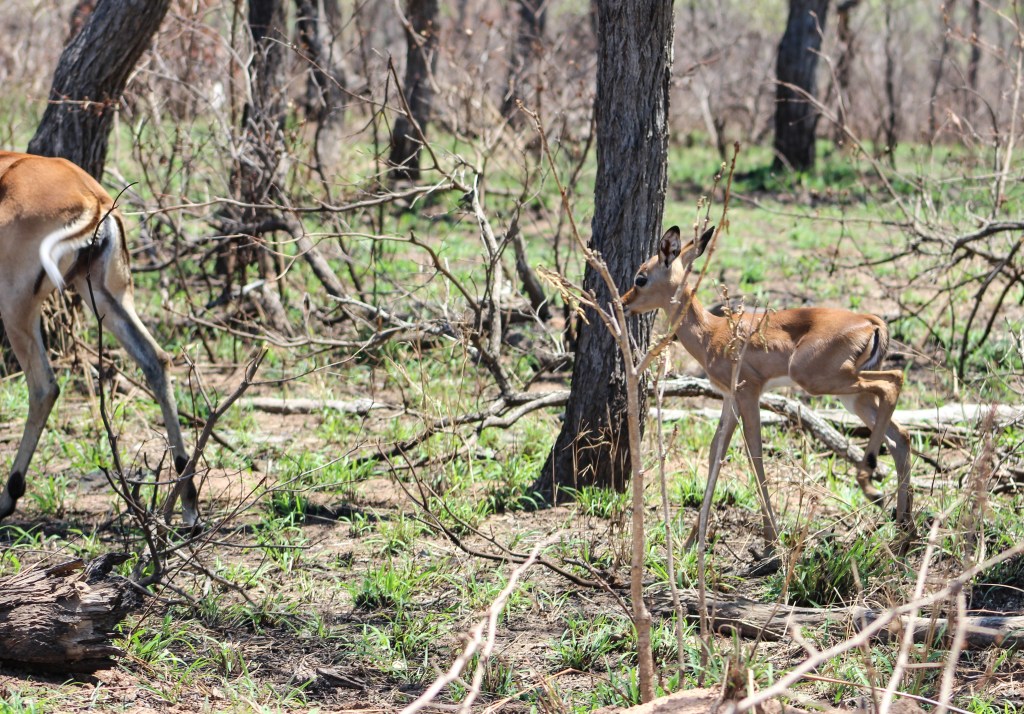
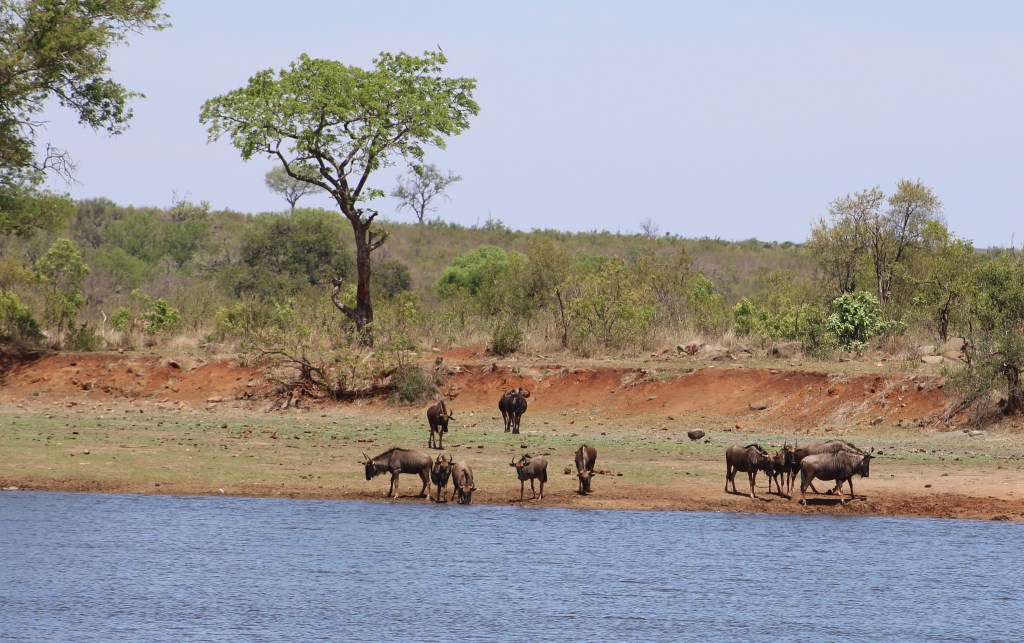
Once on the S1 the vegetation changed again to a mixed woodland and thorn thickets, not known for an abundance of game. But we did see several baby impala along this route and stopped in at N’waswitshaka Dam to see hippo in the water and impala and wildebeest coming down to drink.
Joining the H11 about 8 kms from Skukuza, we then turned left onto the gravel road to Lake Panic, a well-known bird hide. It was well occupied with birders and a guide who was pointing out the different species.
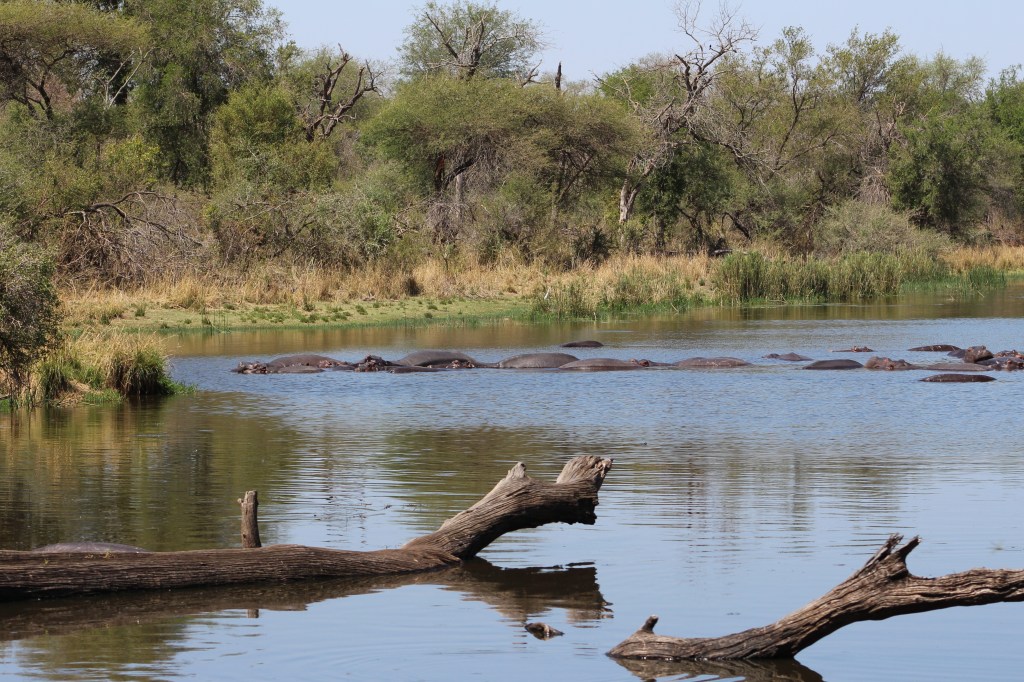
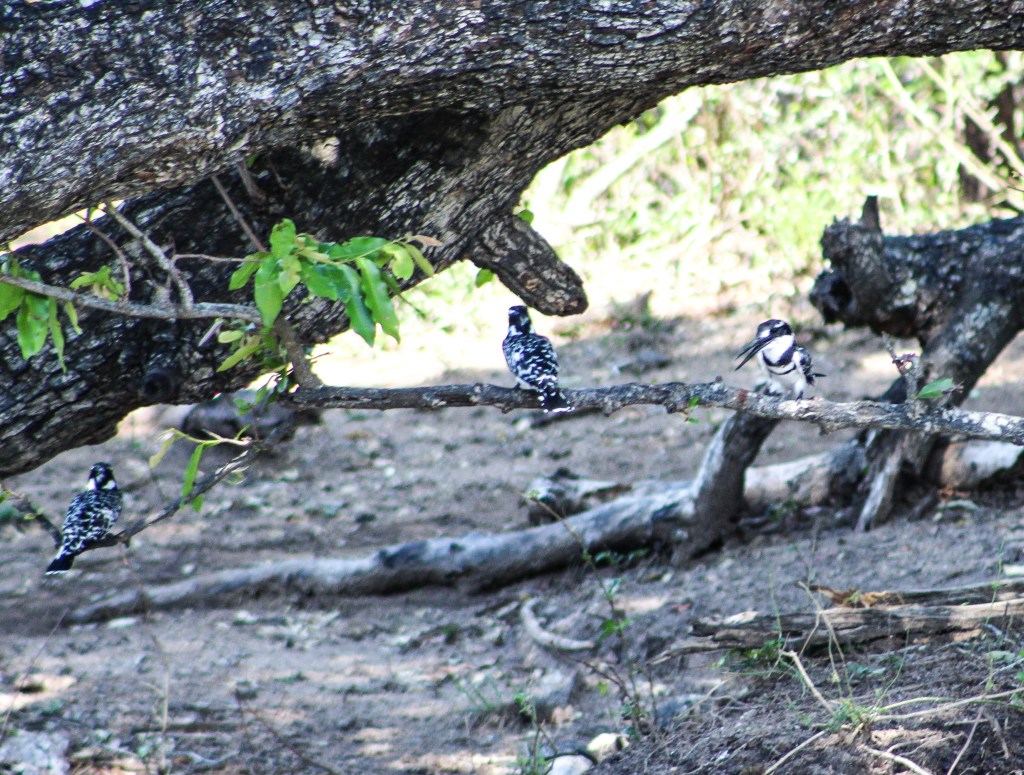
Hippo were in abundance here, as well a hamerkop, pied kingfishers and several other bird species.
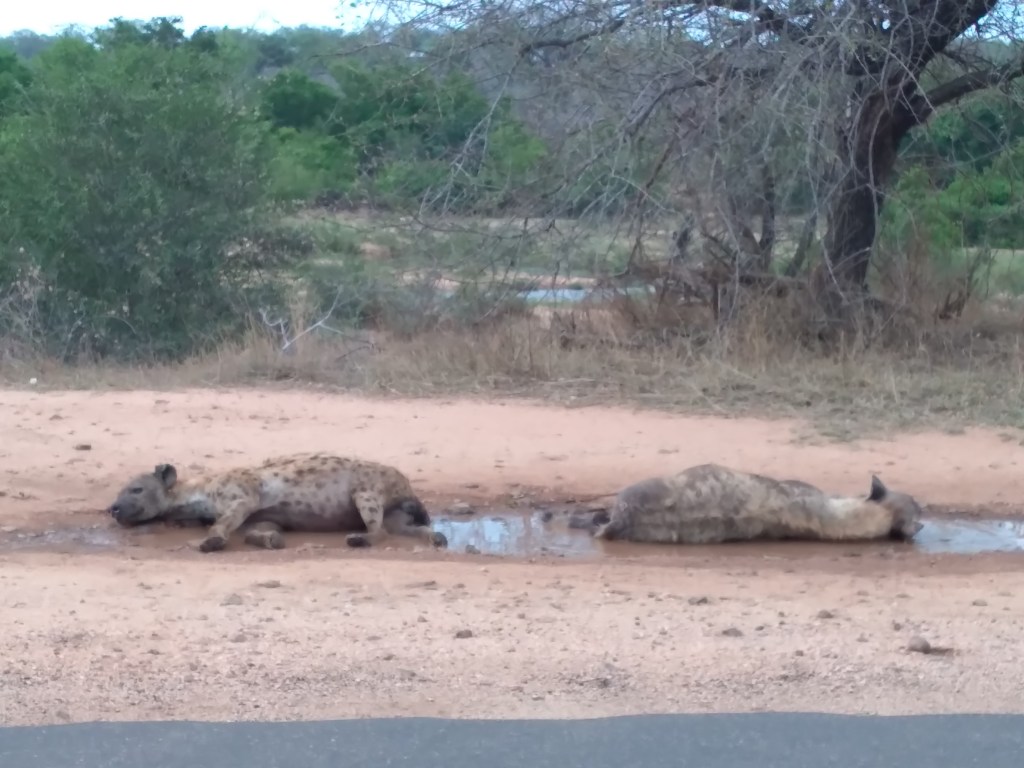
We had a restful afternoon and wandered along to make a booking for a dinner at the Cattle Baron restaurant overlooking the Sabie River, before going for a short drive along the H4-1. We had a brief late afternoon drive this time going left along the H1-2 towards Tshokwane. We came across the wild dogs that had moved camp from their previous site – they were all still curled up asleep some way off the road though. We followed the road up to the H12 and down across the low bridge back onto the H4-1. Again, it was not a very productive drive but we did see two hyena sleeping in a puddle beside the road!
We went back to the restaurant at about 6.30pm and fortunately chose to sit undercover as it looked as if a storm was brewing. We ordered our drinks and main meal, which arrived just in time for the electricity to go off. Load-shedding had been affecting the rest of the country since we left Cape Town but we had been fortunate to avoid it, except in Dullstroom, because most places and camps in Kruger had generators and could keep lights on. It seemed that the generators in Skukuza were giving trouble, though. At least we had our food and could enjoy eating by candlelight. The electricity did come on after about 30 minutes but other people had a long wait for their dinner, including a Dutch family that we began chatting to when the lights first went off. They had an interesting story to tell, as they had initially been scheduled to go to Cancun in Mexico on holiday but a cancelled flight at the last minute meant they could not go and they decided to arrange this trip to South Africa on the spur of the moment, visiting places recommended to them by another family member. While the lights were out we noticed a glow in the distance some way on the other side of the Sabie River, and wondered if it was a fire caused by the lightning we could see in that area. We had noticed earlier on, on our afternoon drive that various areas of veld had been burnt and wondered if lightning could be the cause. We decided not to linger too long after finishing our meal as the storm seemed to be getting closer and closer and the wind was picking up considerably. In the dark, although we had a torch, we misjudged the way home but found our way just in time to avoid getting completely drenched as the rain poured down seconds after we got inside our bungalow.
Day 17 7 November. This was our last full day in Kruger. We managed to get up fairly early but before we set out, we watched a troop of monkeys on a raid through our part of the camp. Fortunately, we were around and took care not to leave any food out for them to snatch. But it was lovely to watch their antics as they made their way passed our bungalow. One young female was having trouble with a small baby that kept wanting to escape and explore on its own but she kept scooping it up and attaching it beneath her as she hurried on, only to sit down again and have the baby escape once more. Eventually an older female picked up the little one and they all disappeared out of sight.
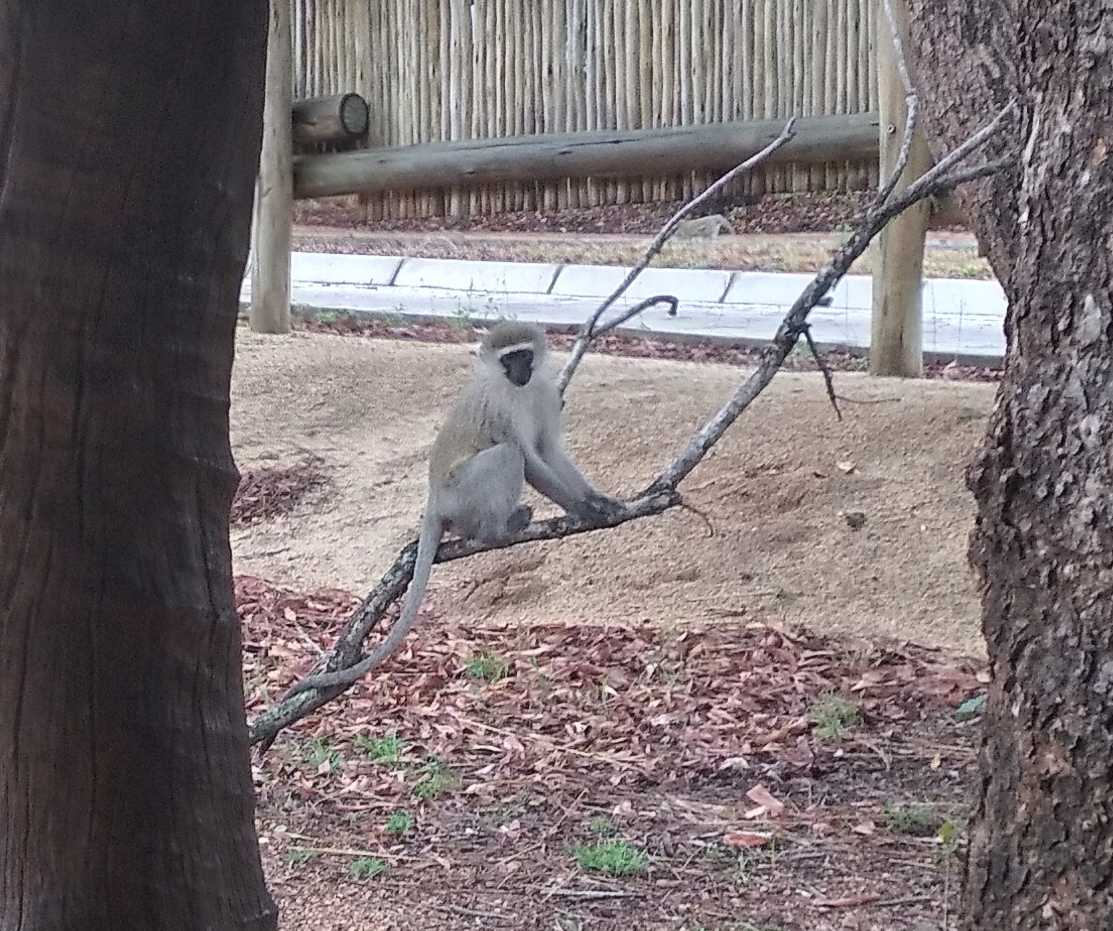
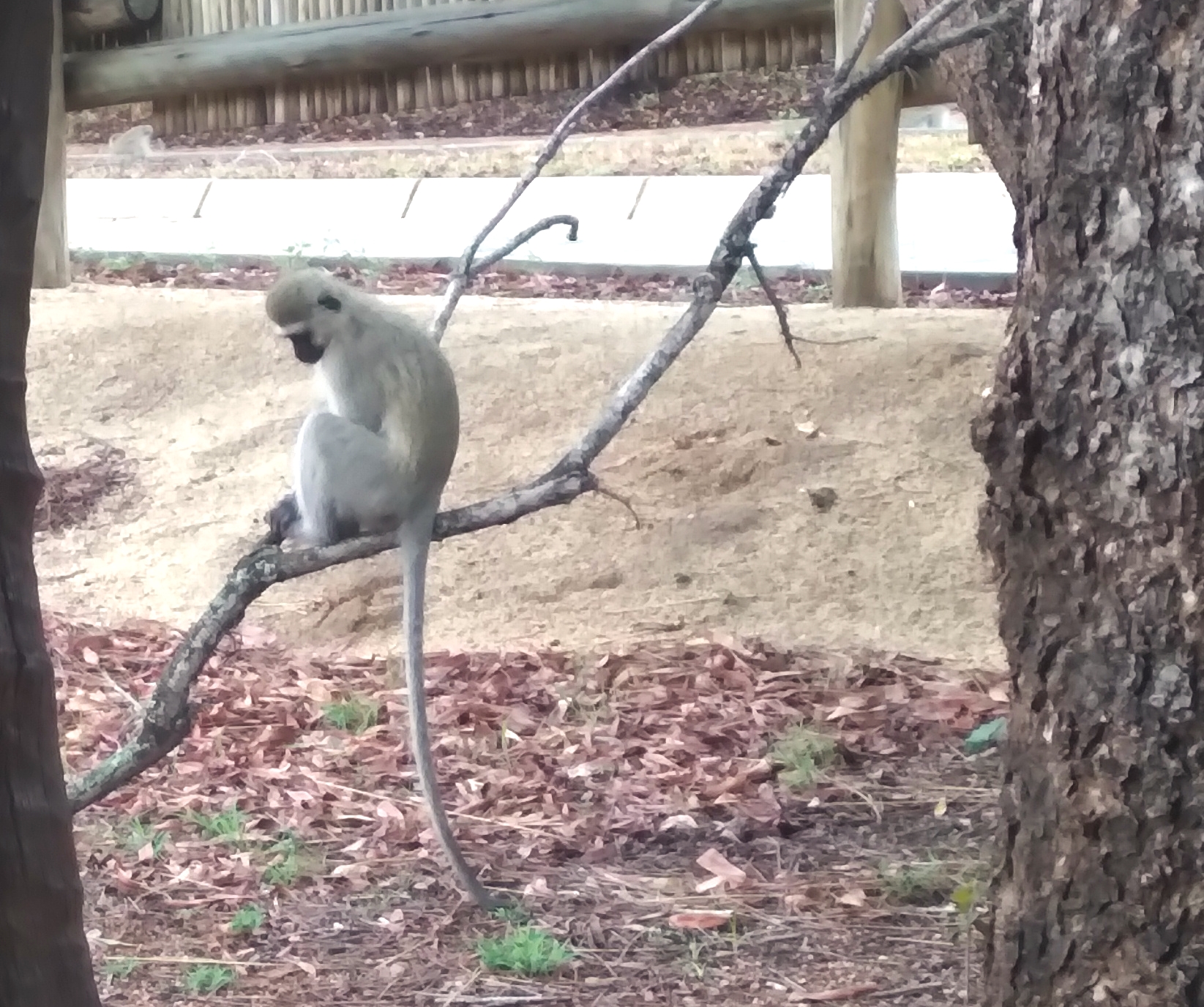
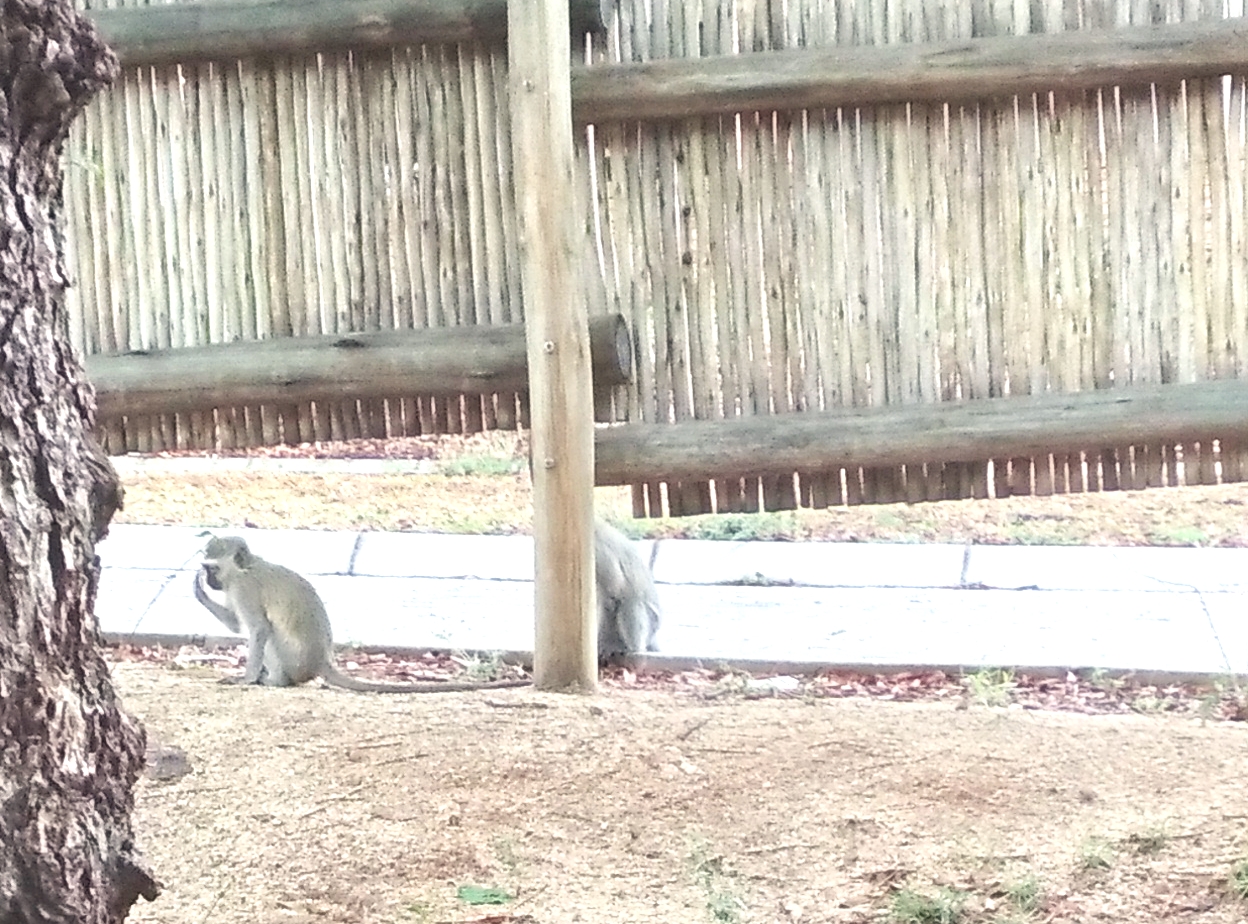
Cheeky monkey, pensive monkey, planning the attack!
Once on the road our route took us along the H4-1 to Lower Sabie before turning north on the H10. Again, the H4-1 was fairly quiet, with a troop of baboons just waking up in a tree alongside the road and a vulture stretching its wings prior to flying off.
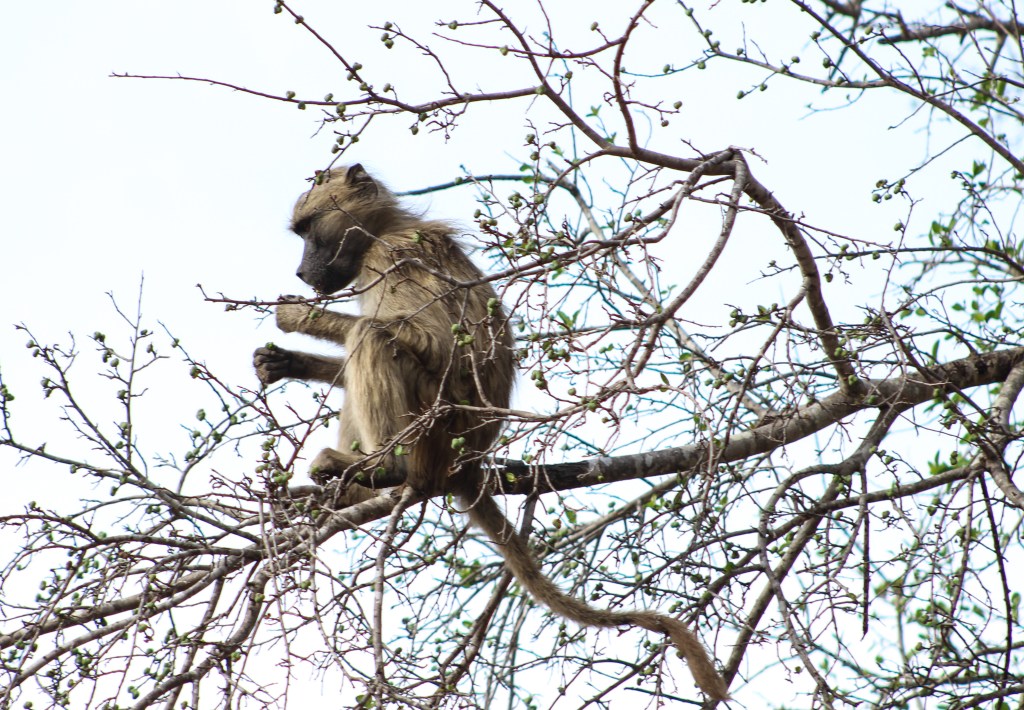
The S29 turned out to be an interesting road. It was quite difficult going after the rain of the night before and we kept going from side to side avoiding the worst puddles, which proved fortunate as we soon noticed considerable activity in those puddles. First, we noticed hundreds and hundreds of flying ants emerging from everywhere, then we saw those on the ground were being pursued by something that looked like little scurrying balls. Looking closer, we realised that they were some sort of frog or toad but again without our amphibian book we didn’t know what they were.
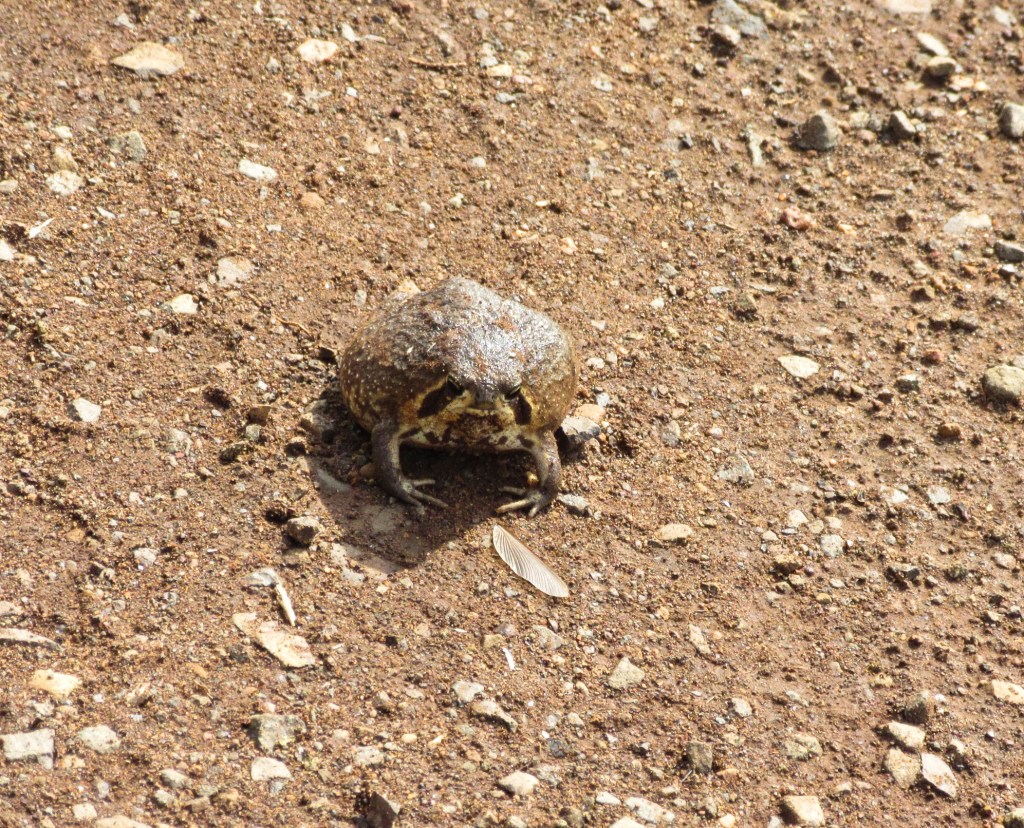
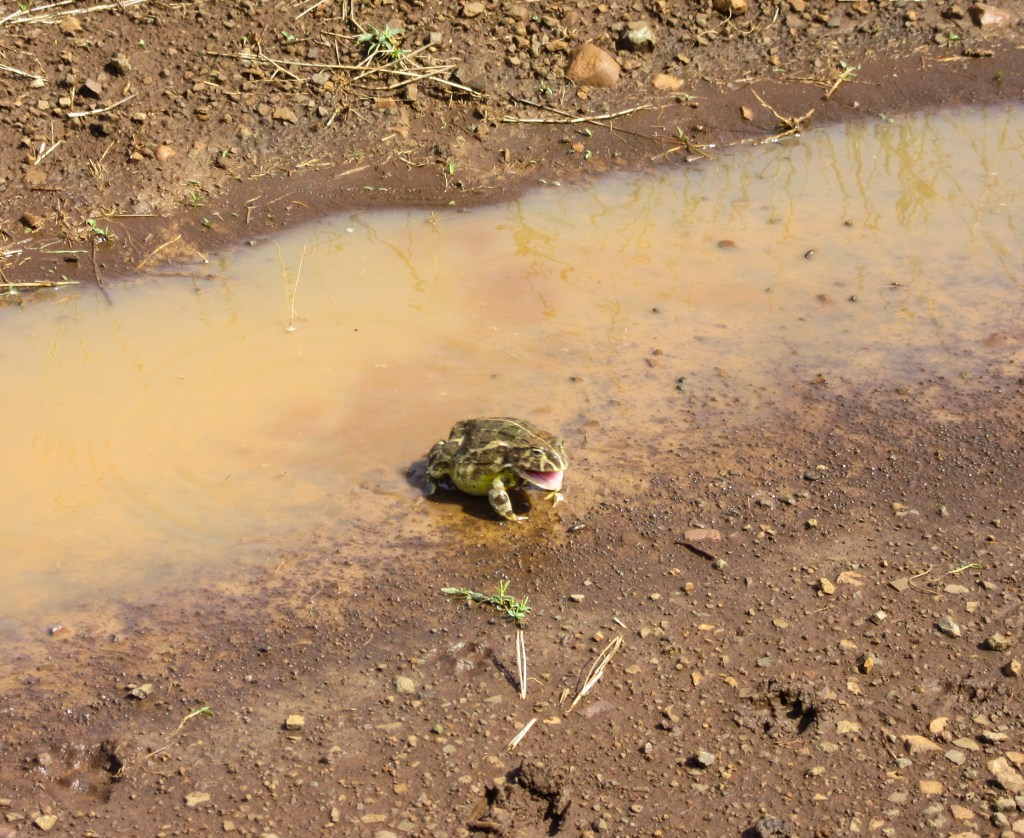
A bit further on we also noticed that there was more than one species and the second species looked and behaved more like a conventional bull frog in that it hopped rather than waddled. For several kilometres we had to drive very cautiously trying to avoid running over these creatures leaping all over the road. When we were back home, we checked up on these species and found that the little round balls were Bushveld Rain frogs and the more conventional looking ones were African Bull Frogs.
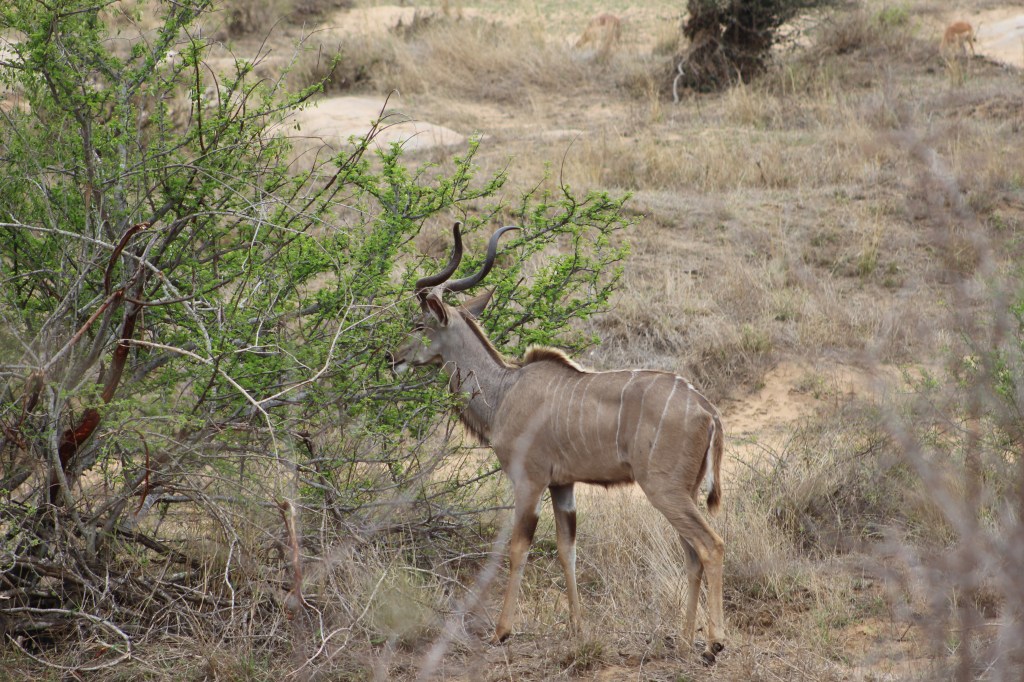
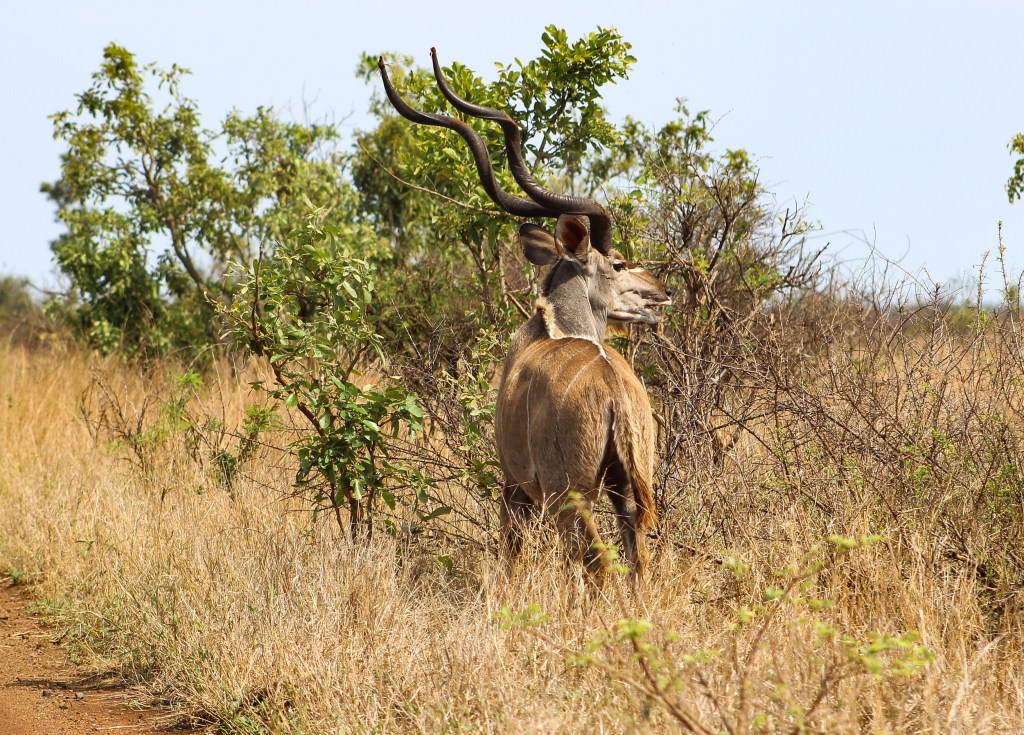
A little later we stopped to photograph a kudu with extraordinarily long horns browsing next to the road.
The road (S29) continued through largely open savannah grasslands. We were aiming for the Mlondozi Picnic site for our last traditional coffee and condensed milk ritual. The picnic site is also a spectacular view site as it is situated on top of a hill overlooking the Mlondozi Dam. We set up our little gas stove under the covered terrace with a view looking down to the dam and waterhole, where there was a huge flock of yellow-billed stork and one lone heron in the middle of them, playing the part of a preacher in the midst of his flock.
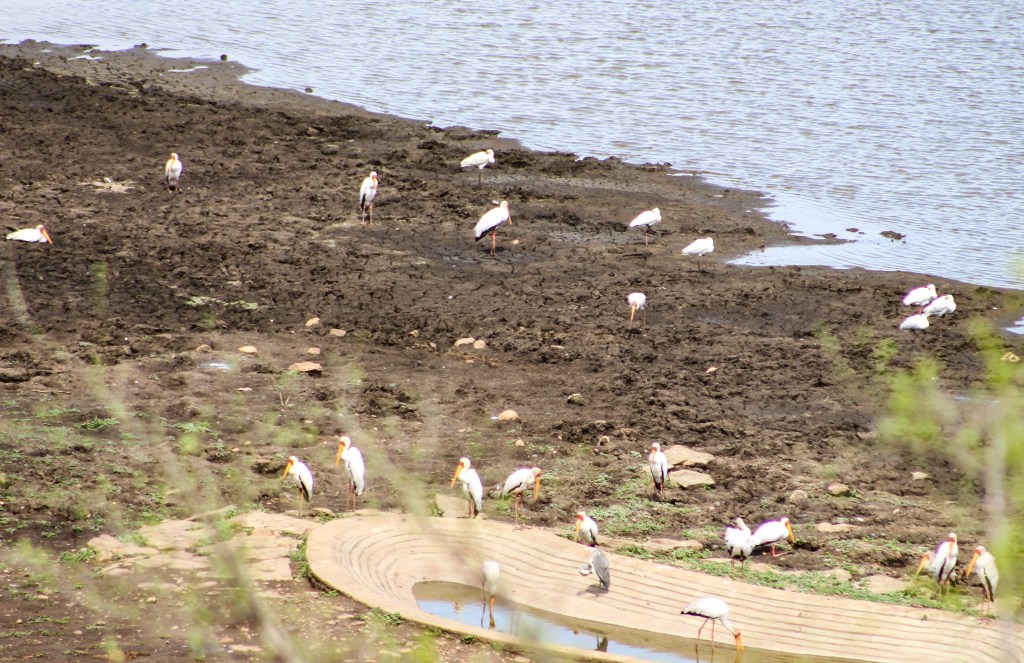
We really enjoyed taking in the view and relaxing there for a while and were quite reluctant to leave but we did continue, heading a bit further north on the H10, which parallels the Mlondozi River.
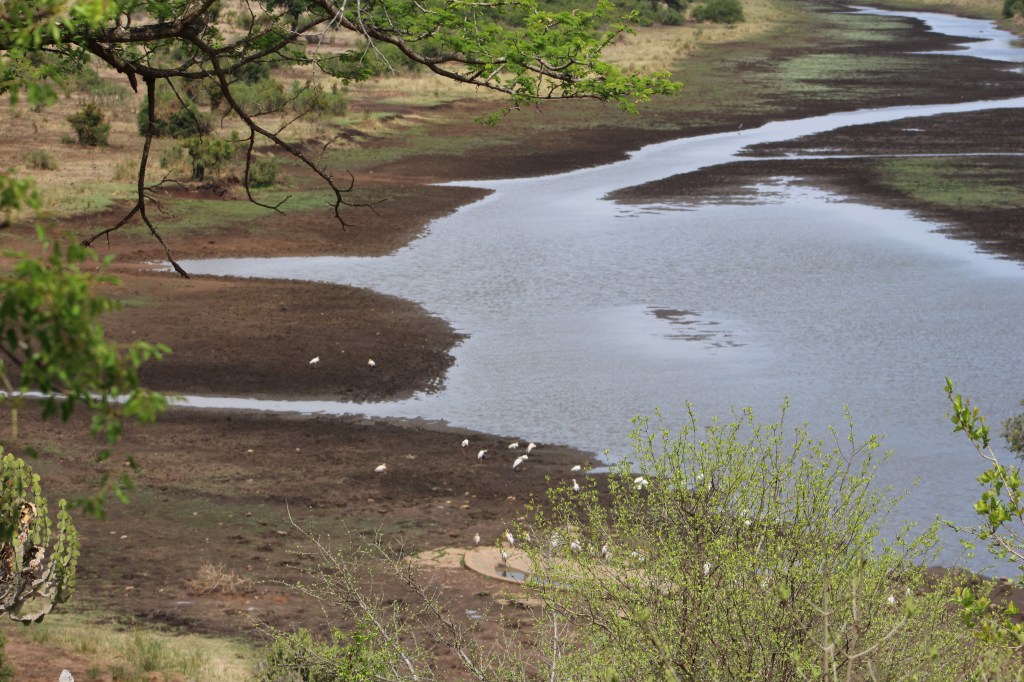
Then we turned west, then south, working our way back towards Skukuza. At the turning onto the S30, we pulled into a little loop above a small river to have a second cup of tea and immediately saw two little klipspringers standing on the edge of the road just above the slope down to the river. We parked far enough away so that we didn’t disturb them but still had a good view. We were able to watch and photograph them pottering around for some time before they finally moved off out of sight.
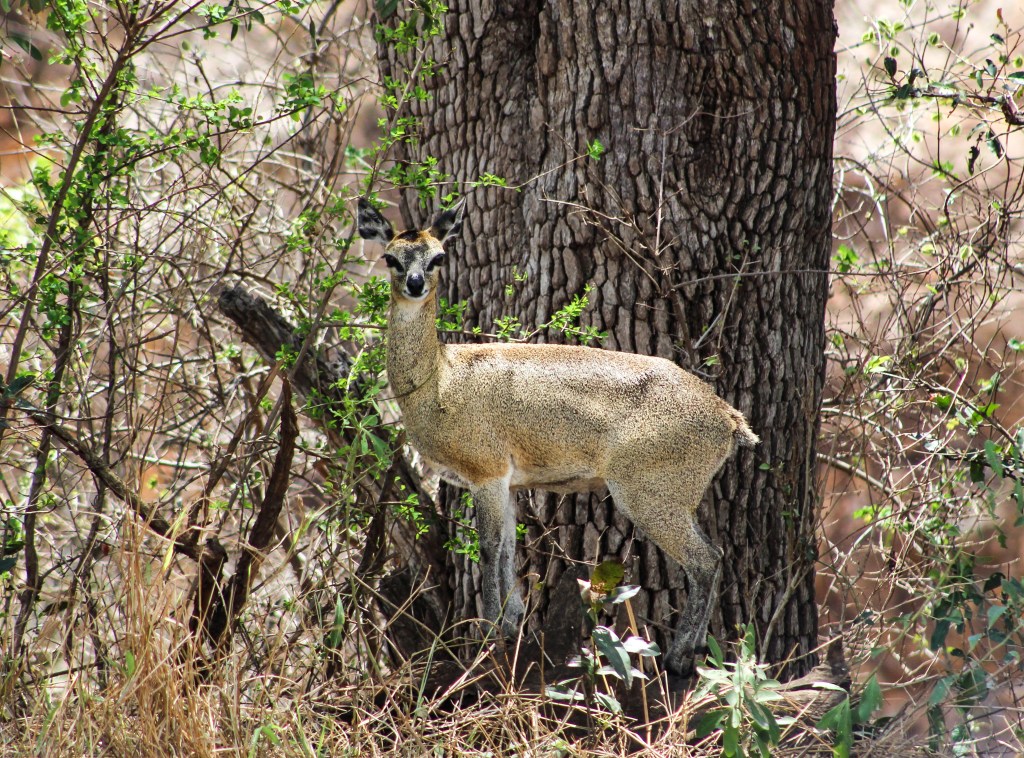
We went back to Skukuza along the S30, H12 and H1-2 but the animals seemed already to be keeping their distance and lying low in the heat of the day as we saw very little.
The rest of the day was spent in camp, having a swim in the pool, which was close to our bungalow, buying a few gifts in the Parks shop and eating ice cream overlooking the Sabie River. We saw a few very colourful Southern tree agamas ….
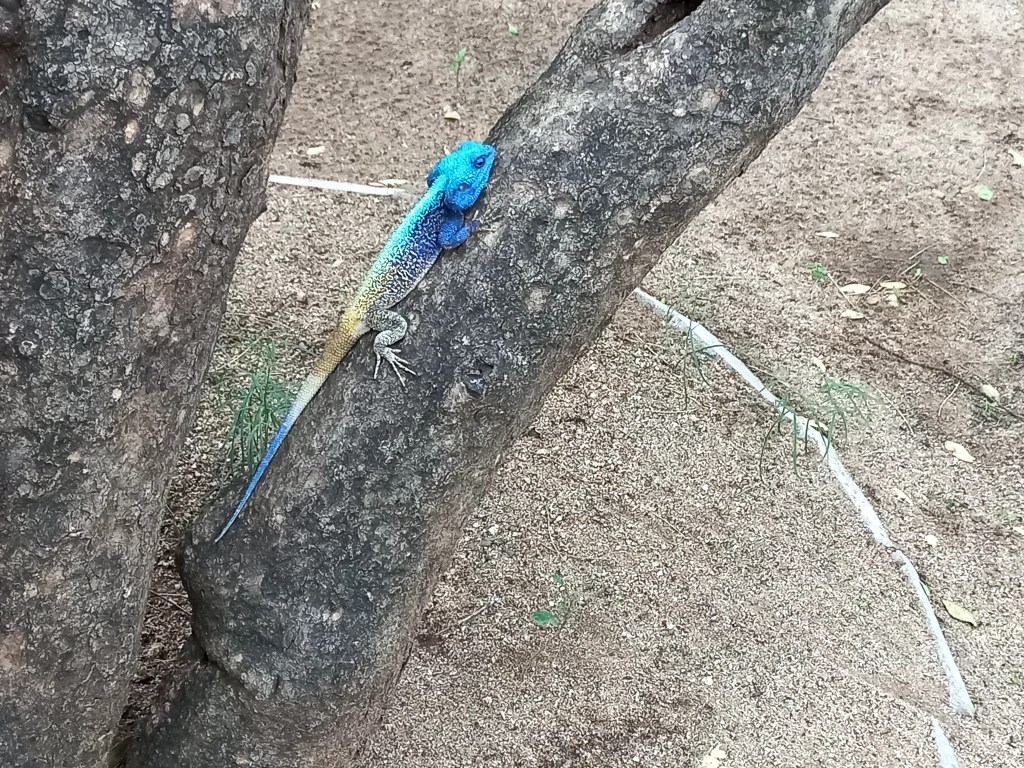
……. and watched a herd of buffalo wandering along the river and wading to and from the islands in the riverbed.
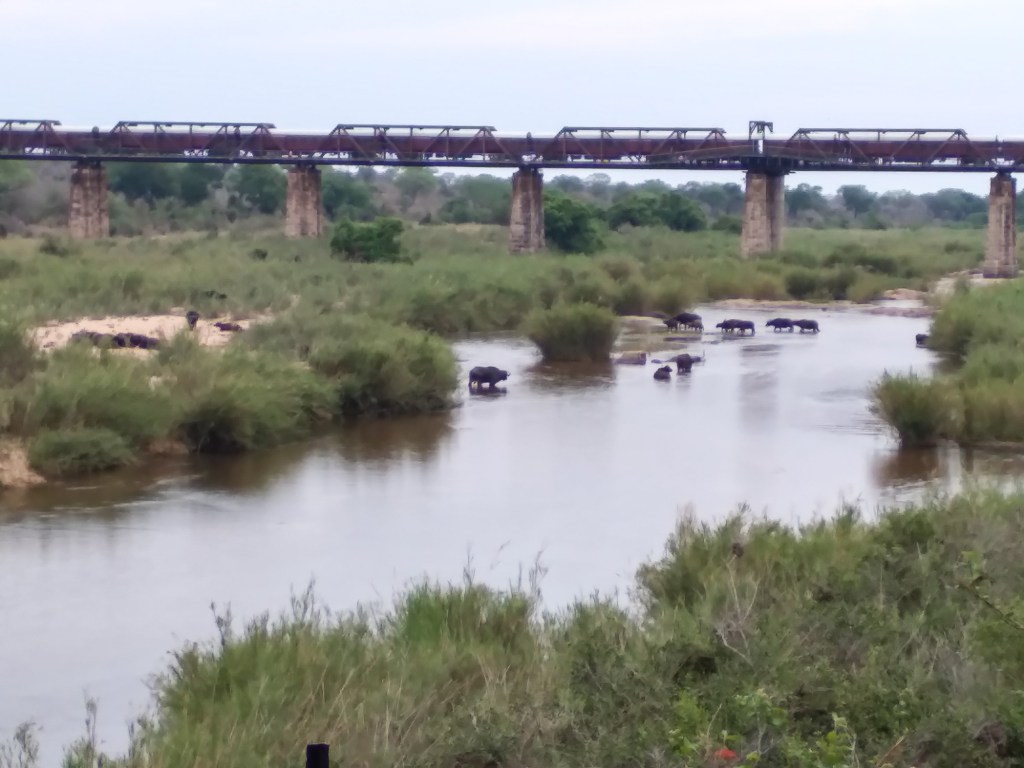
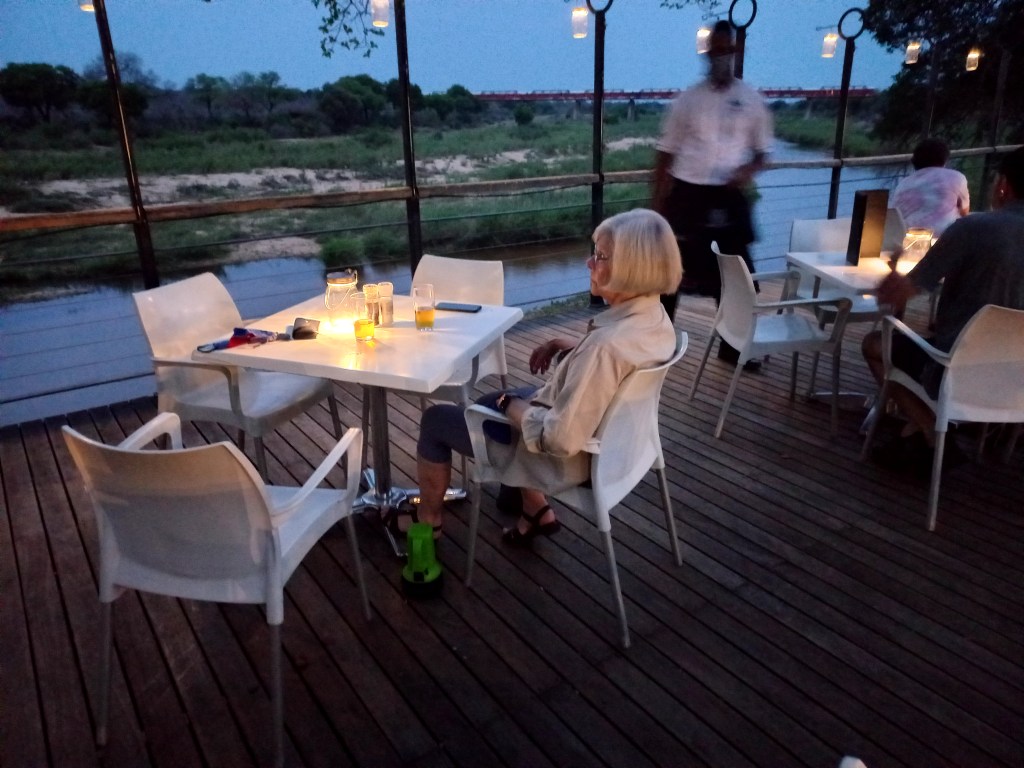
Later we returned to the Cattle Baron restaurant for a beer as the sun went down. The buffalo were still there, some settling down for the night next to the river. We sat and watched as the dusk fell and one by one the little solar powered lights came on surrounding the terrace with an almost fairy-like glow. On our way back to our bungalow we disturbed a raiding party of banded mongoose intent on finding some carelessly unguarded food.


Lovely to see and very interesting.
Thanks Dot.
LikeLike
Thanks and glad you enjoyed it! Hilary
LikeLike