Part 2 Civitavecchia to the island of Rhodes
In comparison with other experiences we have had in checking in to our cruise, this was amazingly quick. There was almost no queue and all the necessary processes were very streamlined and before we knew it, we were on board! We found our cabin and dropped our hand luggage there (the big suitcases would be delivered later) and made our way up to the top deck buffet for a late lunch.
The Queen Victoria belongs to the Cunard line and is one of the newer ships. She is also the smallest of the range at 90 049 gross tonnage. The ship was built in the Fincantieri dockyards in Venice, starting in 2004 and completed in 2007. She can accommodate just over 2 000 passengers and about half that number in crew. The Queen Victoria is an essentially British ship – elegant but understated and very comfortable. We had a cabin on the portside on deck 7 with a small balcony. The Britannia Restaurant at the stern of the ship is the main dining room but the Lido Restaurant on deck 9 was where we preferred to have breakfast and lunch. The ship also boasts a typical English pub called the Golden Lion. In the afternoons an elegant tea is served in the Queen’s room, with white coated and gloved waiters bringing round a selection of scones and cakes with a choice of teas! Overall the décor is reminiscent of the Victorian era but with all modern conveniences as well.
After a quick lunch we went out on deck to admire Civitavecchia from a different perspective and to watch the comings and goings in the harbour.
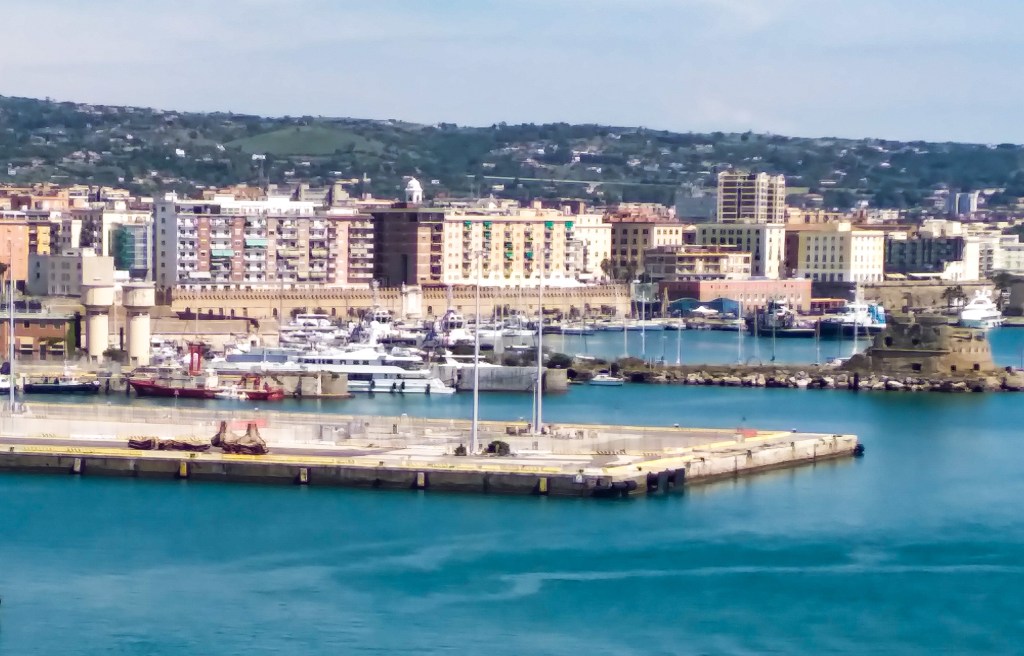
Our sailing time was not until 6.30 but a couple of other cruise ships got underway before we did so we watched them depart and head out onto the ocean. We also wandered around the various different venues on the ship. The Commodore Club up on the 10th deck and facing forward has lovely views of the ocean ahead, while the Winter Garden is midships and has a cosy atmosphere when the weather is cooler. Another nice feature of the Queen Victoria is the small library, with a selection of novels, non-fiction books and reference works, including a large sized atlas. This was very useful during our cruise, especially when navigating among the Greek Islands. We also checked out the times of the evening show in the Royal Court Theatre and decided to have a fairly early dinner and go to the 8pm show. The main dining room is the Britannia Restaurant on Decks 2 and 3 at the stern of the ship and it is good idea to get there in good time to get a table for two if you don’t want to share!
Having found our way around the ship we headed back to our cabin to unpack and have a quick rest before changing for dinner.
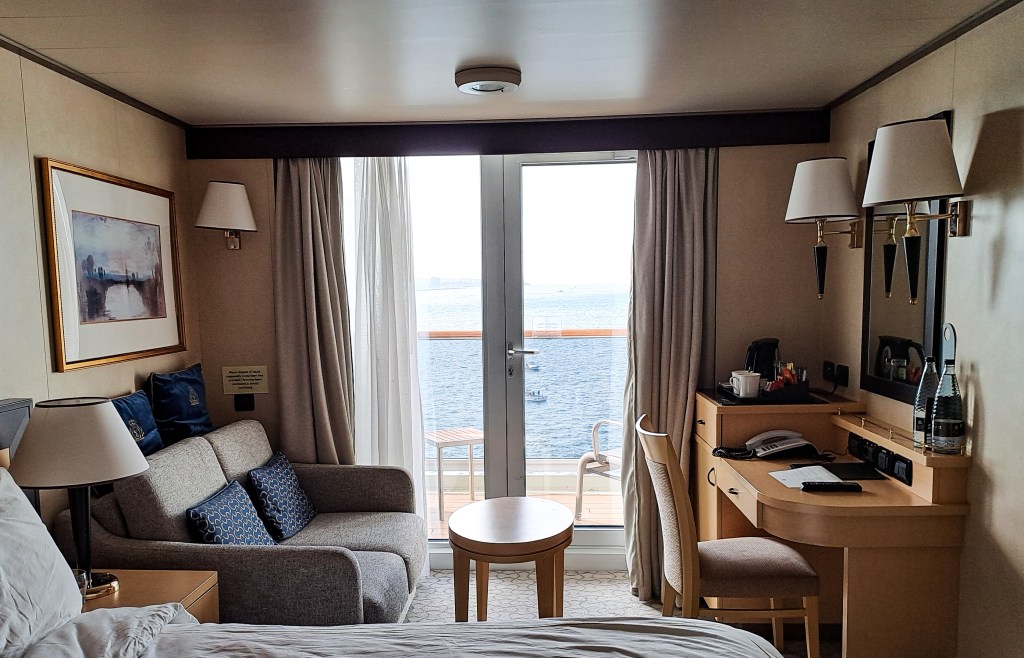
As on most cruise ships you are expected to dress reasonably smartly, especially if you go to the main restaurant. Dress code for the buffet on the higher deck is much more casual. By the time we were ready for dinner the ship was heading out of the harbour and into the Tyrrhenian Sea.
We enjoyed our dinner a little too much and had to rush to the Theatre, where the show had already started! The performer was a woman flautist, Suzanne Godfrey and her repertoire was lovely relaxing music, both popular and classical.
After the show, it was back to the cabin for our first night at sea.
1st day at sea
We woke up somewhere off the west coast of Italy, cruising steadily along in calm seas. We made a cup of tea in the cabin and got up leisurely before going up to the breakfast buffet on deck10. As on other cruises we have been on, there was a huge range to choose from, from all kinds of fruit, cereals, eggs and egg dishes, American style, English style, toast, croissants, etc etc! Not to mention teas and coffees!
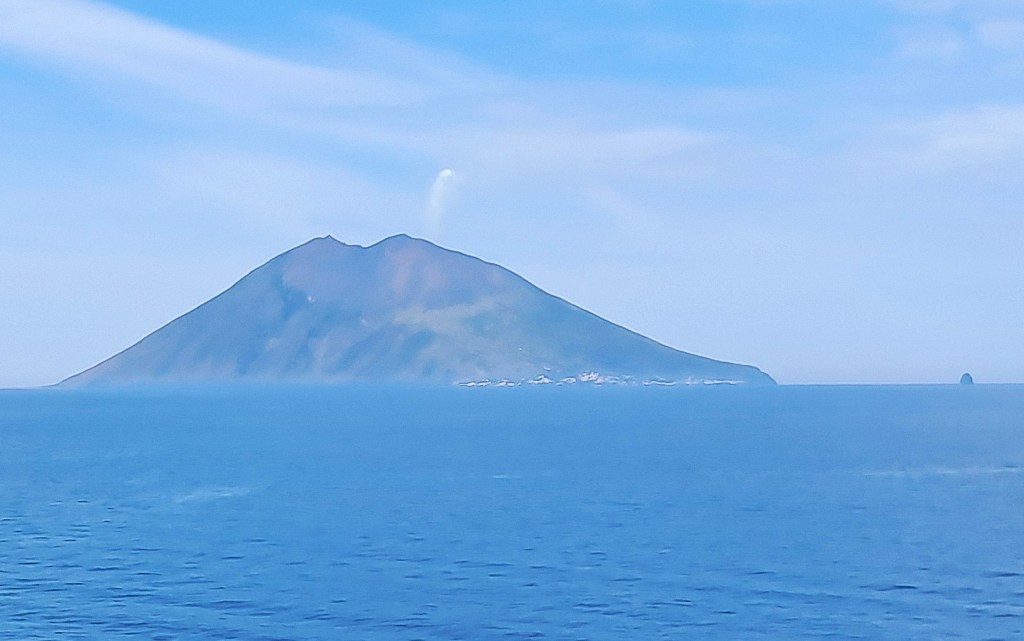
After breakfast we wandered around the decks getting some exercise and fresh air. Around midday we noticed we were cruising past an island that appeared to have a stream of smoke issuing from its summit. It took a few moments to realise that it was probably Stromboli, a volcanic island a few miles off the coast of Calabria. The island is less than 13sq km in size and the part above sea level represents the top third of the volcano. It has been in almost continuous eruption for more than 2000 years. The activity is almost exclusively explosive with only a few known lava flows. There are a few hundred people living on the island although in the early 20th century the population was a few thousand. The island is nicknamed the ”Lighthouse of the Mediterranean” because it is constantly active and this activity can be seen not only on the island but from the sea and even on the coast.
Less than an hour later were approaching the coast of Sicily and the Straits of Messina, the narrow waterway between the island of Sicily and the toe of Italy. Because it is such a narrow channel, the ship had to come almost to a stop to allow a pilot to come on board to navigate the ship through the deepest part of the channel.
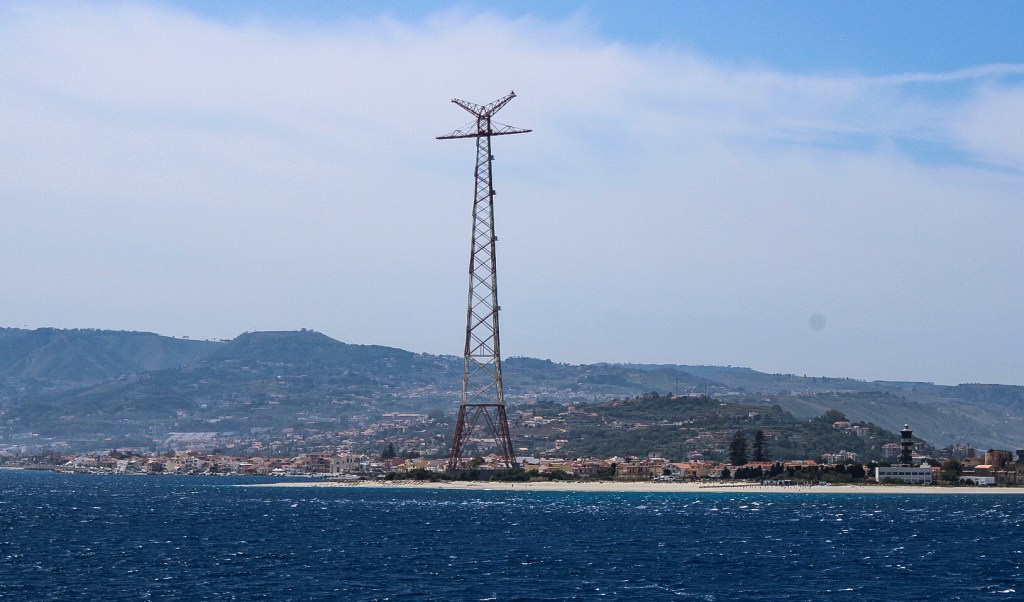
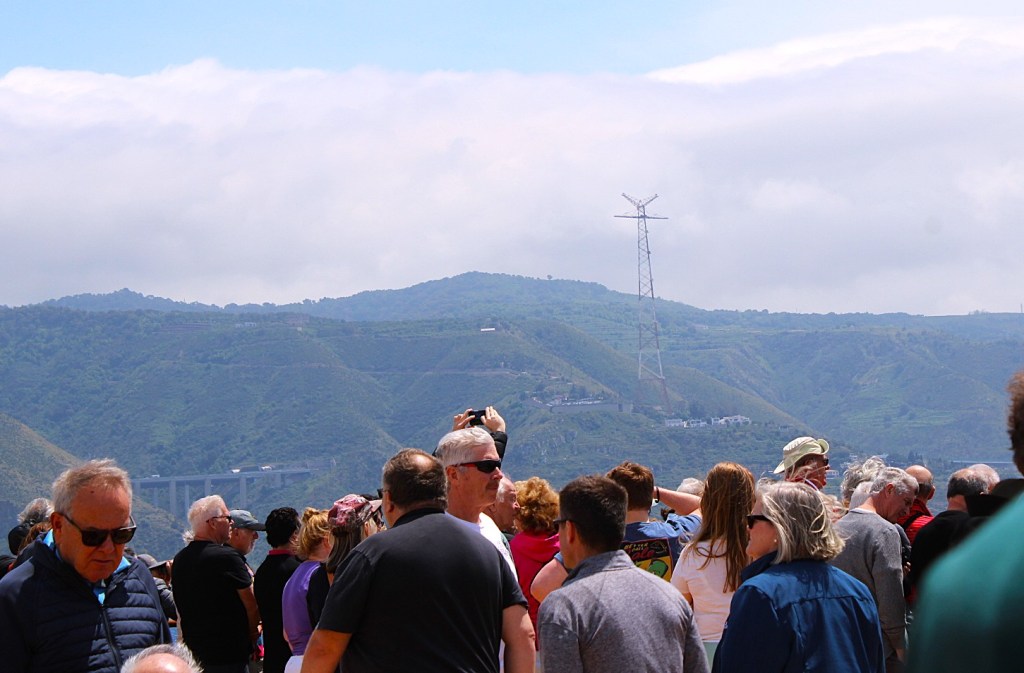
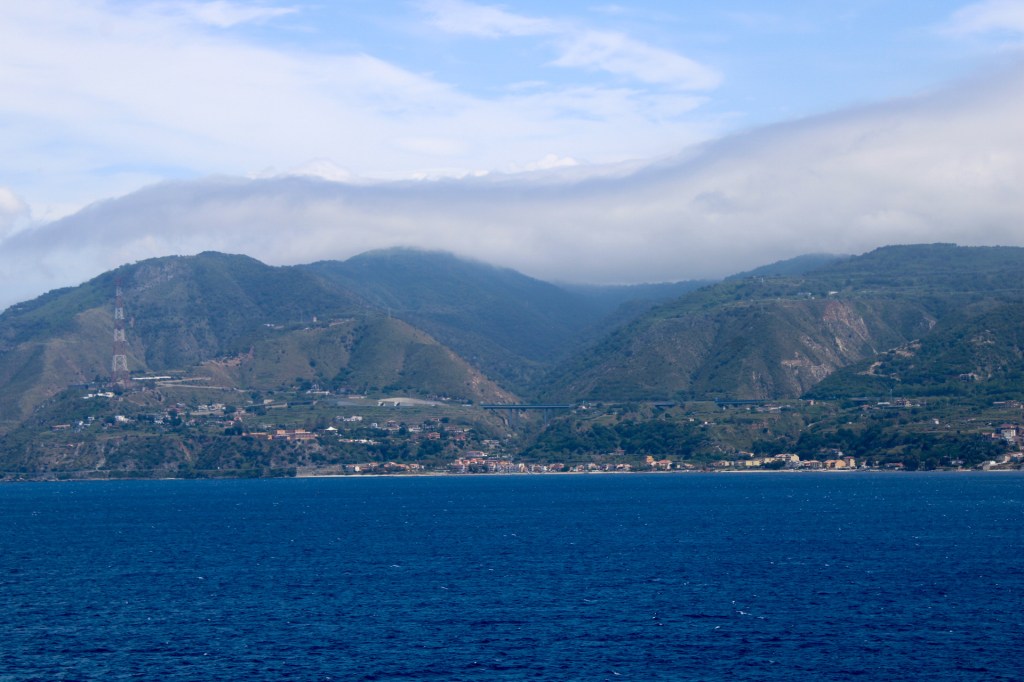
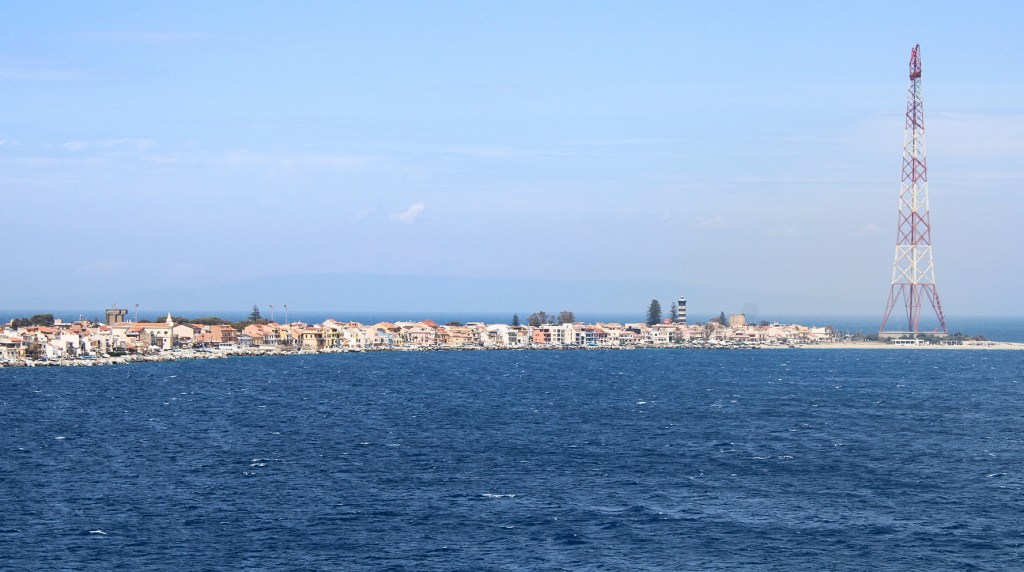
So that passengers could get a better view of the passage through the channel, the foredeck on level 5 was open to everybody. Normally this is a crew only area. We did spend a bit of time out there but it was incredibly windy and fairly crowded with people trying to take photos so we didn’t stay that long.
It was interesting to see the contrast of the white walls and red roofs of the Sicilian town of Messina to the west and the wooded hills of Calabria to the east. Plans for a bridge linking the two sides have been discussed since the middle of the 19th century but, despite Silvio Berlusconi’s assurance that building would start in 2009, nothing has yet happened!
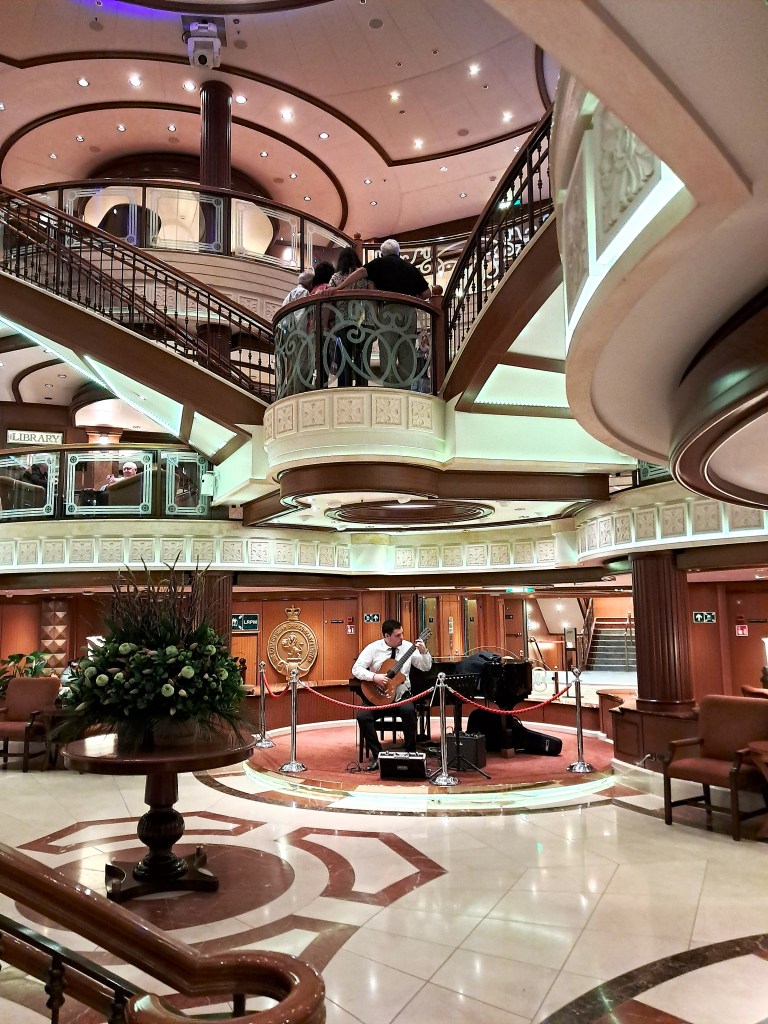
The evening’s attire was Black and White Evening dress but as we were not prepared for dressing up, we opted for dinner in the buffet upstairs. Before that, though, we wandered down to the Grand Lobby and listened to the classical guitarist Joao Carvalho for a while.
After dinner we enjoyed the show put on by the Royal Court Theatre Company of music and songs from various musicals.
Day 3 of the cruise
The next day, another day at sea, was even more lazy as we cruised across the Mediterranean towards the Greek island of Rhodes. We went to a talk about what to expect on our visit to Istanbul and another on Ancient History. We pottered in the Library and consulted the enormous atlas to see where we were and what we would be passing through on our way to Rhodes and then on to Ephesus and Istanbul. In the afternoon we had a formal tea in the Queen’s Room, where the classical guitarist was playing suitable tea time music. This occasion is definitely reminiscent of a bygone era but probably one that took place on all the Cunard ships in the past. The head waiter showed us to a table for two and asked us what type of tea we would like. Other waiters were circulating with trays of little sandwiches, small cakes and scones with jam and cream. So English and Victorian but a good tradition to be followed!
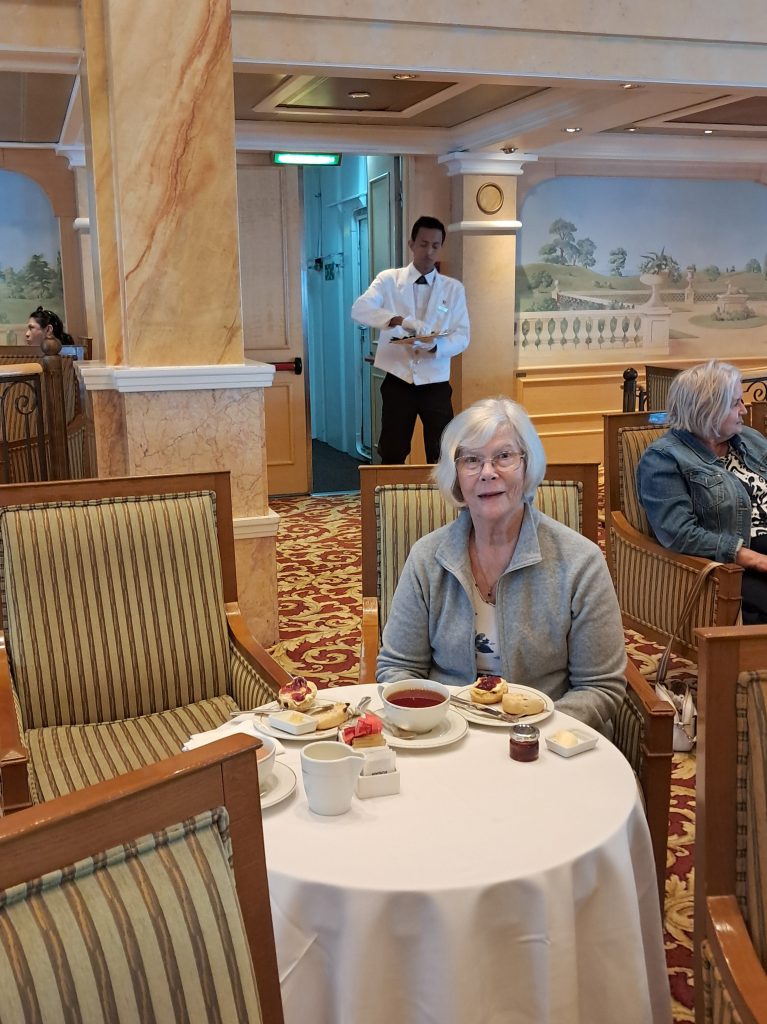
After tea, to walk off the teatime treats and work up an appetite for dinner, we did a powerwalk around Deck 3. Here you could walk all around the ship passing through a special passageway in the bow of the ship. Three times round was equal to one mile!
We had dinner in the main restaurant again, as it was not a black tie evening. The show in the Royal Court Theatre was a comedy/pianist act performed by Jon Courtney.
After the show we wandered through the Winter Garden and paused for a few minutes to listen to the Foggy Folk Duo singing the Irish country songs. We were beginning to know which musical offerings we liked and looked out for where they were being performed. One that we enjoyed particularly was Habit To, a husband and wife team from Durban, South Africa.
Day 4 brought us to the island of Rhodes. We docked before 8 in the morning but, as we had not booked a specific tour, we got up fairly leisurely, had breakfast and then got ready to go ashore. The weather was beautiful and promised to be a very hot day so we were covered with sunscreen and hats before heading out.
It was a short walk from the ship to one of the entrances through the walls of the old town of Rhodes.
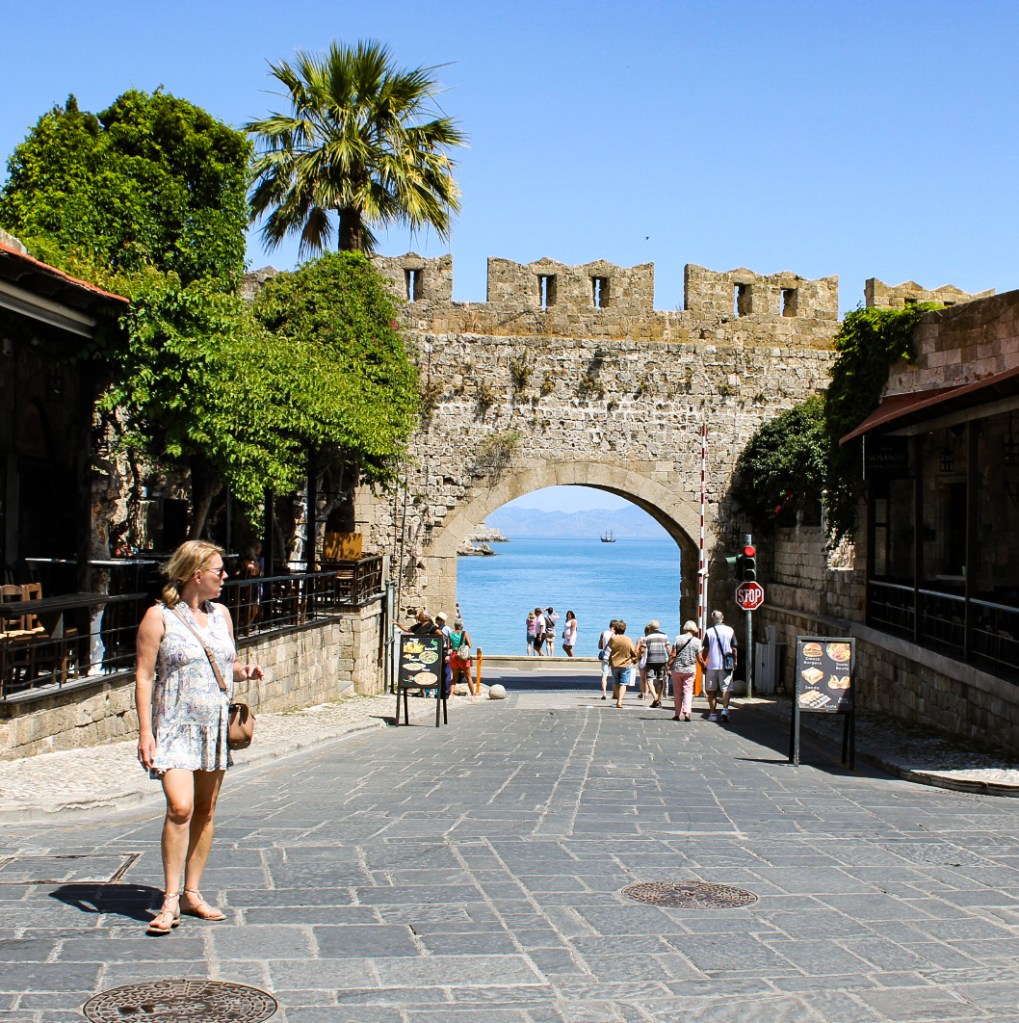
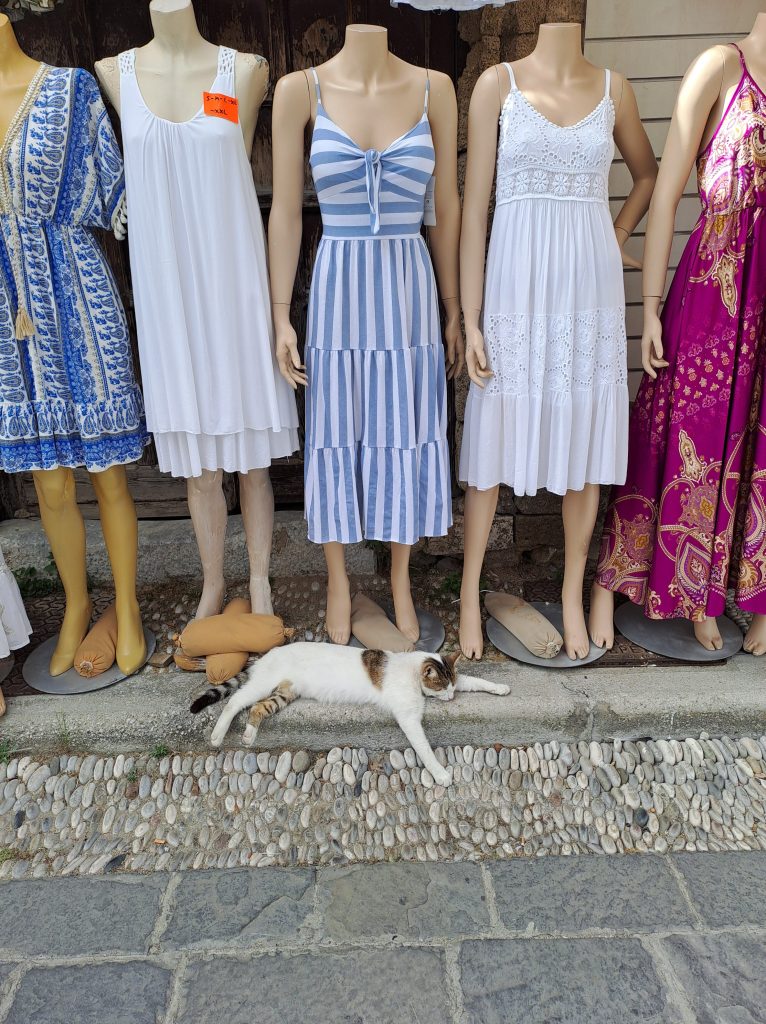
We were immediately struck by the huge number of people wandering around as well as all the stall sellers trying to get people to buy from them. It was a market place with a vengeance! We walked on quite a way hoping to get beyond the crowds and into a more tranquil part of the town.
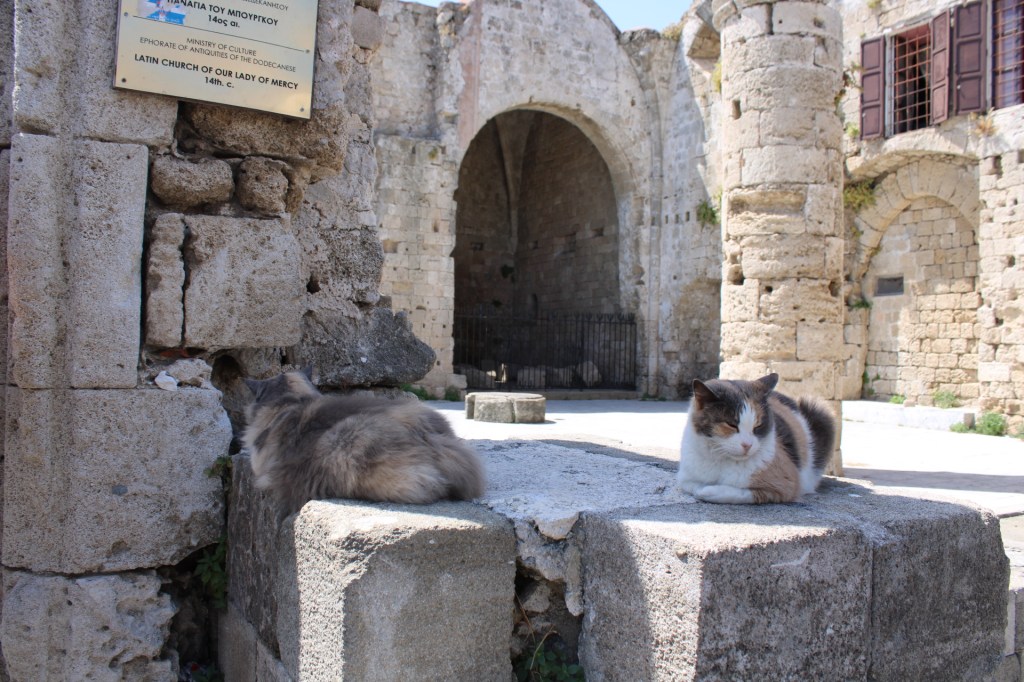
However, the cats didn’t seem to mind the crowds!
We started heading uphill to get away from the crowds and, after passing a large mosque, spotted an interesting looking tower at the top of the hill. This is the Roloi Clock Tower. The base dates back to the 7th century but the top part was rebuilt about 150 years ago after suffering damage. The views from the clock tower gave us a good sense of the layout of the Old Town and we could see the Mosque of Suleiman on one side and the Palace of the Grand Master fairly close by on the other side, so that is where we headed next.
The Palace of the Grand Master is a very imposing building, with well-preserved towers and battlements. It had been destroyed in an explosion in the mid-19th century but eventually restored in 1940. We decided not to spend time going inside, partly because of the long queue but also because we had limited time to explore the rest of the town.
Instead we wandered down the Knight’s Street. On either side of the street are 7 large buildings. These represent the tongues or languages of the countries from which the Knights of St John came. They were also known as the Knights Hospitaller and were originally a Roman Catholic sub-order of the Benedictines. They were initially a charitable movement, building hospitals and caring for the poor, although they did become militarized and fought in the Crusades. In 1310 the Master of the Knights completed the planned takeover of the island of Rhodes and established accommodation for the 7 tongues, which can still be seen today. At the bottom of the steep street is the Hospital of the Knights of St John, which now houses an Archaeological Museum.
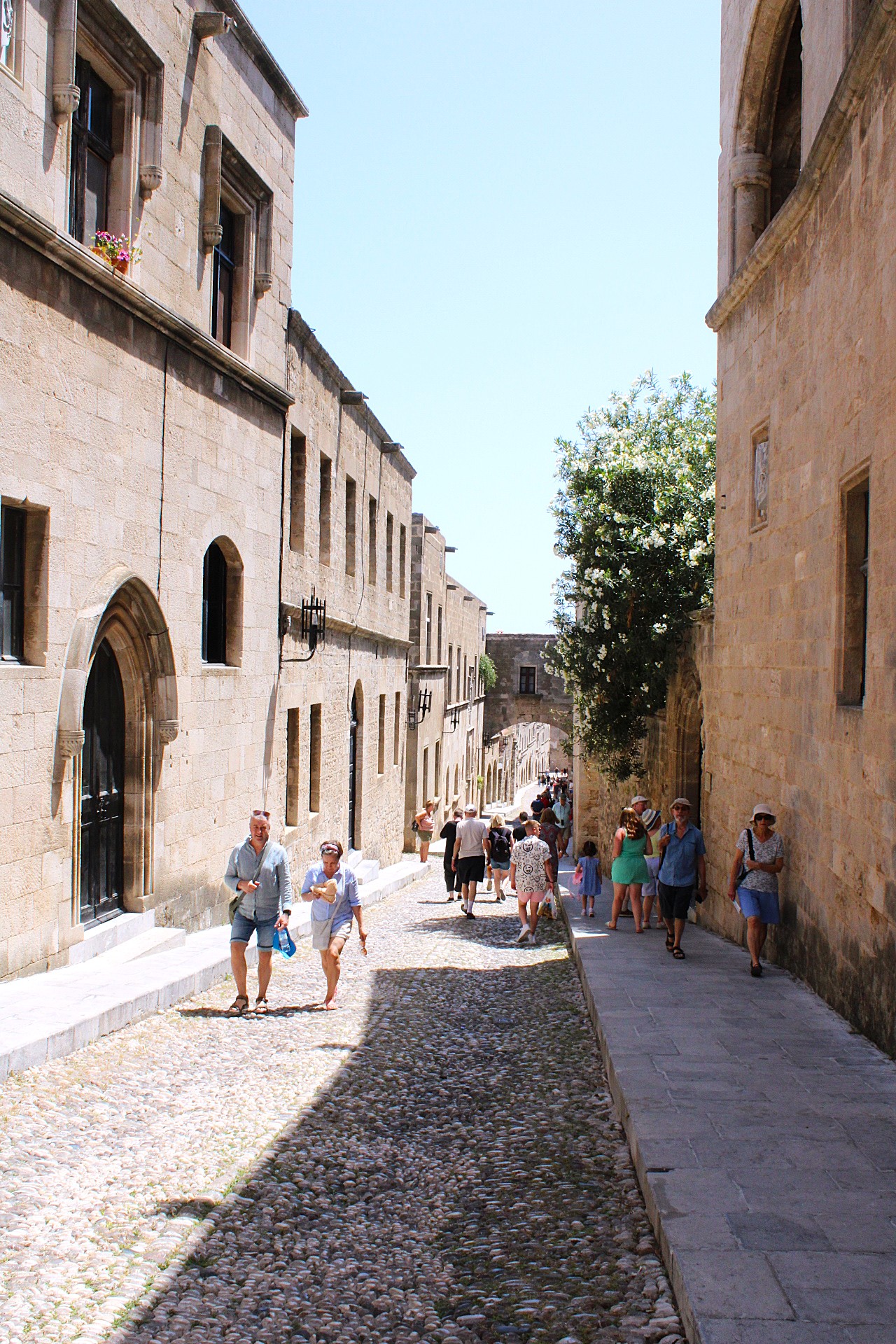
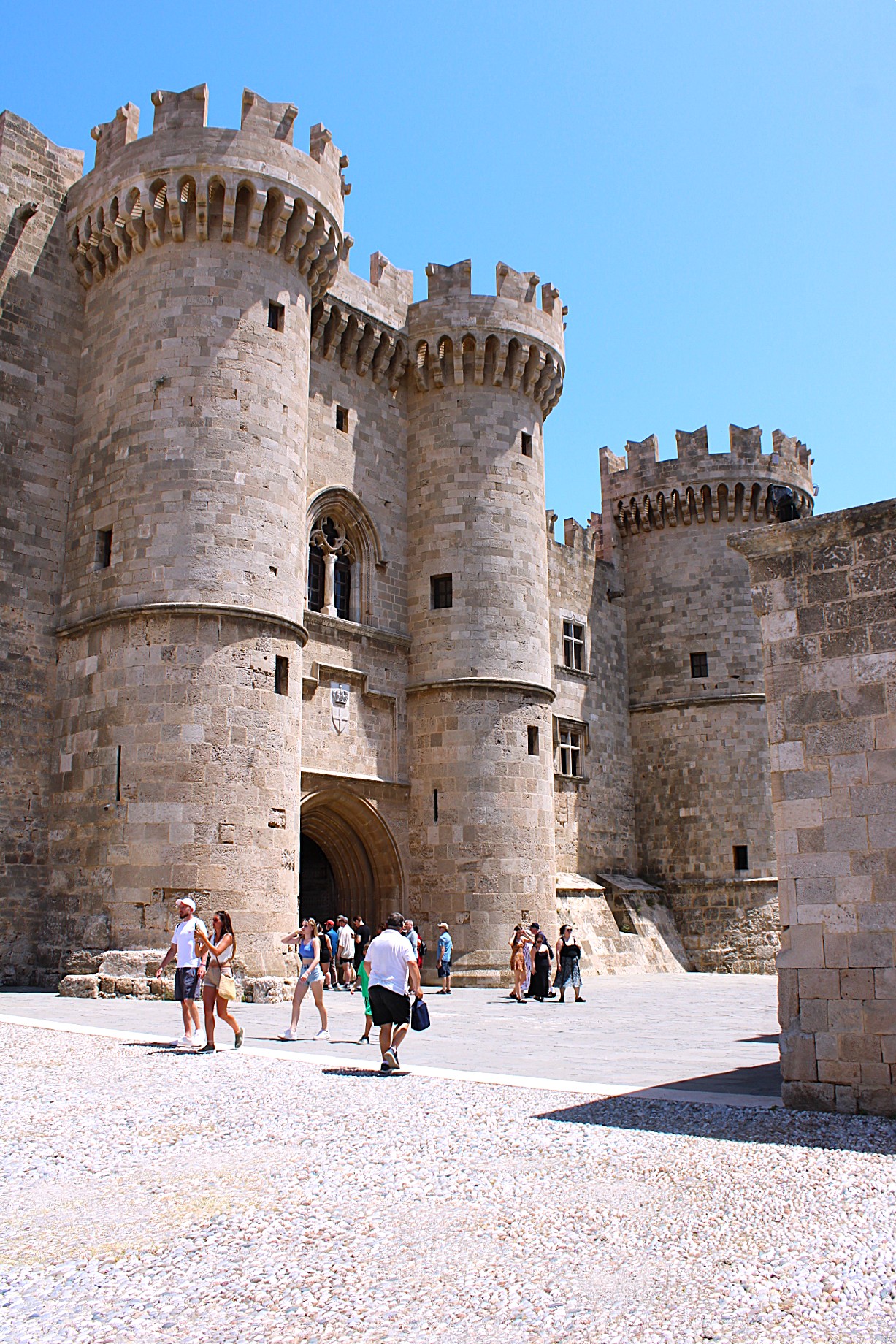
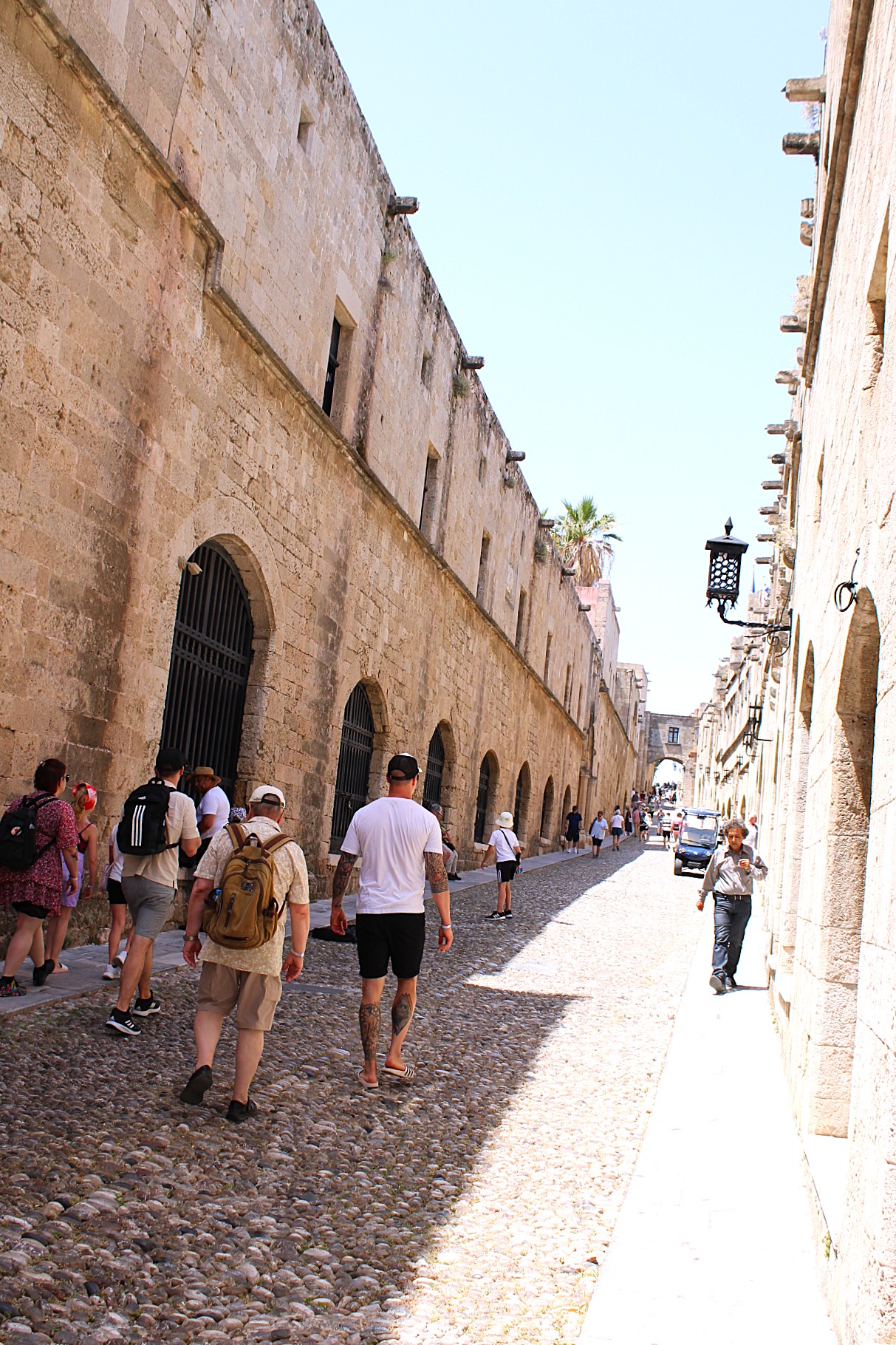
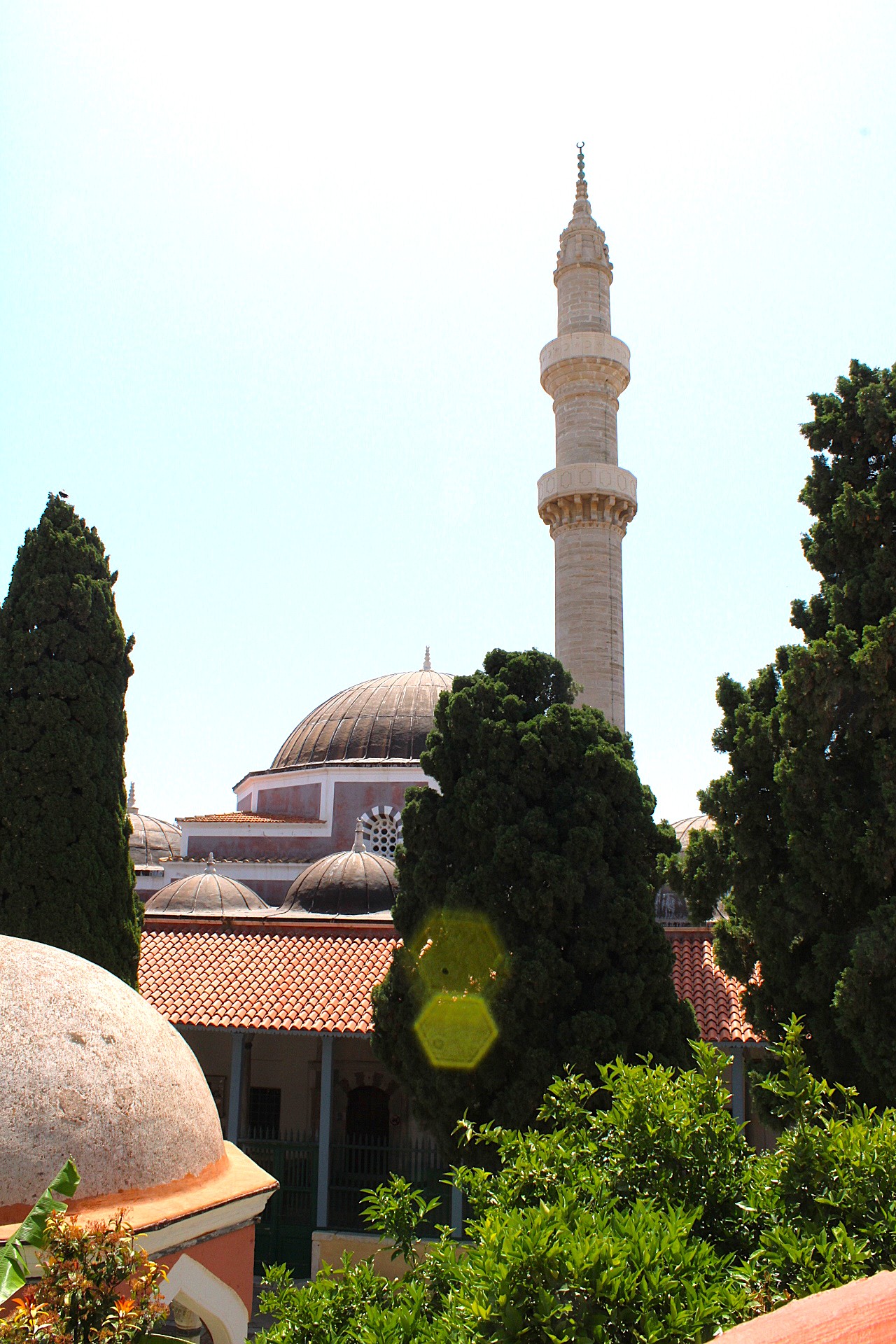
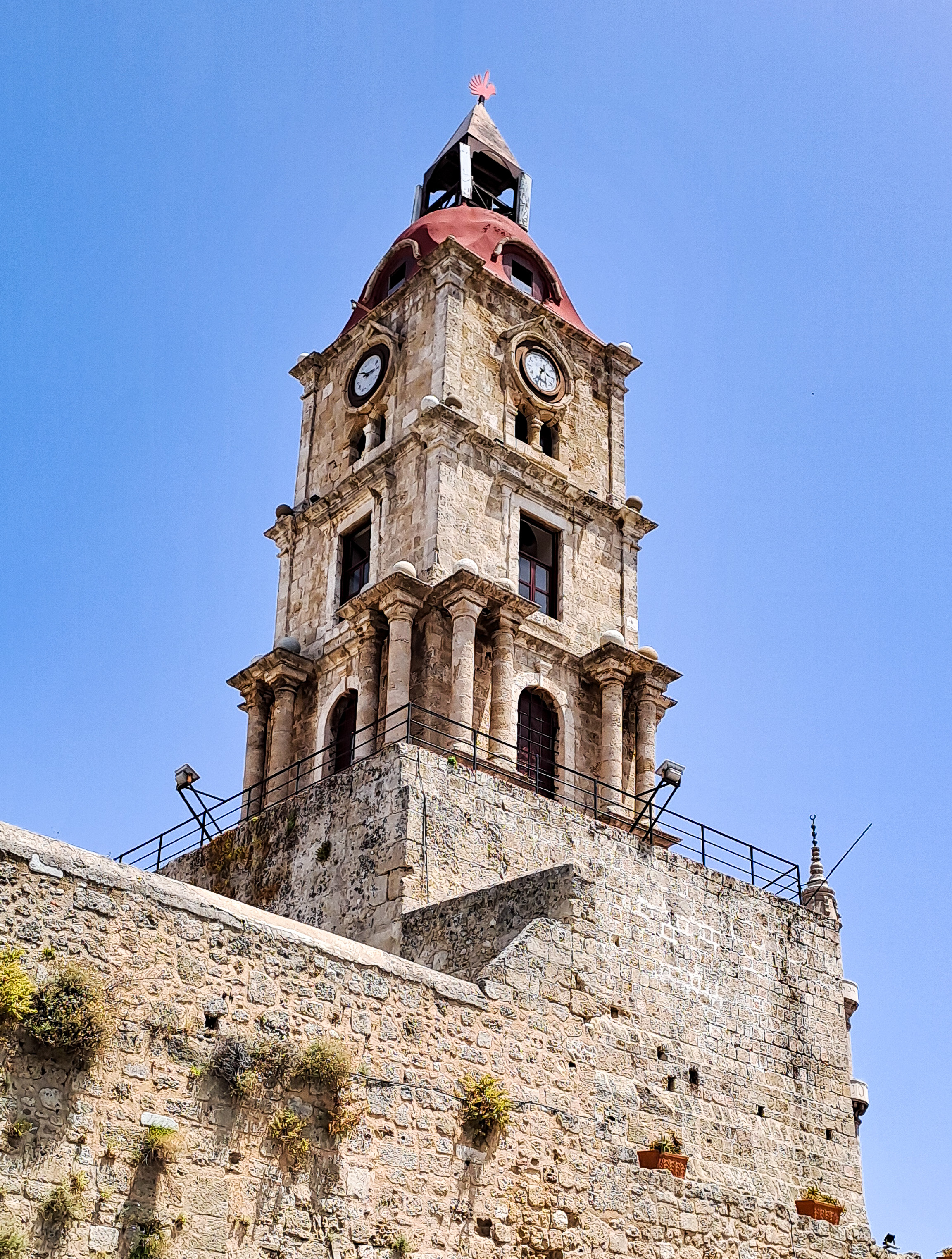
The photos above show, from top left moving clockwise, a street in Old Town, Rhodes, the courtyard entrance to the Grand Palace of the Master, Knoght’s street, the Mosque of Suleiman, the Roloi Clock Tower.
By this time it was time for a coffee! We exited the Old Town through another of the gates in the old walls – the Sea or Marine Gate – which led to the harbour. After the intense heat inside the walled part of the city, it was good to feel a sea breeze and we found a café where we could sit outside and enjoy an ice cold frappe.
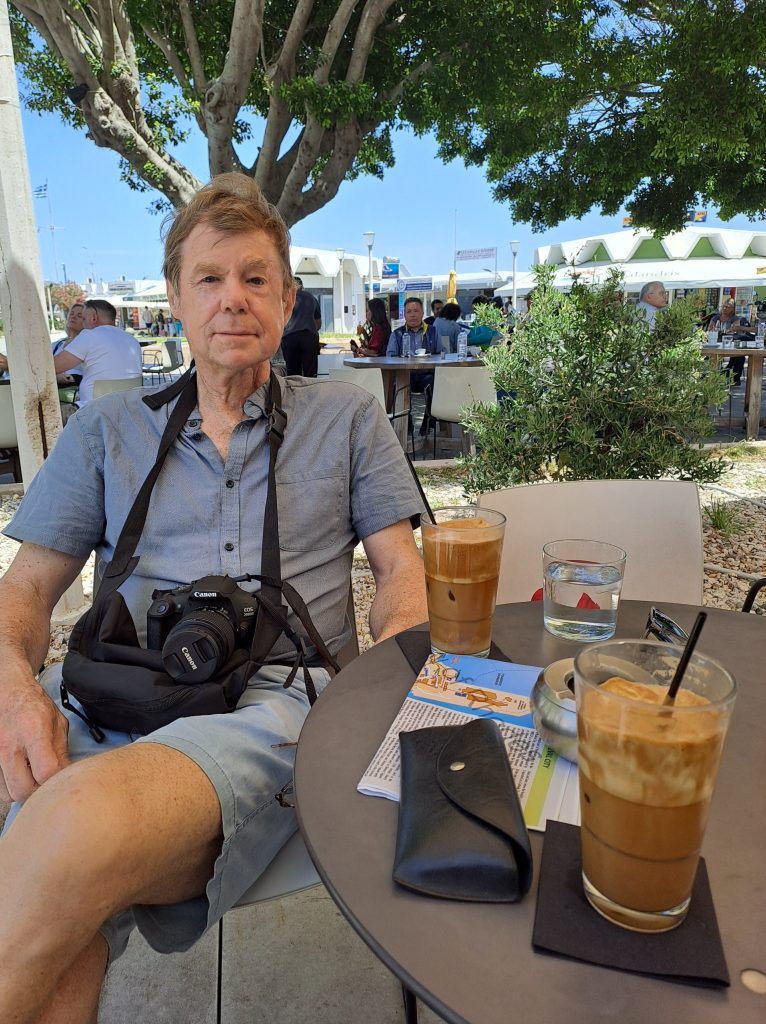
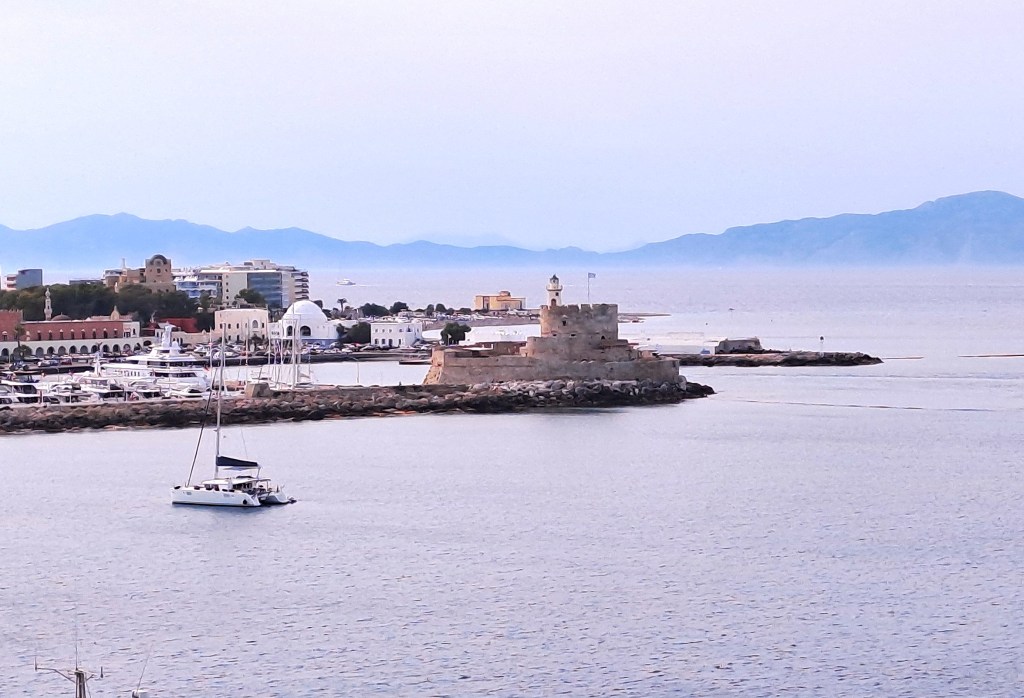
From the café we could see some strange-looking towers spaced out on one of the breakwaters. These are the only 3 of the windmills of Mandraki left.
They were built by the Knights of St John in the 14th century to grind the corn that was off-loaded from ships in the harbour. At the end of the breakwater is the Tower of St Nicholas. This also marks the point where the legendary Colossus of Rhodes is thought to have stood. It was destroyed in an earthquake in 226 BC.
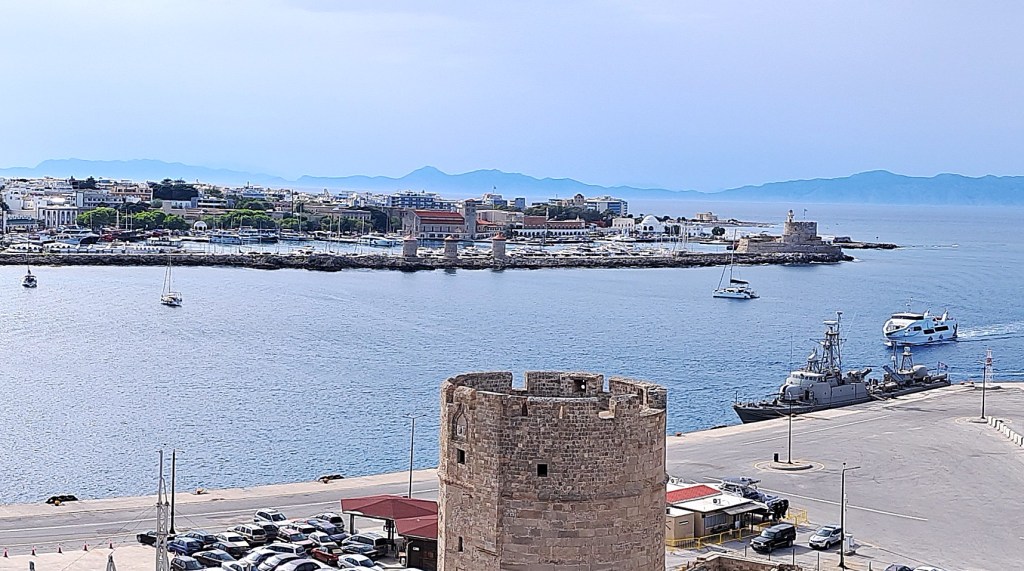
After coffee we continued on our wanderings and found our way on a woody and shaded path leading up to the walls of the Old Town and following around the outside of the walls. From various vantage point we had beautiful views of the fortifications of the Grand Palace and the dry moat protecting the walls from the outside.
We walked around the outside till we came to the St Athanasios Gate, then walked across the bridge and through the archway into the another popular tourist area with several shops and cafes.
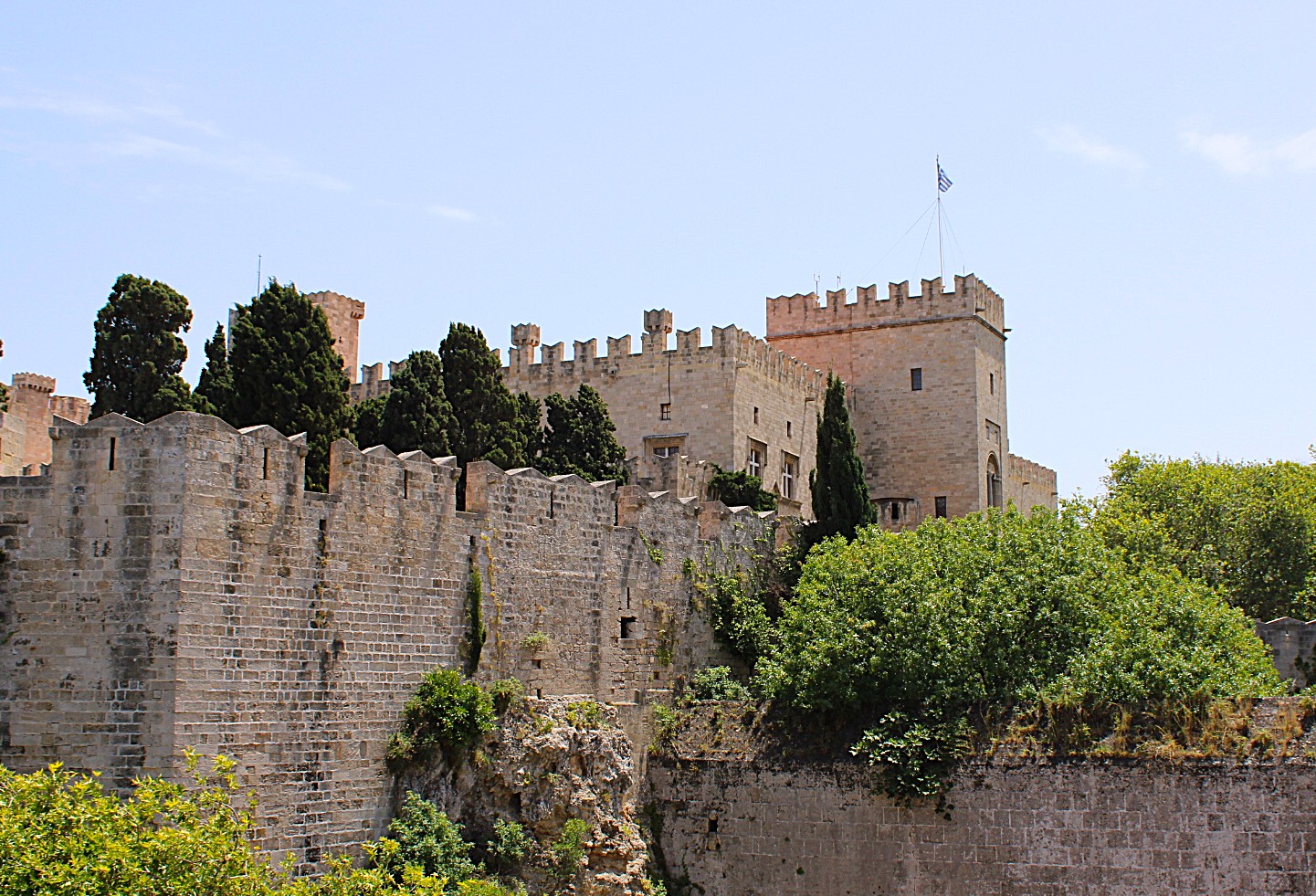
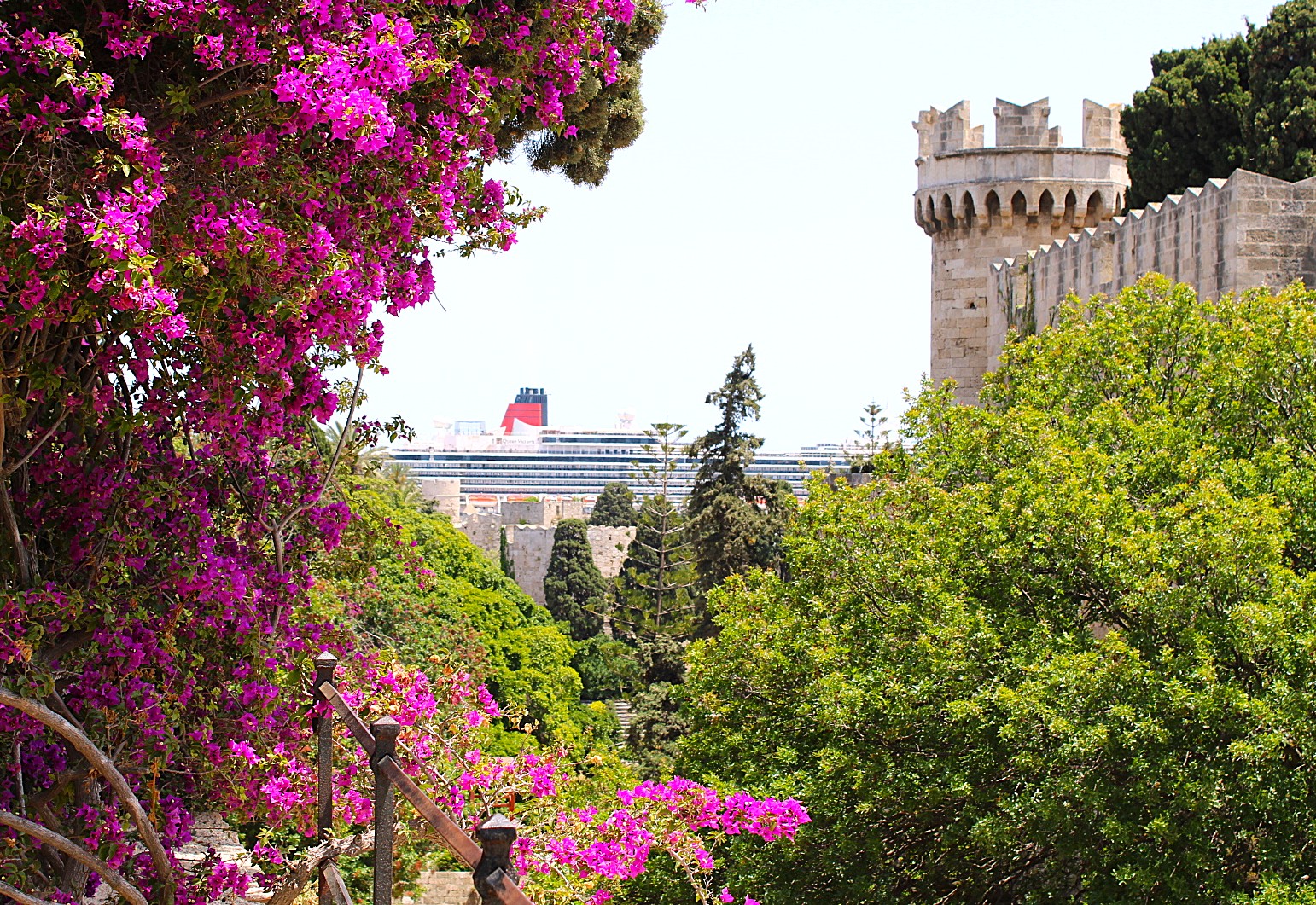
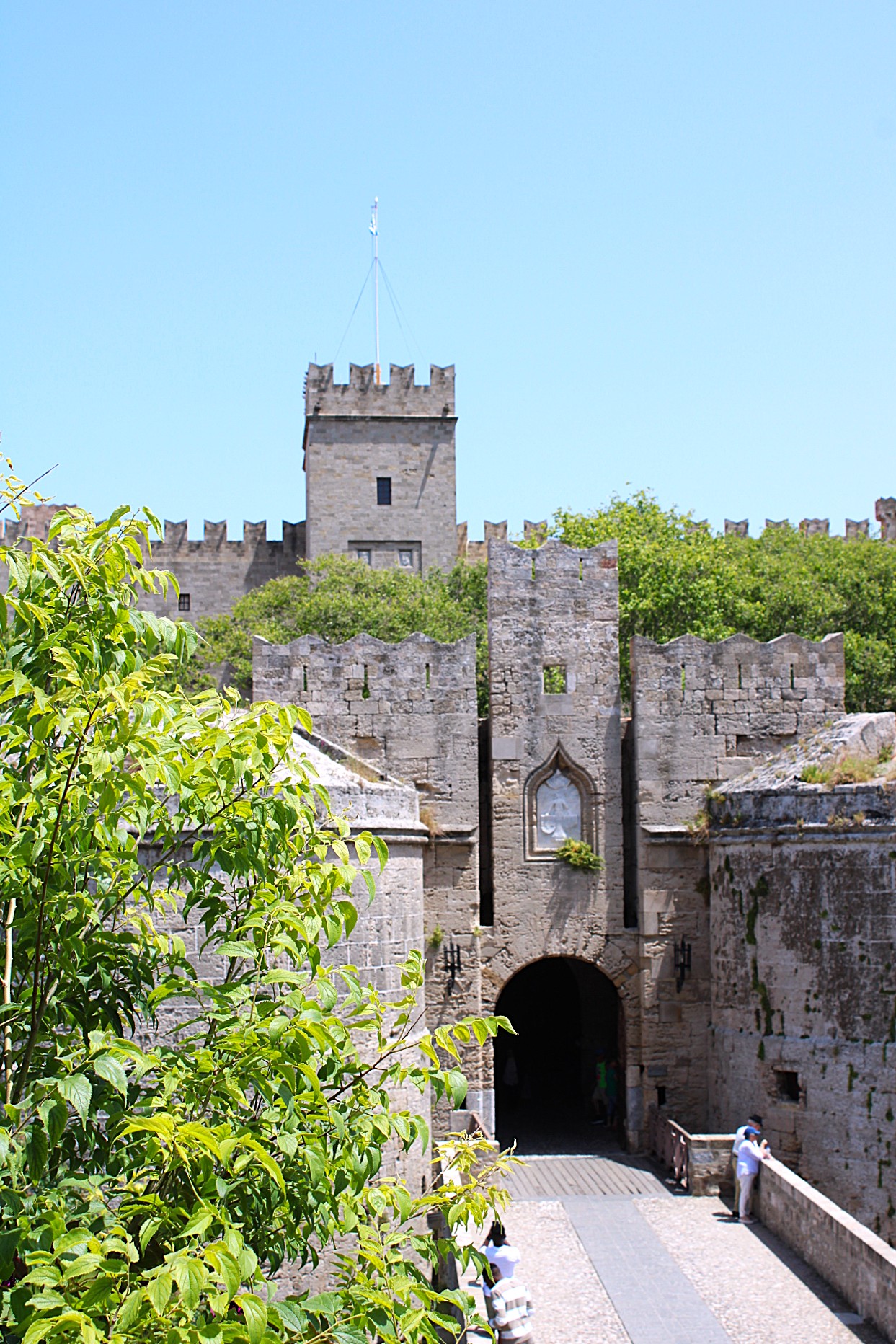
Walls of the Palace of the Grand Master, the Queen Victoria in the harbour beyond the Old Town, the D’Amboise Gate – one of the medieval entrances to the Old Town
We walked around the outside till we came to the St Athanasios Gate, then walked across the bridge and through the archway into the another popular tourist area with several shops and cafes.
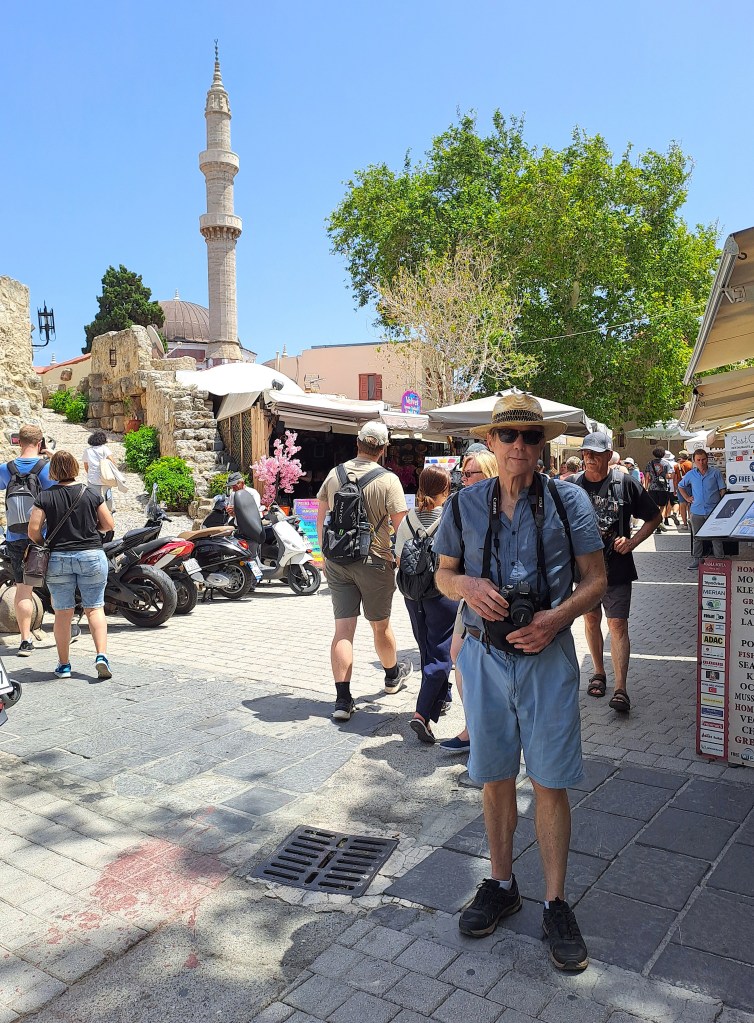
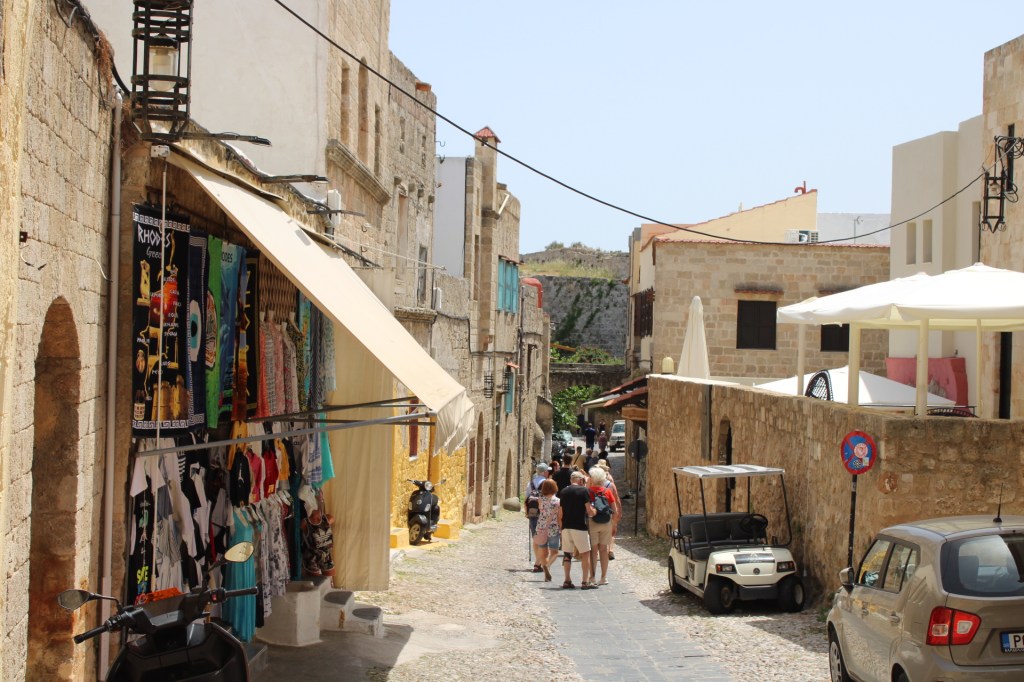
As we were still looking for a quieter place to have a bit of lunch we walked through the busy square and streets into the quieter back streets. Eventually we found ourselves in a spacious plateia shaded by a huge fig tree.
There were a couple of cafes around the square so we were able to find one that served a delicious looking spanakopita for lunch accompanied by ice cold tea.
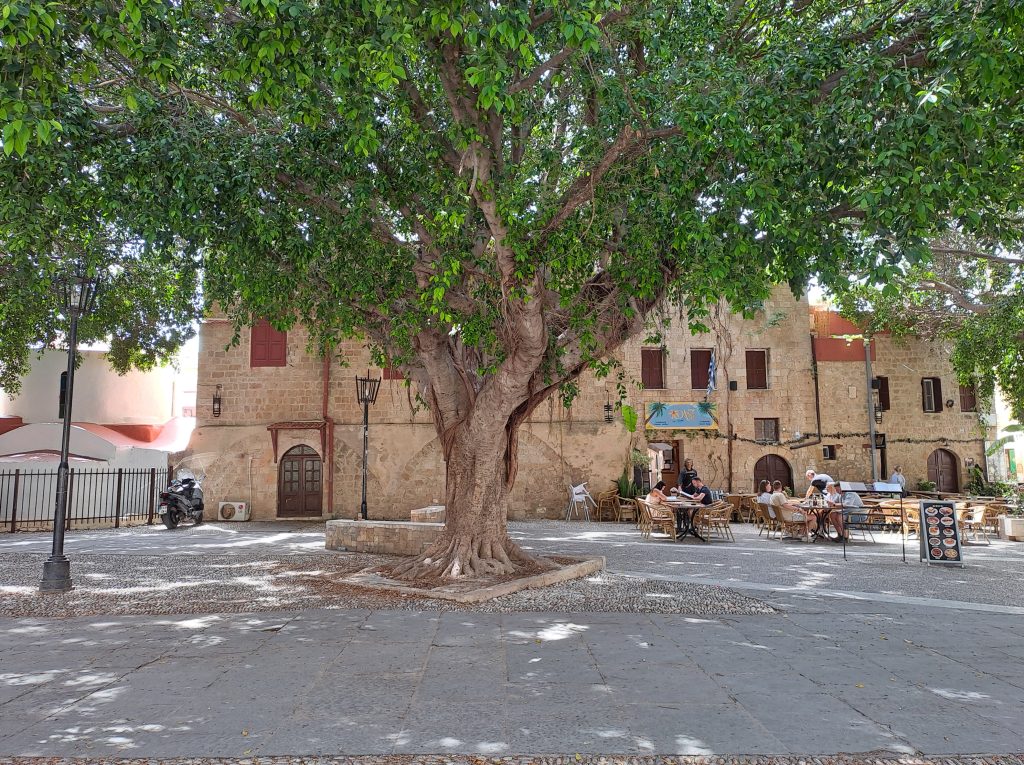
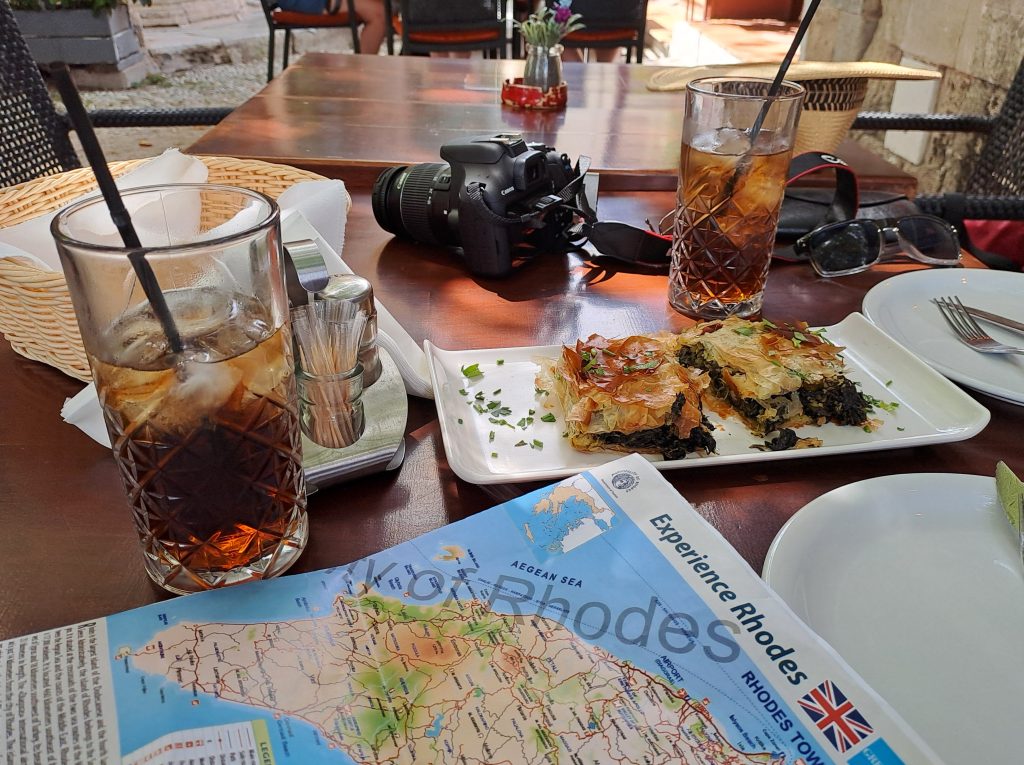
Apart from the huge tree, in the centre of the square there was an odd looking fountain, which we discovered had been the fountain of an old mosque, the remains of which formed one side of the square. It was the Recep Pasha Mosque. It is one of 7 mosques that were built within the walls of the old town following the invasion by the Ottoman Turks in1522.
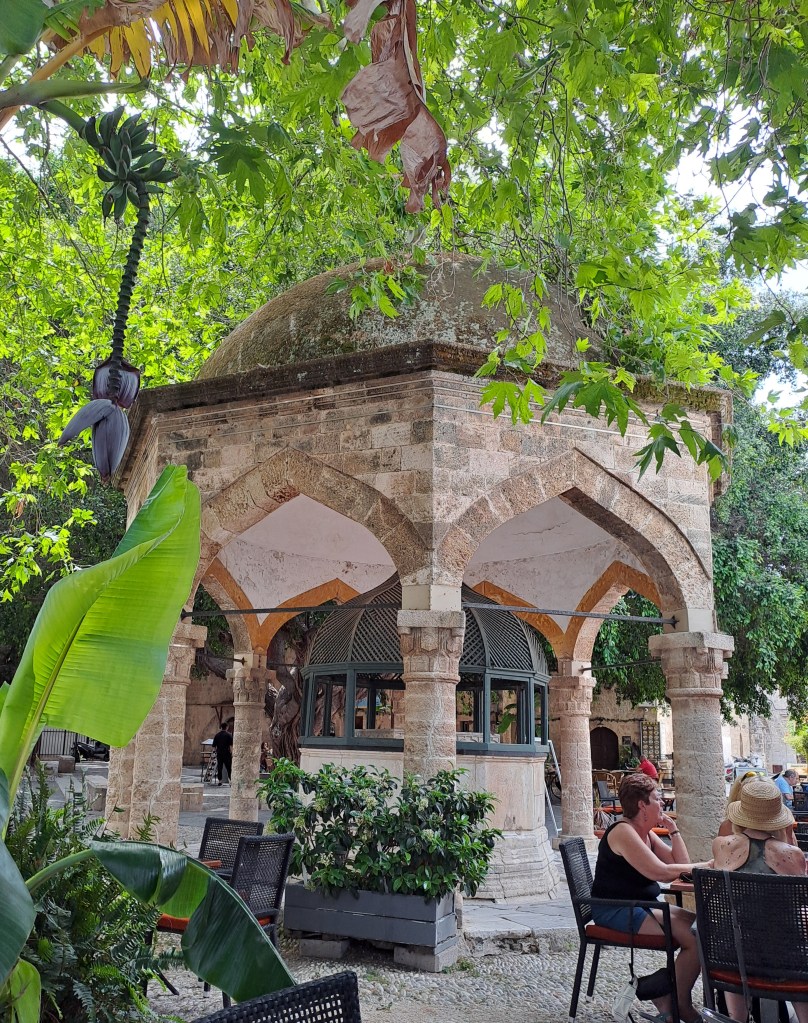
After lunch we wandered back towards the harbour via the back streets of the Old City, getting glimpses of daily life still going on amidst the bustling tourist activity all around.
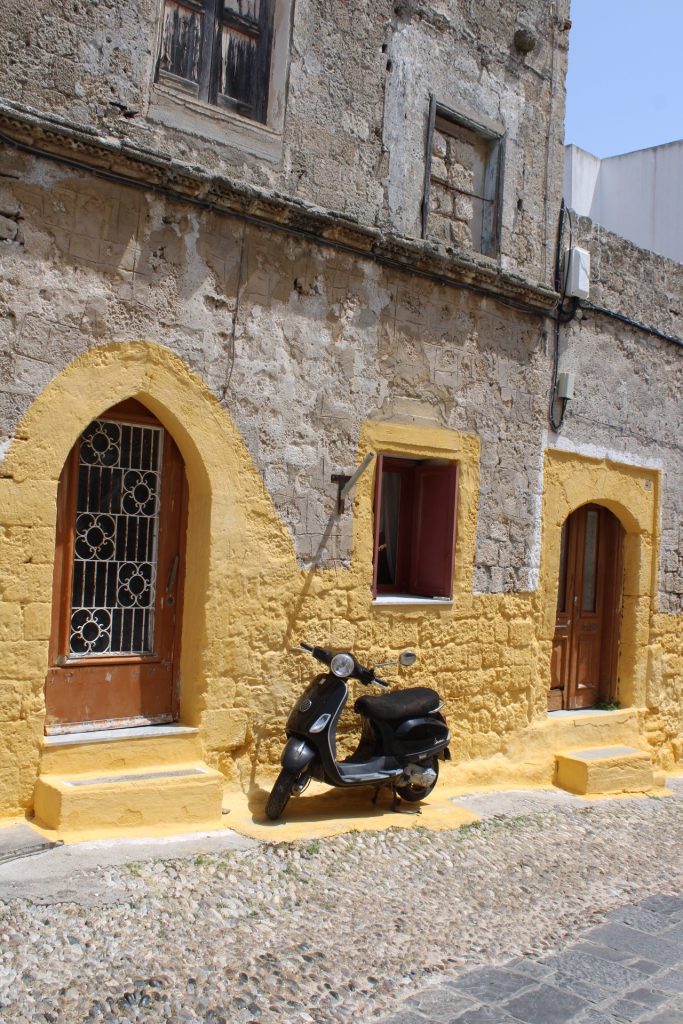
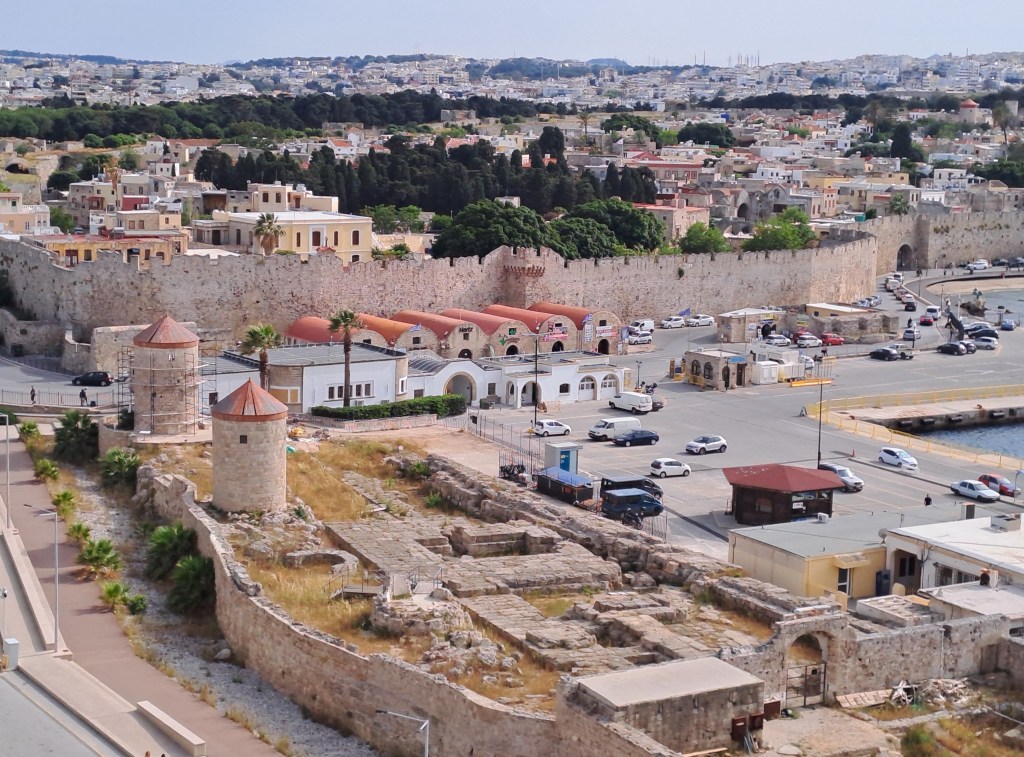
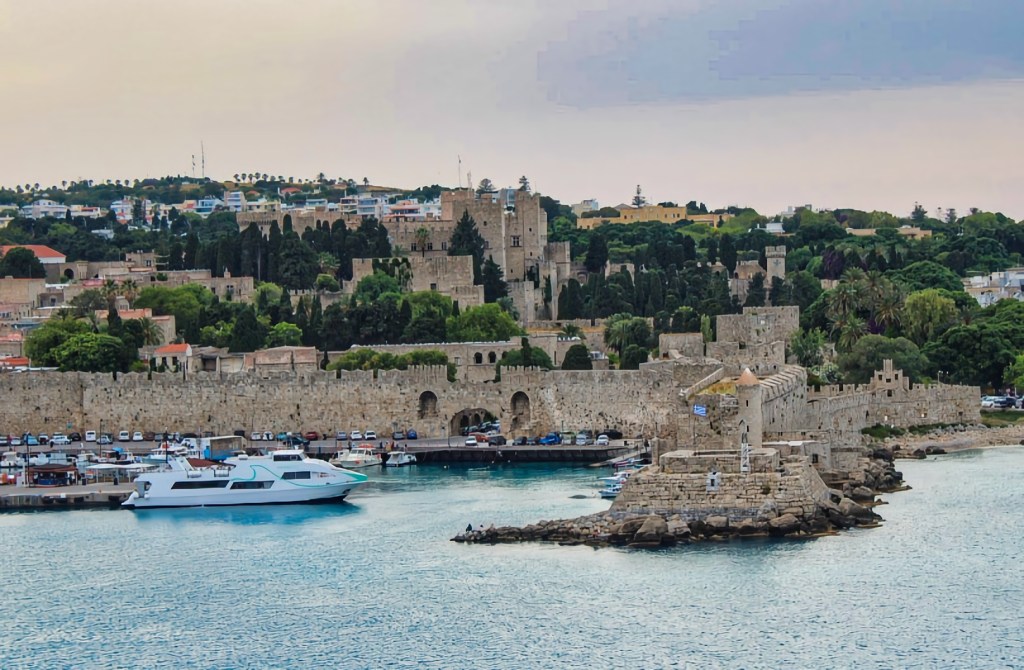
Back onboard, we admired the view of Rhodes from the ship.
After dinner in the Britania restaurant, we went to the theatre to see and hear the MacDonald Brothers , a pop duo singing Scottish folk songs and popular hits. Then to bed anticipating an exciting day to come with a visit to Ephesus in Turkey.

